
The Overwhelm Recovery ProtocolWellness & Routines · ~5 min
About this template · Updated November 2026
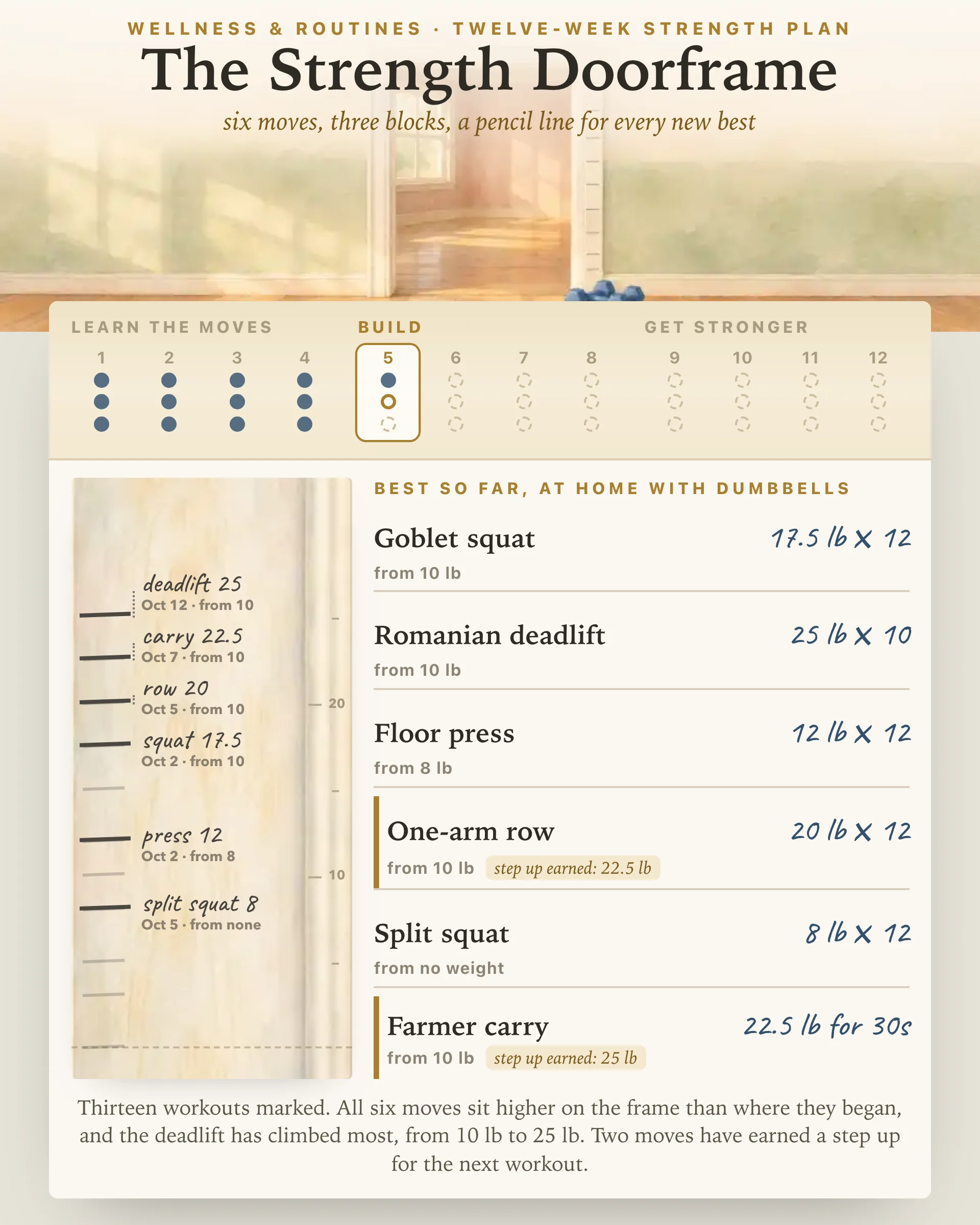
Plenty of homes keep a doorframe covered in pencil lines. A child stands against the wood, someone rests a book on top of their head, and a new line goes up with the date beside it. What sticks is never one line but how far they climbed. This page borrows that habit for a strength training plan women can begin with no lifting experience at all.
The plan runs for twelve weeks, split into three blocks of four, and every workout uses the same six movement patterns: a squat, a hip hinge, a push, a pull, a lunge and a loaded carry. Together they work the whole body, which is why so many beginner programs return to them.
At home, all six moves use dumbbells: the goblet squat, Romanian deadlift, floor press, one-arm row, split squat and farmer carry. At a gym, the press moves to a weight bench and the row becomes a lat pulldown. Train two or three days a week with a rest day between workouts.
Choose where you train and how many days. The beam across the top of the doorway shows all twelve weeks and fills in a dot for every finished workout. Inside the doorway sits today's workout: each move with a weight you can nudge up or down and a circle for each set. Tap a circle once you finish the set and it fills with the top of the rep range. Tap it again for every rep you came up short, add a short line for next time if something stood out, then mark the frame.
Marking the frame is where the doorframe earns its name. The heaviest weight each move has reached is drawn as a pencil line on the painted jamb, dated, with the weight it started from written beside it. Earlier levels stay behind as faint lines lower down, the way old heights stay on a real frame. Each time a move gets heavier, a new line goes up.
The plan uses what coaches call double progression. You stay at a weight until every planned set of a move reaches the top of the rep range, then you use the next weight up at the following workout. The sheet runs that check and puts a gold cue on any move that has earned it. The American College of Sports Medicine's position stand on progression models in resistance training suggests eight to twelve reps for novices, two or three sessions a week, and a load increase of two to ten percent once you can do one or two reps beyond your target.
Dumbbells rarely come in steps that small. Going from twelve pounds to fifteen is a twenty-five percent jump, so expect your reps to dip for a week or two after each step up. That dip is ordinary, and the rule waits for you to climb back before asking for more.
The World Health Organization's 2020 guidelines on physical activity and sedentary behavior advise muscle-strengthening work covering all the major muscle groups on two or more days a week for every adult. A meta-analysis of resistance training in women pooled twenty-four studies and found large gains in upper and lower body strength and a medium gain in muscle size. Its authors also found signs of publication bias, and once they corrected for it the lower body effect shrank to medium, so read the headline figures as optimistic.
A separate review comparing women and men on identical programs found similar relative gains in muscle size and lower body strength, and a larger relative gain in upper body strength for women. Most of the studies behind it were short and enrolled young and middle-aged adults, so they say little about the long run or about later life.
None of this promises a particular shape, a number on the scale or a score on a test. Twelve weeks is long enough to get noticeably stronger at these six moves and to learn them well.
Use this page if you are new to strength work or returning after a long break; regular lifters will outgrow the first block quickly. To arrange your own exercises across the days, a blank weekly planner you fill in by hand suits that better, and the eight-week training board for women over 40 rotates three different workouts if you want more variety. If you are in your sixties, The Strength Trellis is a twelve-week plan done at home with a chair, a band and light dumbbells.
Talk with your doctor or a physical therapist before week one if you are pregnant or recently postpartum, or if you live with joint pain, an old injury, or a heart or blood pressure condition. Stop any move that hurts, keep a counter within reach for the split squat, and set the carry down before your grip gives way.
It covers the main ways your body moves under load: a squat, a hip hinge, a push, a pull, a lunge and a carry, two or three days a week with a rest day between. Weights start light and rise only when your reps show you are ready. This one runs twelve weeks in three blocks of four.
With two sets of ten to twelve reps at weights that feel almost too easy. The first month is for learning each pattern, so the heavier blocks later land on good form. Sore muscles in the first week or two are common and ease as your body gets used to the work.
Heavy enough that the last reps of a set take effort, light enough that you could still do two or three more. For many beginners that lands somewhere around eight to fifteen pounds for presses and rows, and a little more for squats, deadlifts and carries, but your own reps are the judge.
Once every planned set of a move reaches the top of its rep range, use the next weight up at the following workout. Dumbbells jump in big steps, so expect fewer reps for a week or two after each one. Hold your weight whenever form slips or a joint complains.
Unlikely in twelve weeks. Studies of women on programs like this one find strength climbing quickly while muscle size grows slowly and modestly. What most people notice first is that carrying groceries, climbing stairs and getting up off the floor feel easier.
By the team behind Fabulous, the science-based self-care app used by over 30 million people.


