
The Overwhelm Recovery ProtocolWellness & Routines · ~5 min
About this template · Updated November 2026
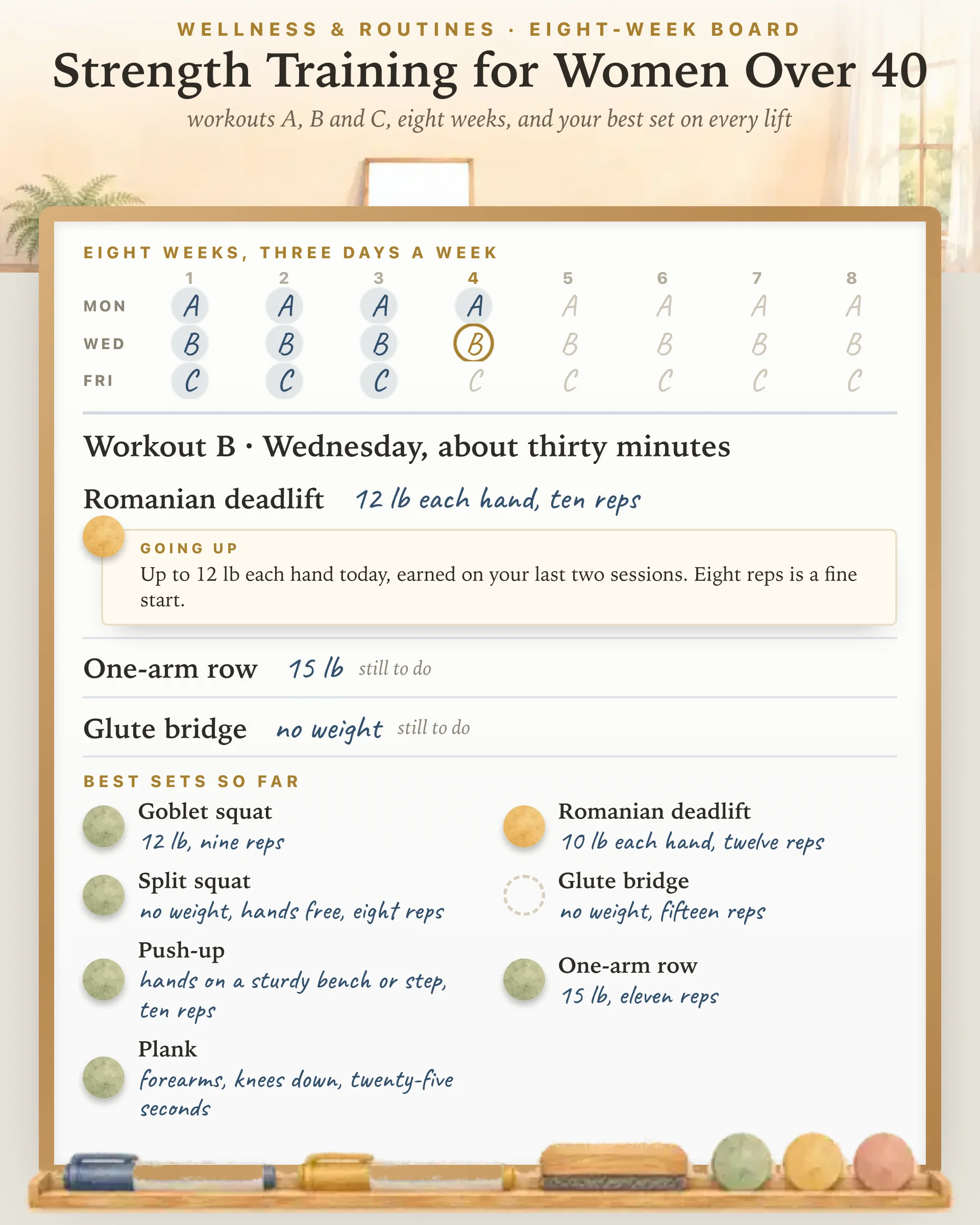
Your forties are a good decade to start lifting, or to come back to it. You know your schedule, your joints and your excuses better than you did at twenty-five, and a plan that respects all three tends to last. This page gives you eight weeks of strength training on a whiteboard: three short workouts that take turns, a log for the weight and reps you lift, and a running record of your best set on every move.
You lift three days a week, with a rest day between sessions where your calendar allows. The sessions rotate through workouts A, B and C, so each one comes around eight times before the block ends.
The first two weeks use two easy sets while you learn the moves and find your starting weights. Weeks three to seven move to three sets, with week five slowing the lowering half of each rep to a count of three. Week eight drops back to two easy sets so you finish fresh and can read the board honestly. Most sessions run twenty-five to thirty-five minutes, warm-up included.
Each move has an easier way in, so you start on a step you can do today.
If you do not own dumbbells yet, The Resistance Band Rack builds similar moves with bands, and The Wall Push-Up Ladder is a gentle way to build toward the floor version of the push.
The board logs the weight or easier version you used and the reps you got on your last set. A move earns its next step when you reach the top of its range on two sessions in a row at the same weight. Then a gold magnet pins a note to that move, naming the next step, and a single tap sets it for today.
That rule follows the American College of Sports Medicine's position stand on progression in resistance training, which suggests eight to twelve reps for newcomers, two or three training days a week, and a small increase in load once you can beat your target by a rep or two. Asking for two sessions in a row is a more patient version of the same idea, so one lucky day never pushes you up too soon.
Underneath, each move shows its best set so far and where it started, and a sage magnet marks every move that has climbed.
The World Health Organization's 2020 physical activity guidelines ask adults to do muscle-strengthening work at moderate or greater intensity, covering all the major muscle groups, on two or more days a week. Three short whole-body sessions clear that bar with room to miss one.
Perimenopause comes up often in talk about lifting, with some reason. A follow-up study of 234 Finnish women tracked from perimenopause into early postmenopause found lean and muscle mass fell across the transition, while women who were more physically active kept more of it. That was an observational study, so it cannot prove that lifting alone holds the change back, and it says nothing about hot flashes, sleep or mood. Treat this plan as a way to build and keep strength, not as a menopause treatment.
If you have had a fall or dizzy spells, live with a heart or blood pressure condition, have a joint replacement, or carry pain that keeps returning, talk with your doctor or a physical therapist before your first session. Leave out any move that hurts rather than pushing through it, and keep a wall or counter within reach for the standing moves.
When the eight weeks are done, start a fresh board: your weights carry over and the rotation begins again at workout A. For a slower, longer block with two workouts instead of three, Strength Training for Women Over 50 runs twelve weeks with dumbbells, bands or a chair.
The best plan is one you will repeat a few times a week that gets slowly heavier. Whole-body sessions built on a squat, a hip hinge, a push, a pull and a core hold reach every major muscle group, which is what the World Health Organization asks of adults on two or more days a week. This board rotates seven such moves across three short workouts.
Goblet squats, Romanian deadlifts, push-ups or a dumbbell press, one-arm rows, split squats, glute bridges and planks. Each has an easier version, such as push-ups with your hands on a kitchen counter or a split squat with one hand on the wall, so you can begin wherever you are today.
Pick a weight that makes the last two or three reps of your final set feel hard while your form still holds. When you reach the top of the rep range on two sessions in a row at that weight, move up one step. The board watches that rule for every move and tells you when the time comes.
It can help you hold on to muscle at a time when many women lose some. A Finnish study that followed women through the menopause transition found lean mass dropped on average, and the more active women kept more of it. Lifting is not a treatment for hot flashes or sleep trouble, so bring those to your doctor.
Either works. At home you need a few pairs of dumbbells, a sturdy chair or bench, and a clear stretch of wall. At a gym the push-up becomes a dumbbell press on a flat bench and the bridge becomes a hip thrust. The board keeps separate best sets for each place, so switching never muddles your numbers.
By the team behind Fabulous, the science-based self-care app used by over 30 million people.


