
The Overwhelm Recovery ProtocolWellness & Routines · ~5 min
About this template · Updated November 2026
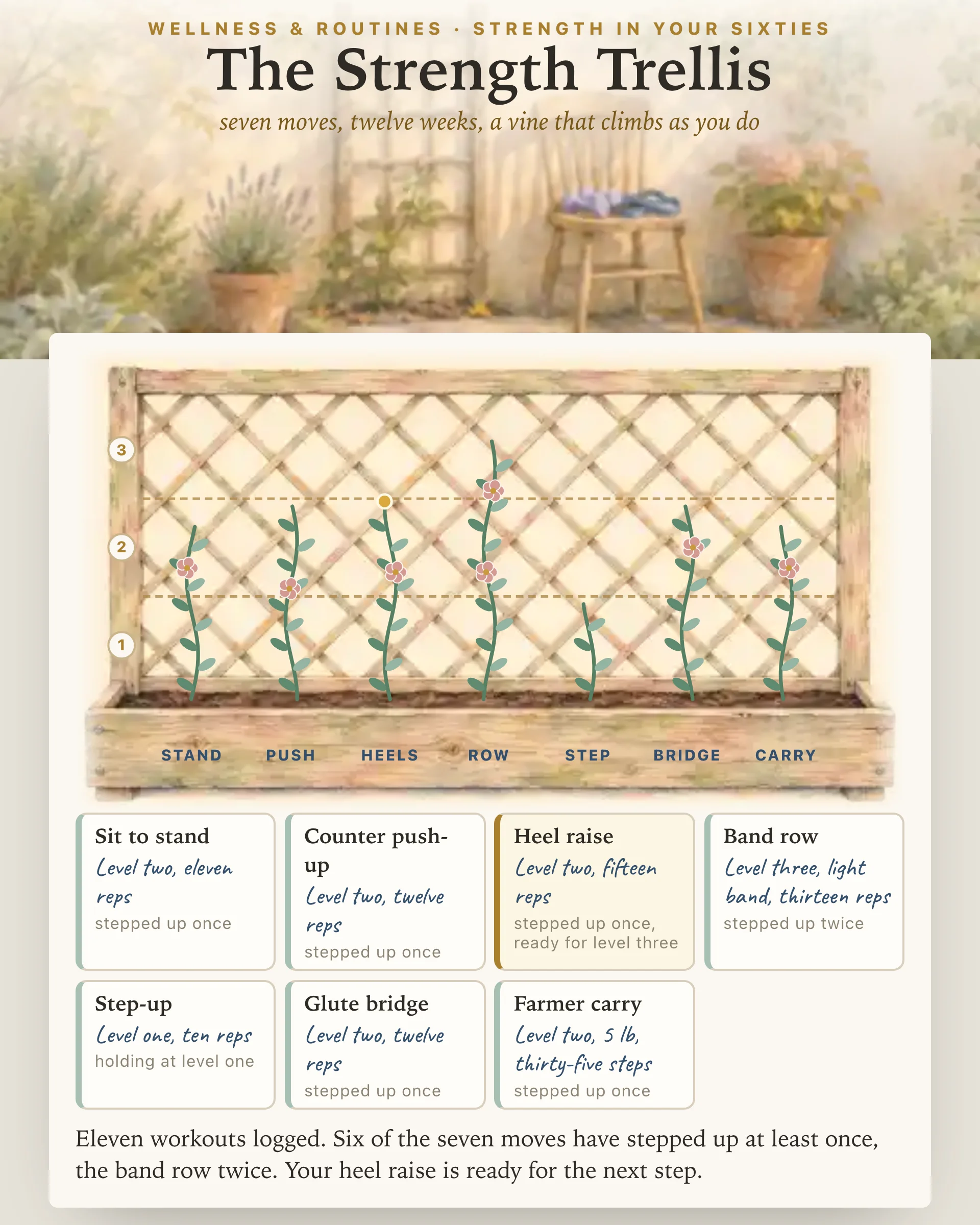
Your sixties are a good decade to get stronger, starting in your own kitchen. This page gives you a twelve-week plan built from seven moves you already half know from ordinary days: standing up from a chair, pressing away from a counter, climbing a stair, carrying the groceries in. Each move has three levels, and the page notices when you have outgrown one.
Before week one, talk with your doctor or a physical therapist if you have had a fall, dizzy spells, a hip or knee replacement, a heart or blood pressure condition, or pain that hangs around. If a move hurts, stop it for the day. Every standing move in the plan keeps one hand on something solid: the counter, the stair rail or a chair pushed against the wall.
Muscle answers training at any age. A Cochrane review of 121 trials with 6,700 older adults found that strength work which grows harder over time, usually two or three sessions a week, had a large effect on strength and a moderate to large one on getting up from a chair, but only a small effect on overall physical ability. Side effects were poorly recorded: sore muscles and achy joints turned up in many of the trials that looked for them, while serious problems were rare.
The World Health Organization's 2020 guidelines ask every adult for muscle strengthening on two or more days a week, and from age 65 they add varied balance and strength work on three days. This plan follows that shape: two days a week to begin, three from week seven.
Bone is a common reason women take up strength work after menopause, and the honest answer is a modest one. A Cochrane review of exercise for bone in postmenopausal women found a small but possibly important effect on bone density, no effect on the number of fractures, and trials that were often poorly reported. Train to get stronger and count any bone benefit as a bonus. If you have osteoporosis, ask your clinician which levels suit you.
Falls are a separate question. In a Cochrane review of exercise and falls in people over 60, programs built on balance and functional practice lowered how often people fell, while the authors were uncertain about programs made mostly of resistance training. This plan is mostly resistance training, so it makes no promise about falls. Give your rest days some balance practice, such as The Balance Ladder.
The plan counts workouts rather than dates, so a missed day simply waits for you.
Workout A holds the sit to stand, the counter push-up, the heel raise and the band row. Workout B holds the step-up on the bottom stair, the band row again, the glute bridge on a firm bed and a slow farmer carry. Rowing shows up in both because ordinary days hand you plenty of pushing and very little pulling.
The sit to stand goes from pushing off the armrests to arms crossed to a weight at your chest. The counter push-up moves from the wall to the counter, then sets your feet farther back. Heel raises go from both hands on the counter to one foot at a time. The row, the step-up, the bridge and the carry add a heavier band or weight once the top level is yours.
Tap the reps from your last set of each move. When a move reaches the top of its range on two workouts running, at the same level and weight, a gold bud appears on its vine and the page names the next step. Take it that day or next time, and expect your reps to dip for a week or two before they climb back. Hard should feel like the final two or three reps need real effort with your form still steady. Pain is a signal to stop, never a target.
Pick workout A or B, set each move's level and weight, tap your reps and log it. Each move has its own vine: it climbs as your best grows, a rose opens wherever the move stepped up, and the tags beneath keep every best in plain words. A skipped move keeps its place, and two taps take back a workout logged by mistake. After twenty-nine workouts the trellis is full, and a fresh one starts at week one with every move at the level it reached.
If you are in your fifties, or want dumbbells from the first week, Strength Training for Women Over 50 runs twelve weeks of two workout cards. Strength Training for Women Over 40 is an eight-week, three-day plan for home or a gym.
For most women in their sixties it is, as long as the load starts light and grows slowly. In trials with older adults, sore muscles and achy joints came up often and serious problems were rare. See your doctor or a physical therapist first if you have fallen, had dizzy spells, had a joint replaced, or live with a heart or blood pressure condition or ongoing pain.
Moves that copy daily life serve you best: rising from a chair, pressing away from a counter, rowing a band toward your ribs, stepping onto a stair, coming up onto your toes, raising your hips from a bed and walking with a weight in each hand. This plan uses those seven, each at three levels, and every standing one keeps a hand on support.
The World Health Organization advises muscle strengthening on two or more days a week for every adult, and from age 65 it adds varied balance and strength work on three days. This workout plan for women over 60 starts with two days for six weeks and moves to three from week seven.
Once you reach the top of a move's range on two workouts in a row with steady form, step up one level or one weight. Your reps will drop for a week or two, which is expected. Stay put whenever a move hurts or your form slips.
A sturdy chair with arms, a kitchen counter, a staircase with a rail, a firm bed, one resistance band and a few light dumbbells. Full water jugs or grocery bags work for the weighted moves, and a full gallon jug weighs about eight pounds.
By the team behind Fabulous, the science-based self-care app used by over 30 million people.


