
The Overwhelm Recovery ProtocolWellness & Routines · ~5 min
About this template · Updated November 2026
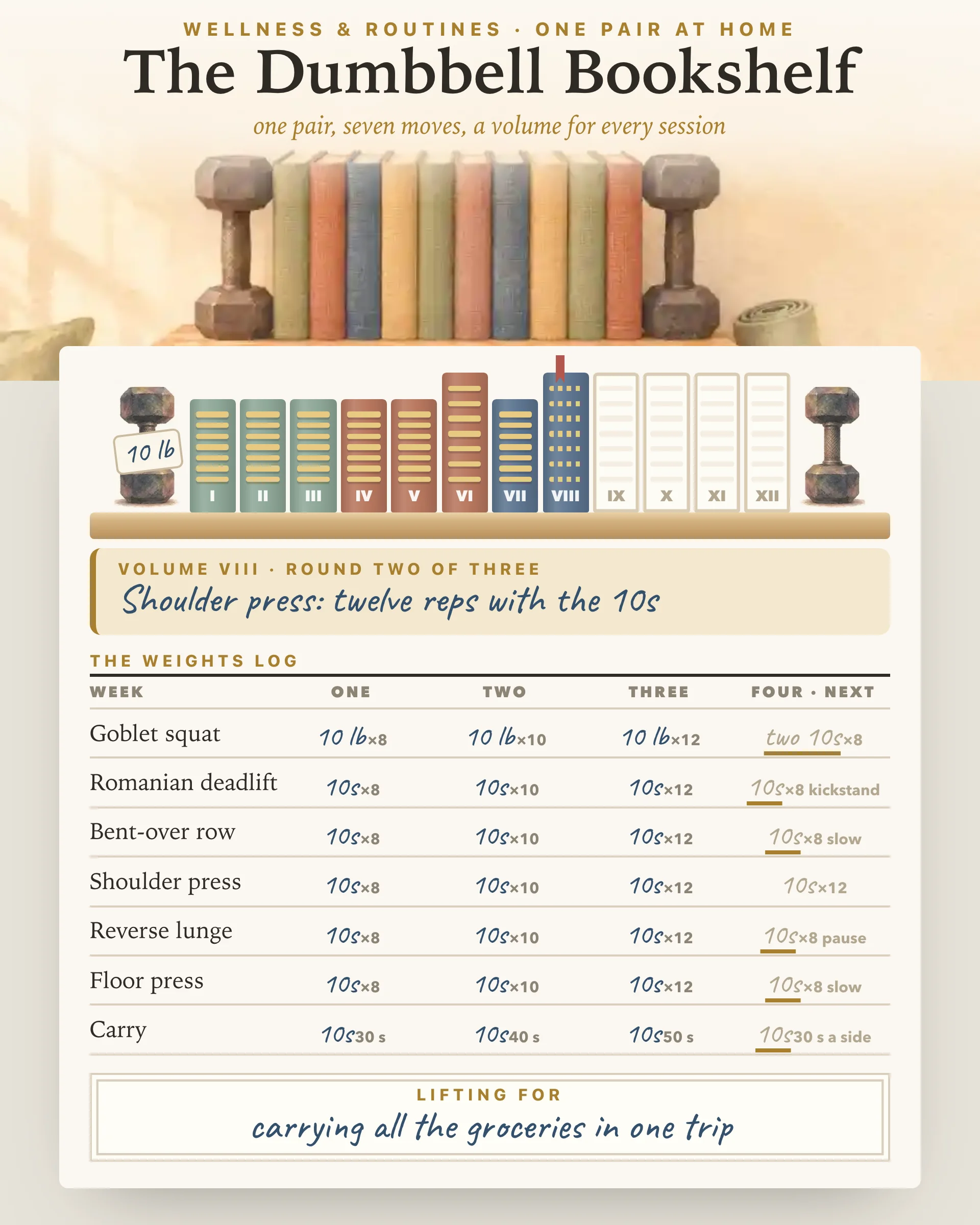
One pair of dumbbells is enough to get properly stronger if the plan knows what to do once the pair feels light. This page is a dumbbell workout for women who train at home: seven moves in a circuit, three sessions a week for four weeks, and a log that decides each move's next step from what you actually lifted. Every session adds a cloth-bound volume to a painted shelf held up by a pair of dumbbells.
The circuit covers the patterns a strong body uses daily, ordered so one part rests while the next works.
Two rounds take about twenty minutes and three about thirty. The plan sets each day's length, and you can switch before the first set.
The plan uses what coaches call double progression. In week one every set is eight reps, so you learn the moves with room to spare. Week two asks for ten and week three for twelve. In week four a move that has done every set at twelve gets heavier: the next pair up if you own one, or, with a single pair, a harder version of the same move. The goblet squat takes both dumbbells at your shoulders, the deadlift moves to a kickstand stance, rows and presses slow to three seconds on the way down, and the carry goes into one hand at a time.
A move climbs only after a whole session with every set at its target, and never more than one step a week. If your press stops at nine reps, it stays at ten while the squat moves on. Holding a step is the plan doing its job.
Tap the weight of your pair, say where you are starting, and volume one is ready. Each move comes with its load, three cues, an easier version and the reason for today's target, such as "Last time: ten, ten. Every set got there, so twelve today." Tap a set done when you finish it, lowering the rep count first if you fell short.
A rest timer starts after every set and reads the clock itself, so a phone that locks between sets still rests the right amount. Cutting a rest short records nothing, and neither does a carry you stop early: the carry counts only when its full time has been walked. If you stop a session partway, end it and the volume goes on the shelf with only the sets you did, its gilt bands showing which moves were finished.
The weights log shows each move by week, so the climb from eight to twelve reads across one line. A bookplate holds what you are lifting for, and the page names the move closest to it and how far that move has come.
Women respond to strength training at least as well as men do. A meta-analysis by Roberts, Nuckols and Krieger found similar gains in muscle size and lower-body strength, and larger relative gains in upper-body strength for women, mostly in short studies of untrained people.
Light weights are not wasted either. A review by Schoenfeld and colleagues found lighter and heavier loads built muscle about equally when sets were taken to failure, while heavier loads gave bigger gains in maximal strength. That is the case for the plan's order: more reps while the pair is enough, then a heavier or harder version once twelve comes easily.
You may have read that lifting protects bone. The LIFTMOR trial found that heavy, closely supervised barbell training twice a week improved spine and hip bone density in postmenopausal women with low bone mass. Its loads were far heavier than a home pair, with a coach at every session, so it does not show that this plan will change your bone density.
The Physical Activity Guidelines for Americans ask adults for muscle-strengthening work on two or more days a week. Three short sessions with a rest day between meets that comfortably.
Use this page if you own one or two pairs of dumbbells and want a plan that moves you up without guessing. If you want arms only, a six-move arm routine works with the same pair. For a longer program with a gym option, see the eight-week whiteboard plan, and in your sixties, The Strength Trellis adds a chair and a band.
Check with a doctor or physical therapist first if you are pregnant or recently gave birth, or live with a heart or blood pressure condition, osteoporosis, a joint replacement or lingering pain, and stop any move that hurts.
The same patterns any strong body uses: a squat, a hip hinge, a pull, an overhead press, a single-leg move, a push from the floor and a loaded walk. Seven moves cover them, and two or three rounds take about twenty to thirty minutes.
Use the shoulder press as the test, because it is usually the hardest of the seven. If you can press the pair overhead eight times with your ribs down and the eighth rep is hard but clean, that pair will work for every move here.
Yes, for a good while. Reps climb first, from eight to twelve. After that the same pair gets harder versions: both dumbbells in the goblet squat, a kickstand stance for the deadlift, slower lowering for rows and presses, and a one-hand carry.
US guidelines ask adults for muscle-strengthening work on two or more days a week. This plan uses three, with a rest day between sessions, so each move gets three chances a week to earn its next step.
It was written for one. Week one is eight reps a set to learn each move, a supported version is shown for anyone new to weights, and nothing moves up until a whole session has gone well.
By the team behind Fabulous, the science-based self-care app used by over 30 million people.


