
The Overwhelm Recovery ProtocolWellness & Routines · ~5 min
About this template · Updated November 2026
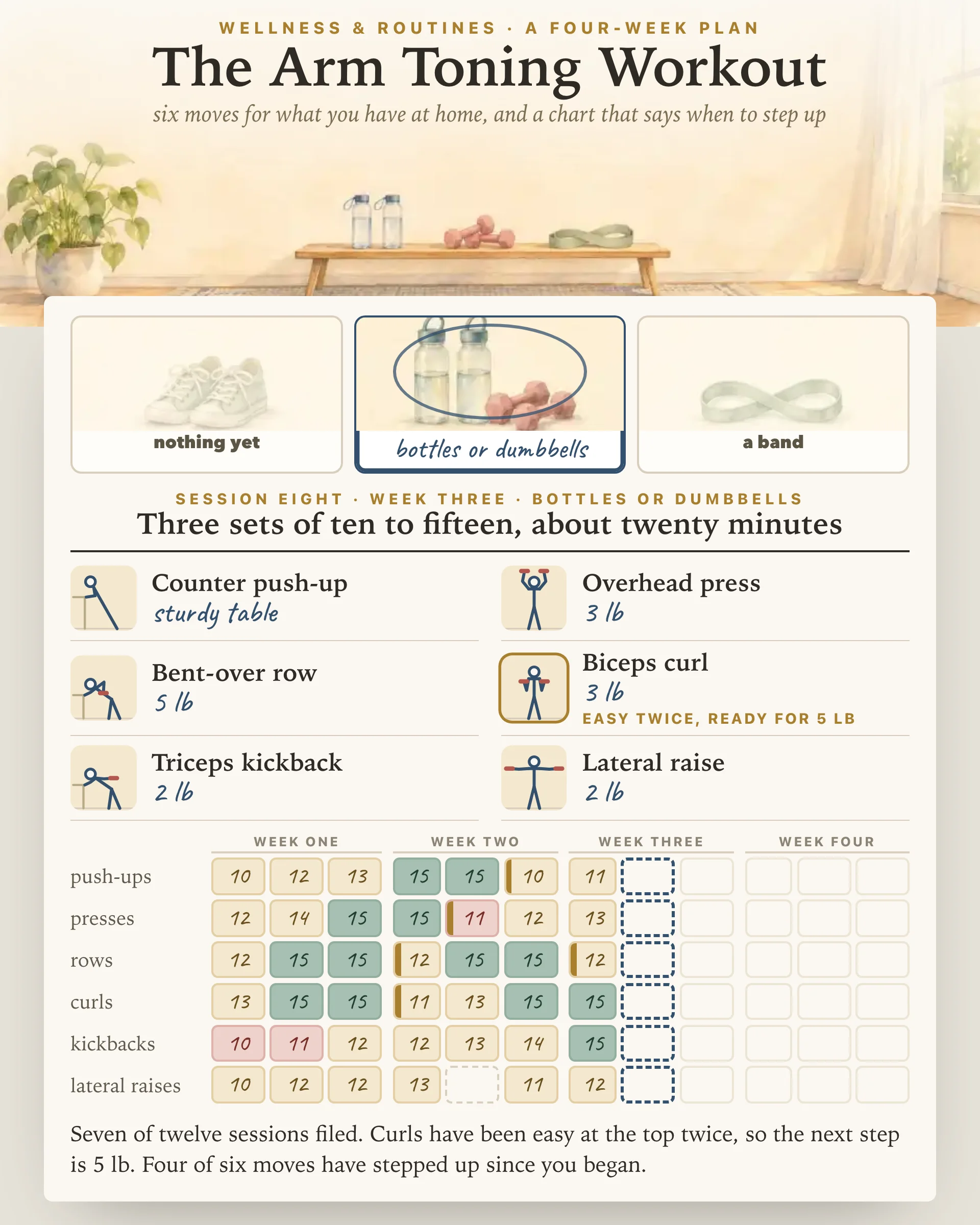
Most arm workouts for women hand you a list of moves and leave the rest to you. What changes your arms is the part they skip: repeating the moves a few times a week for a month, and knowing when to make them harder. Tell this page what you have at home and where you are starting, and it gives you six moves with sets and reps, a four-week plan of three short sessions a week, and a chart that notices when a move has become easy.
Your upper arm has muscle on the front (biceps), the back (triceps) and the cap of the shoulder, working with your chest and upper back. Six moves cover all of it:
Every standing move keeps a counter within reach, and the row and kickback lean on it, so your back stays easy while your arms work.
Start by tapping what you have: nothing yet, two water bottles or a light pair of dumbbells, or a looped band. Then pick where you are starting. Brand new works in sets of eight to twelve reps; the other levels use ten to fifteen and begin a step or two further along.
Each move then shows its sets, reps and step, such as "water bottles", "3 lb" or "medium band", which you can nudge easier or harder. After your last set of a move, tap the reps you reached and whether it felt easy, about right or hard, and leave blank any move you skipped. Add a short note for next time if something stood out, and file the session.
Each filed session paints a column on the four-week chart, one square per move, colored by how it felt. Two easy sessions in a row at the top of the range bring a cue naming the next step, and two hard ones bring a reminder that staying put is fine. Twelve sessions fill the chart, and a fresh four weeks keeps the steps you earned.
Strength training works for older bodies. A Cochrane review of 121 trials in older adults found that progressive resistance training, mostly done two or three times a week, had a large effect on muscle strength and smaller gains in everyday tasks such as getting up from a chair. Side effects were poorly recorded, and sore joints and muscles came up in many trials, which is why the page starts light.
Moving up here follows ordinary strength coaching. The American College of Sports Medicine's position stand on progression suggests eight to twelve reps for newcomers, two or three training days a week, and a small increase in load once you can manage one or two reps beyond your target. Waiting for two easy sessions at the top of the range keeps one good day from pushing you up too soon.
Training makes the muscle under the skin stronger and a little larger, so arms often feel firmer and carry bags with less effort. It does not burn fat from the spot you train. When 104 adults trained only one arm for twelve weeks, MRI scans found fat changes in the trained arm no different from the untrained arm, though caliper readings in the men disagreed. So for flabby arms or bingo wings, these moves build the muscle, and fat changes with your whole routine of eating, sleep, movement and time.
If you have had a fall, dizziness, a joint replacement, a heart or blood pressure condition, or pain in a shoulder, elbow or wrist, talk to your doctor or a physical therapist before you begin. Stop any move that causes pain, which is different from the effort of a hard last rep. Keep a sturdy counter or chair close for every standing move, and breathe out as you push or pull.
Open the page on your three training days, with a rest day between them, and give it fifteen to twenty minutes. If you want a month of bodyweight arm sessions that build from your own day-one test, The 30-Day Arm Challenge works that way. To train your whole body after 50, Strength Training for Women Over 50 adds legs and hips, and if the counter push-up still feels like a lot, The Wall Push-Up Ladder builds up to it one slow rep at a time.
One that reaches the front, back and top of the upper arm plus the upper back, and slowly asks a little more. This page uses six moves, a counter push-up, overhead press, bent-over row, biceps curl, triceps kickback and lateral raise, for two or three sets, three days a week.
Training makes the muscles under the skin stronger and firmer, which changes how your arms feel and work. It cannot pick where fat comes off. When volunteers trained only one arm for twelve weeks, MRI scans found no difference in fat change between the trained arm and the resting one. Body fat shifts with eating, sleep, daily movement and time.
Moves done with a hand on a counter or from a sturdy armchair: counter push-ups, supported rows and kickbacks, chair push-ups and wall slides. Begin with nothing in your hands or two water bottles. If you have had a fall, a joint replacement, a heart or blood pressure condition, or shoulder pain, ask your doctor or a physical therapist first.
Two or three days a week with a rest day between sessions is a sound start, which is what the four-week plan follows. Move up a step once the top of your rep range has felt easy on two sessions in a row. The chart watches for that and names the step.
No. Choose nothing yet and the moves switch to versions that use a wall, a counter and a sturdy armchair. Two full water bottles make a fine first weight, a light pair of dumbbells or a looped band take you further, and the page counts steps for each.
By the team behind Fabulous, the science-based self-care app used by over 30 million people.


