
The Overwhelm Recovery ProtocolWellness & Routines · ~5 min
About this template · Updated September 2026
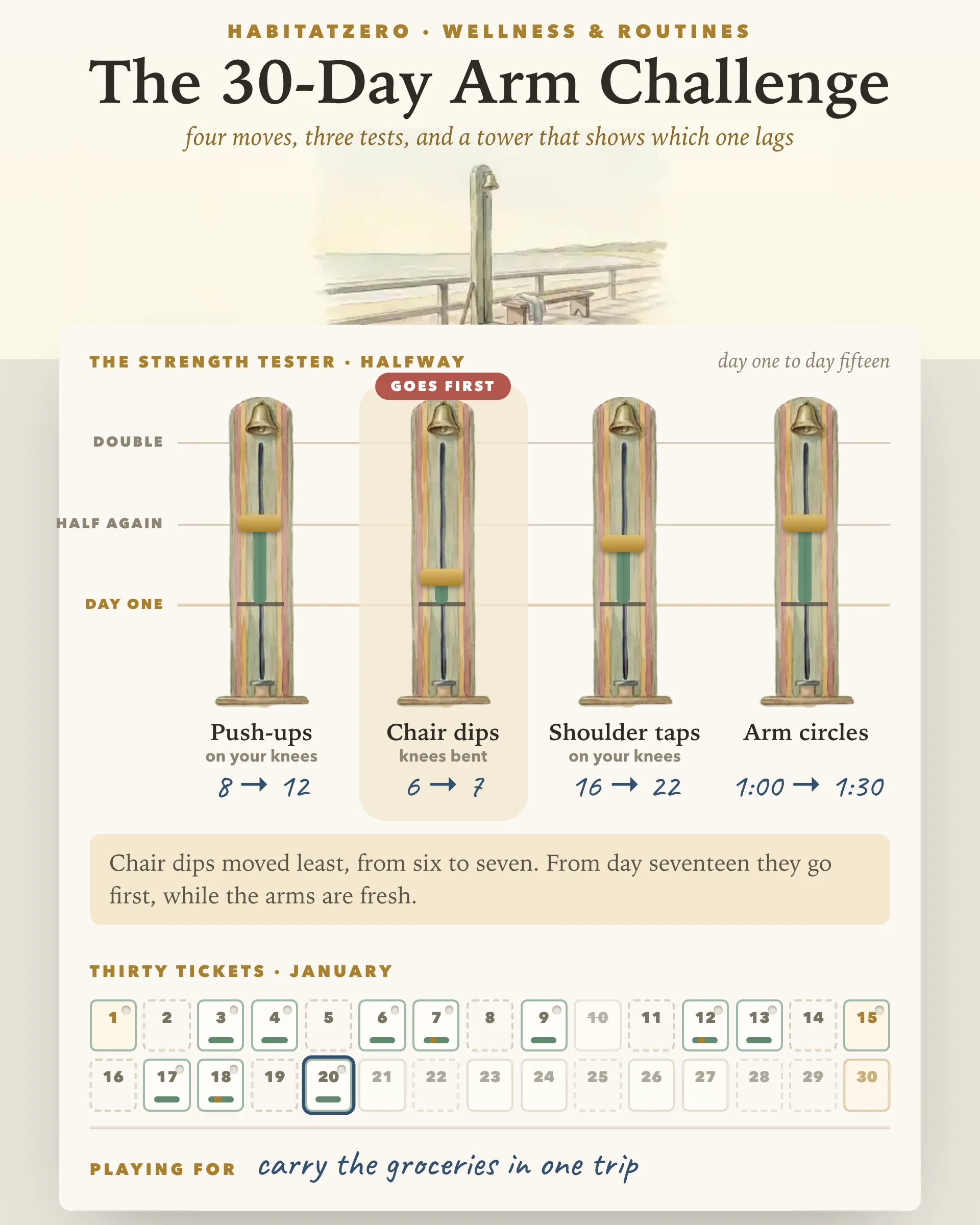
Most arm challenge charts hand everyone the same numbers, add a few reps every morning and never check whether anything changed. This one starts from a test of your own arms, climbs only as far as that test allows, and tests again on day fifteen and day thirty so you can see which move is keeping up and which one lags.
You need a sturdy chair, a clear patch of floor and a clock.
Day one is the test: one set of each move, stopped the moment your form slips. A move you cannot do comfortably can sit the month out. When all four are in, day one takes that date, and every later day belongs to its own date on the calendar.
After that come two sessions, then a rest day, with a rest after each test and before each retest. A session is two sets of every move, a minute apart. Each set starts near half of your test count and gains one rep, two taps or five seconds after a clean session, stopping at about three quarters of your latest test. A session that came up short holds the numbers. A move that hurts two sessions in a row rests until the next test.
Those numbers are a rule of thumb that follows the shape of the evidence. The American College of Sports Medicine's 2026 position stand pooled 137 systematic reviews and found that resistance training built strength, size and endurance compared with doing nothing, with strength favoring two or three sets, a full range of motion and at least two sessions a week. Training all the way to failure made no consistent difference, which is why every set here ends with a rep or two left. The federal guidelines set a similar floor for adults: muscle-strengthening work such as push-ups on at least two days each week.
The page draws your test as four fairground towers. A line marks each move's day-one count, and at each retest a brass puck climbs by how far that move grew against its own start, so twelve push-ups after eight sit level with ninety seconds of circles after sixty. The bell at the top rings only if a move doubles.
The halfway retest does more than draw. Each move's ceiling resets to about three quarters of its new count, and the move that grew least goes first in every session from day seventeen. The same position stand found larger strength gains in exercises done at the start of a session, while you are fresh, so the laggard gets the best of your effort. On day thirty the reading names the move that grew most and the one that lags, and the ticket dots show whether the laggard also kept coming up short.
In thirty days, expect more clean reps and steadier form. Visible change in arm size usually takes longer, and no arm routine melts fat from the arm itself. When 104 adults trained only their nondominant arm for twelve weeks, MRI scans found that fat changed about equally in the trained and untrained arms. Fat comes off the whole body, through food, sleep and daily movement; the challenge works the muscle underneath.
Dips off a chair reach your arms behind your body. A motion-capture study of three dip styles in thirteen experienced men found that the bench version mainly worked the triceps but pulled the shoulder further back than bar or ring dips, and its authors flagged that for anyone with a history of shoulder pain. So back the chair against a wall, stop at a right angle, and sit dips out if the front of a shoulder aches or you have had a dislocation or rotator cuff trouble. Push-ups still train the backs of your arms.
A burn in the working muscle is expected; a sharp or pinching pain in a wrist, elbow or shoulder means stop the set. If the same spot hurts again next session, have it checked. With a joint injury, a heart condition, high blood pressure or a pregnancy, talk with your clinician before day one. Chest pain, dizziness or unusual breathlessness mean stopping at once and getting medical help.
It suits the last week of December, but any rested day works as day one. If push-ups are the only move you care about, The 30-Day Push-Up Challenge goes deeper on that single move. On rest days, The Daily Stretch Mat gives tight shoulders and wrists some gentle attention, and The 30-Day Squat Challenge lets your legs work while your arms recover.
It works for what a month can do: more clean reps, steadier shoulders and a habit of training twice or more a week. Visible change in arm size usually takes longer, which is why this plan keeps retesting instead of promising a new look by day thirty.
Not on its own. When adults trained only one arm for twelve weeks, MRI scans showed fat changing about the same in both arms, so fat comes off the whole body rather than the muscle you work. The challenge works the muscle underneath; overall fat loss follows your food, sleep and daily activity.
They suit many people, but of these four moves they take the shoulder furthest back, with the arms reaching behind the body. Keep the chair against a wall, bend the elbows to a right angle and no deeper, and sit dips out if you have shoulder pain or an old shoulder injury.
US guidelines ask adults for muscle-strengthening work on at least two days a week, and strength research favors two or more sessions. This month runs two sessions and then a rest day, so each arm move gets about four days of work a week with room to recover.
The sample on this page is a month twenty days in. Personalizing it in HabitatZero costs nothing and lets you log your own day-one test, punch each session and read your towers on day thirty.
By the team behind Fabulous, the science-based self-care app used by over 30 million people.


