
The Overwhelm Recovery ProtocolWellness & Routines · ~5 min
About this template · Updated November 2026
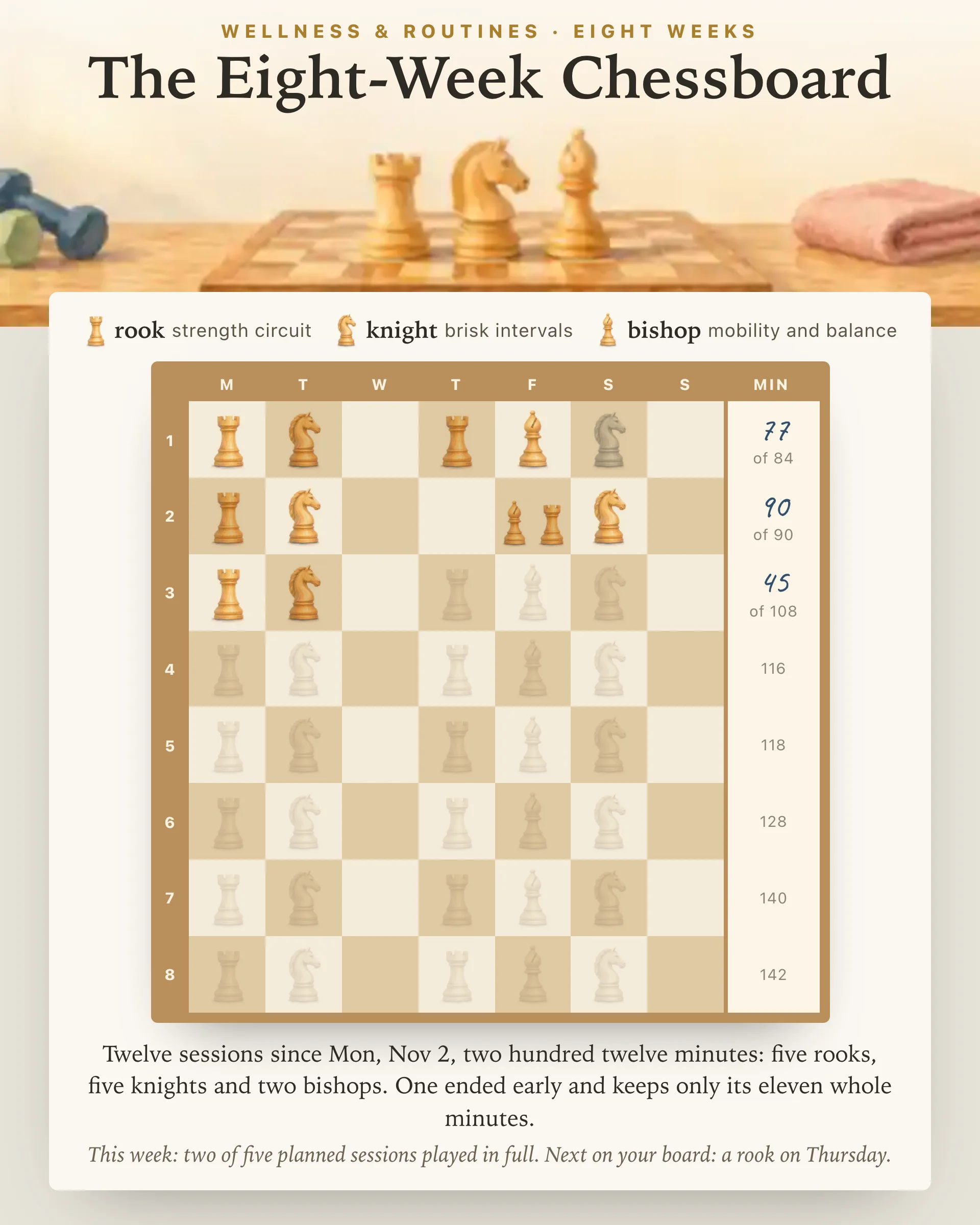
This page turns a week of exercise into a chessboard. A rook stands for a strength circuit, a knight for brisk intervals, and a bishop for mobility and balance. You place them on the days that suit you, press start when it is time to move, and a real-time clock calls each part. Every move has a joint-friendly swap, and eight weeks of sessions fill a board you can read at a glance.
If you want dumbbells and nothing else, The Twelve-Week Honeycomb is the strength-only plan, three days a week with a rule for adding weight. This one is broader and lighter: two short strength days, two that raise your breathing, and one for moving freely and standing steady.
Talk to your doctor before the first session if you have a heart condition or high blood pressure, a joint replacement, dizzy spells or a fall behind you, or any new chest pain. Stop any move that hurts. Keep the kitchen counter or a sturdy chair within reach for every balance move. If chest pain or pressure comes on while you exercise and does not ease with rest, call 911.
The CDC's guidance for adults asks for at least 150 minutes of moderate activity a week and muscle-strengthening work on two or more days that reaches the legs, hips, back, abdomen, chest, shoulders and arms. For people 65 and older, the CDC's page on older adults keeps both and adds activities that improve balance, naming heel-to-toe walking as one. A man of 55 is not there yet; the bishop day simply starts the habit early.
The plan begins well below 150 minutes on purpose. Week one comes to about 84 minutes across five days, and week eight to about 142. Walks on your rest days add to the total.
A trial of 160 adults aged 65 and older, all with obesity and all sedentary at the start, compared aerobic training, resistance training and both combined, each alongside a weight-loss program, for six months. The combined group improved most on a test of everyday physical tasks, about 21 percent against 14 percent for either kind alone. Most of the volunteers were women, the authors say the sample was too small to compare men and women, and everyone was dieting under supervision. So it supports mixing kinds of training in later life; it does not show what this exact week will do for you.
A Cochrane review of 108 trials with 23,407 people found that balance and functional exercise reduced the rate of falls in older people living at home by about a quarter, with high certainty. Those volunteers averaged 76 years old and three in four were women. This page makes no promise about falls; it simply gives balance a regular day.
Brisk intervals have their own limits. In the Generation 100 trial, 1,567 Norwegians aged 70 to 77 spent five years doing high-intensity intervals twice a week, steady moderate training twice a week, or simply following national activity advice. Deaths did not differ between the training groups and the advice group. The interval group's lower trend could have been chance, and most volunteers were healthy and active to begin with. The knight days here are brisk, not all-out: fast enough that you can talk but not sing.
Tap any of the seven squares to cycle it through rook, knight, bishop and rest. The note under the row adds up the week and flags two rook days side by side or a missing kind of day. The planner takes six training days at most, so one day always stays free.
Today's square sets the piece, and you can pick another. The rook day runs six moves, from a squat to a chair to a suitcase carry, at forty seconds each with twenty to rest. The knight day trades brisk and easy stretches indoors or on a walk outside. The bishop day runs eight moves, from shoulder rolls to a one-foot stand at the counter.
Each move names the joint its swap spares: a push-up against the wall for wrists and shoulders, a bridge on the bed for the low back, a split stance hold when standing on one foot feels unsteady. Turn a swap on before you start; a session keeps the versions it began with.
The clock reads real time, so a locked phone does not slow it, and a pause never counts. A session ended early with two taps keeps only its whole minutes and the rounds, intervals or moves that ran to the end, and shows as a gray piece; a full one sets a solid piece. Each week's last square adds up its minutes against the plan.
Strength days grow from two rounds to four, brisk stretches from one minute to four with shorter easy gaps, and mobility holds from ninety seconds to two and a half minutes. Week one is the Monday-to-Sunday week of your first session.
If standing for twenty minutes is too much for now, The Seven-Gear Seated Workout keeps the same idea in a chair. For the rest days, a paced walk set to a metronome adds minutes toward the 150 without asking anything new of your joints. If you have a pair of dumbbells and want more arm work, The Eight-Arm Dumbbell Workout has eight arm moves with a plain rule for going heavier.
One that mixes three things across the week: muscle work on at least two days, some brisk activity that raises your breathing, and practice at balance and moving freely. The CDC asks adults for 150 minutes of moderate activity a week plus strength work on two or more days, and this plan starts well below that on purpose and grows for eight weeks.
Moves you can scale without changing the pattern: a squat to a chair, a counter push-up, a row with one hand braced, a step-up holding the rail. Every move here has a named swap for the joint most likely to object, so a sore knee changes the version, not the whole plan.
Four or five days suits most men starting out, with rest days between the hardest sessions. This plan begins with two strength days, two interval days and one mobility day, about 84 minutes in week one, and allows six training days at most so one day always stays free.
Anyone with a heart condition or high blood pressure, a joint replacement, dizzy spells or past falls, or any new chest pain should talk to a doctor first, as should anyone who has been told to limit exertion. During a session, stop at once and call 911 if chest pain or pressure starts and does not ease with rest.
Yes. It asks for a sturdy chair, a kitchen counter, a wall, the bottom stair or a low step, and one dumbbell or a full grocery bag, with a resistance band for one swap. The brisk intervals work just as well as a walk outside, with the timer telling you when to speed up and ease off.
By the team behind Fabulous, the science-based self-care app used by over 30 million people.


