
The Overwhelm Recovery ProtocolWellness & Routines · ~5 min
About this template · Updated November 2026
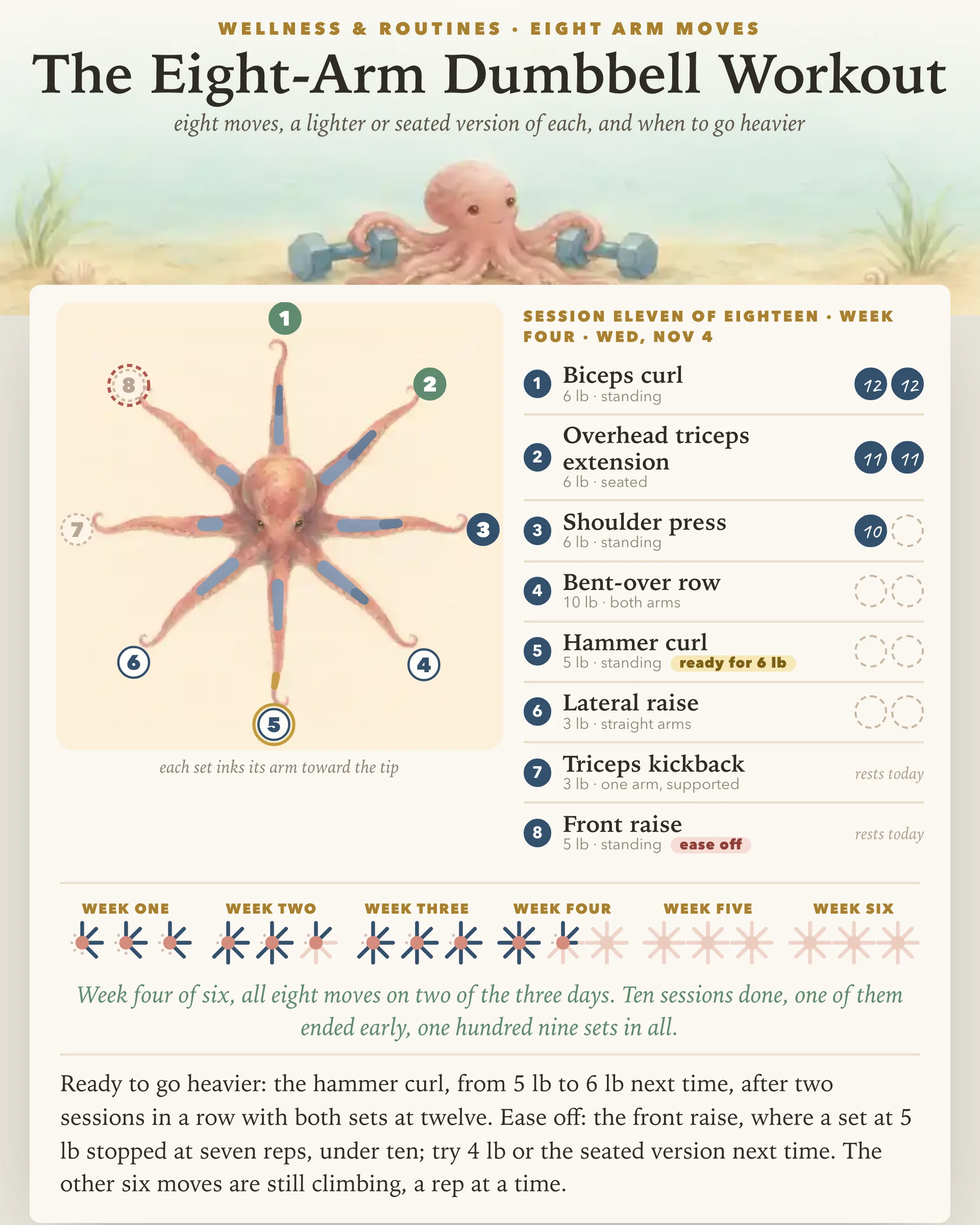
This page is a dumbbell arm workout built around eight moves, one for each arm of a painted octopus. You pick fifteen, twenty or thirty minutes, do two sets of each move in the routine, and log every set with the weight in your hands. Over six weeks the log says, move by move, when to go heavier. Every move has a lighter or seated version, so a kitchen chair works as well as standing.
The order moves around the arm, so one part rests while the next works.
Fifteen minutes covers the first four, twenty adds the hammer curl and lateral raise, and thirty brings in all eight. The plan grows from fifteen minutes in week one to thirty in weeks five and six, three days a week with a rest day between, and any session can take another length before its first set.
The card shows the next move and how to do the version you chose. Set the weight, and the reps start where your last session left off. Tap count me through and the page paces you, two seconds up and three down. A counted set goes in only when its last rep is done; stop partway and nothing is logged. Or do the set in your own rhythm and tap done at your own pace. The one-minute rest after each set reads the clock, so a locked phone still rests you the right amount.
Each finished set inks its arm of the octopus a little closer to the tip, a shade darker whenever that move goes up a pair, and every session gets a small octopus of its own. A session you end early keeps only the sets you did.
Reps climb first: each session aims one rep past your last complete one at that weight, until both sets reach the top of the range: twelve for curls, presses, rows and overhead extensions, fifteen for raises and kickbacks. When two sessions of a move in a row have both sets at the top, at the same weight and in the same version, that arm is marked ready for the next pair up. A session that planned the move but never reached it breaks the run.
The American College of Sports Medicine's position stand on progression suggests eight to twelve reps for people new to lifting, two or three days a week, and adding two to ten percent to the load once you can go one or two reps past your target. Light dumbbells rarely come in steps that small, since five pounds to six is already twenty percent, so this page waits for two good sessions and starts a new pair back at the bottom of the range. Easing off is quicker: one set under the range, even in a session you ended early, brings a suggestion of a lighter pair or the seated version.
A meta-analysis of 47 studies in adults over fifty found clear strength gains on all four tests it pooled, about a quarter to a third on average, with harder training linked to bigger gains. They were measured on gym machines in research programs, so read them as possible, not promised.
What arm work will not do is take fat off your arms in particular. In a twelve-week study that trained only one arm of 104 adults, MRI found the fat loss was general rather than local, with no difference between the trained arm and the untrained one. Stronger arms can make carrying and reaching easier; how they look depends far more on everything else.
Arms are also only part of the body. The World Health Organization's 2020 guidelines ask adults for strength work on two or more days a week that involves all the major muscle groups, legs and hips included.
Check with a doctor or physical therapist first if you have had a fall or dizzy spells, a shoulder, elbow or wrist injury, a joint replacement or recent surgery, a heart or blood pressure condition, or pain that lingers. Breathe out as you curl, press or pull, and stop any move that hurts. Whenever standing or hinging feels unsteady, use the seated or supported version.
Use this page when you own a pair of dumbbells and want stronger arms without guessing. With no dumbbells yet, six arm moves for whatever you have at home start from nothing, bottles or a band. For the whole body with one pair, the seven-move bookshelf circuit adds the squats, deadlifts and carries this plan leaves out.
Start with two sets each of a biceps curl, an overhead triceps extension, a shoulder press and a bent-over row. Those four reach the front, back and top of the arms in about fifteen minutes, and hammer curls, lateral raises, kickbacks and front raises can join as the weeks go by.
Pick a weight that leaves the last two reps of a set hard but still slow and steady. Many beginners land around three to five pounds for raises and kickbacks and five to ten for curls, presses and rows, yet your own reps should decide, not a chart.
Two sets per move. Curls, presses, rows and overhead extensions use eight to twelve reps, and the raises and kickbacks use ten to fifteen. Reps climb by one a session until both sets reach the top, and only then does the weight go up.
It makes the muscles stronger and, given months, a little larger, but training one body part does not melt fat from that spot. When researchers trained only one arm of over a hundred adults for twelve weeks, MRI showed fat loss spread across both arms rather than gathered in the trained one.
Three days a week with a rest day between is plenty for arms. The World Health Organization asks adults for strength work covering all major muscle groups on two or more days a week, so give your legs, hips and back their turn too.
By the team behind Fabulous, the science-based self-care app used by over 30 million people.


