
The Overwhelm Recovery ProtocolWellness & Routines · ~5 min
About this template · Updated November 2026
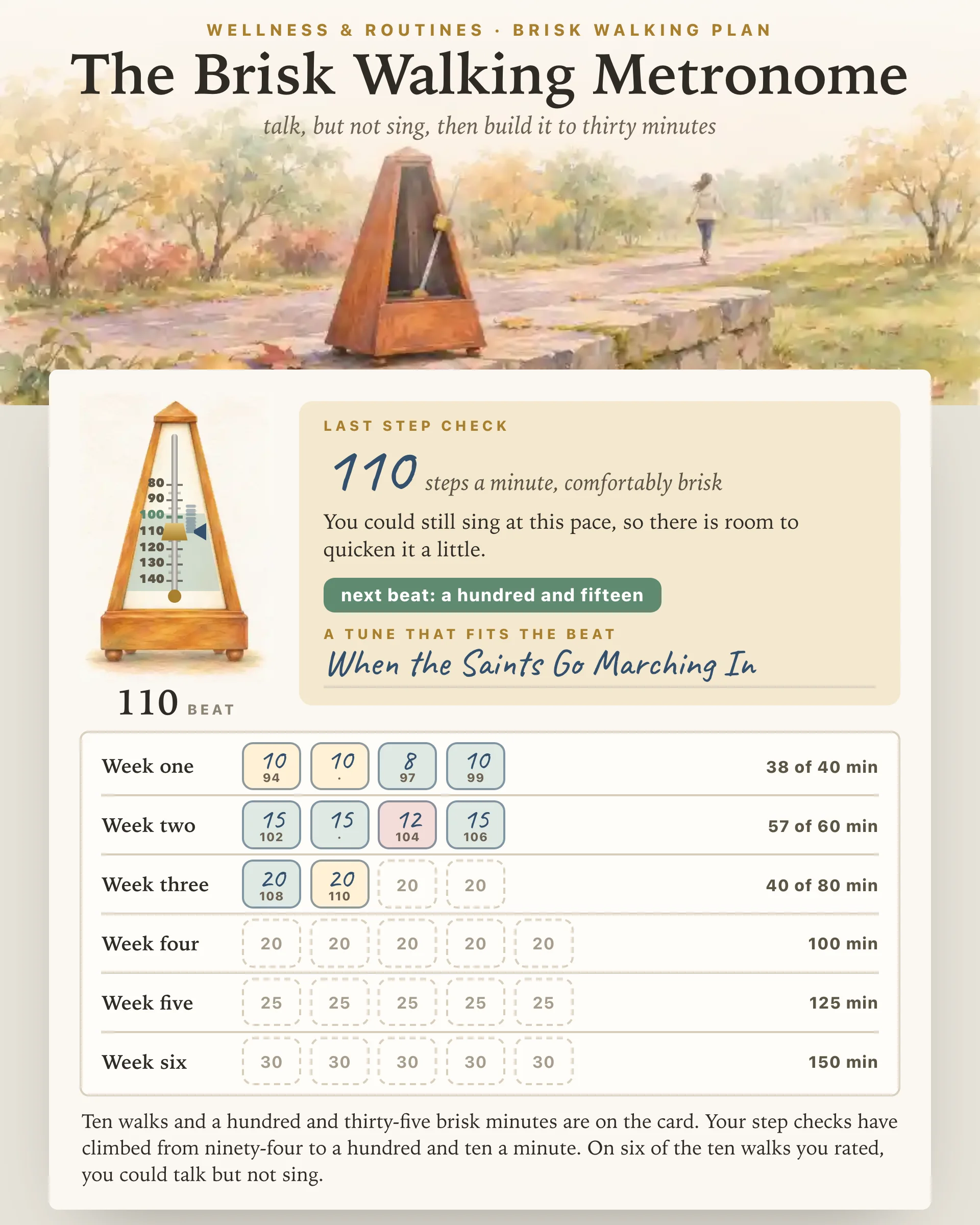
Brisk walking is the most ordinary exercise there is, and the easiest one to drift out of. You set off meaning to stride, and ten minutes later you are ambling past the mailboxes at a Sunday pace. This page gives you two ways to tell the difference out on the path, the talk test and a step check, plus a metronome to set your pace and six weeks that grow ten brisk minutes a walk into thirty.
There are two practical tests, and they work best side by side.
The first is your breath. The CDC's rule of thumb is the talk test: during moderate activity you can talk but not sing, and during vigorous activity you can say only a few words before pausing for air. Brisk walking belongs in that band. If you could belt out a chorus, you are strolling; if sentences come out in pieces, ease off.
The second is your feet. The CADENCE-Adults study counted steps while measuring how much oxygen people used. In people aged sixty-one to eighty-five, about 100 steps a minute marked the start of moderate effort, with 110 and 120 marking harder levels, the same pattern the team had found in adults from twenty-one to sixty, where about 130 marked vigorous effort. These are rounded guides, not personal targets: a tall walker with a long stride may be working hard at ninety-five. When the two tests disagree, trust your breath.
The painted metronome's brass weight sets the beat you aim for, from eighty to a hundred and forty steps a minute, and the green on its face begins at a hundred. Press swing the beat and the rod rocks silently, one swing for each step, for a minute. March in place to it by the door, then carry the rhythm outside, or write down a tune that fits the beat and hum it as you go.
The step check measures what your feet really do: once you are moving briskly, tap the pad every time a foot lands. The page times the minute against the clock, works out your steps a minute from your first tap to your last, and inks the answer on the metronome's scale as an arrow. You can finish after fifteen seconds if holding the phone gets awkward. The reading names where you landed and offers a beat for next time.
Back home, slide to the brisk minutes you managed, say how the talk test went, and the walk fills the next square of the six-week card with your step check beneath it. Squares are shaded by the talk test, so a green week is a truly brisk one. If you could still sing, the suggested beat rises by five; if only a few words came out, it drops by five.
Every walk opens and closes with five easy minutes around the brisk stretch.
Week six adds up to a hundred and fifty brisk minutes, the weekly moderate activity adults are generally advised to reach. The card counts walks rather than dates, so a rainy Tuesday moves nothing; the next square waits.
Brisk walking can be part of losing weight, but a slow part. The American College of Sports Medicine's position stand on activity and weight loss found that 150 to 250 minutes a week of moderate activity brings only modest loss by itself, that larger amounts went with larger changes, and that adding moderate activity to moderate changes in eating improved on what the eating changes did alone. Food, sleep and time carry as much of the load as your shoes, which is why this card keeps minutes and leaves the scale out. If weight is your main reason, four weeks of walks strung as cords of beads set each week from the minutes you really walked.
Speed is not a secret ingredient. A study of nearly five thousand US adults who wore step counters for a week found that more steps a day went with lower death rates, but once the total was accounted for, a quicker stepping rate showed no clear benefit of its own. It was observational, so it cannot settle cause either way. The useful reading: brisk minutes make your walking count as moderate activity in the time you have, and the total you move still matters most. To grow that total gently, the Daily Steps Ladder adds a rung at a time, and once brisk walking feels routine, the Walking Workout Ribbon shapes walks with hills and short faster stretches.
Living with a heart or blood pressure condition, a new hip or knee, dizzy spells, pain on walking, or a recent fall? Ask a doctor or physical therapist whether this plan suits you first. Slow down whenever a whole sentence gets hard to say, and stop if anything hurts.
Brisk is a pace where you could still hold a conversation but could not carry a tune. Public health guidance uses that talk test to mark moderate effort, and step research puts it near a hundred steps a minute for most adults, although leg length and fitness shift the number for each person.
In laboratory studies of adults from their twenties to their eighties, about a hundred steps a minute lined up with moderate effort. Among people aged sixty-one to eighty-five, about a hundred and ten and a hundred and twenty matched harder levels. Use these as rough guides and let your breathing settle the question.
It helps, slowly, and works best with other changes. An American College of Sports Medicine review found that moderate activity on its own brings only modest weight loss and does more alongside sensible changes in eating. Sleep and patience count as well, which is why this card tracks minutes and not pounds.
Adults are generally advised to reach 150 minutes of moderate activity a week, which comes to thirty brisk minutes on five days. This plan opens with ten brisk minutes inside a twenty-minute walk and climbs to thirty over six weeks, so the step up never arrives all at once.
Yes. The picture on this page shows a card ten walks in, and your own copy costs nothing to personalize. It keeps your beat, your step checks, your tune and every walk you add across the six weeks.
By the team behind Fabulous, the science-based self-care app used by over 30 million people.


