
Leaves on a StreamEmotional Fitness · ~3 min
About this template · Updated September 2026
Willingness and willfulness belong to the distress tolerance skills of dialectical behavior therapy (DBT), the treatment developed by psychologist Marsha M. Linehan. This worksheet follows Distress Tolerance Handout 13, Willingness, and Handout 14, Half-Smiling and Willing Hands, from the 2015 second edition of her DBT Skills Training Handouts and Worksheets. Linehan took the pair of words from the psychiatrist Gerald May, who set them against each other in his 1982 book Will and Spirit. The Willing Note is HabitatZero’s own tool, built independently; Linehan, Guilford Press and May’s publisher had no part in it and have not endorsed it.
Something happens that you did not choose. A flight is canceled, a decision goes the other way, your knee says no to the long run. There are two ways to answer it. May wrote that willingness is saying yes to the mystery of being alive in each moment, and that willfulness is saying no, “or perhaps more commonly, ‘Yes, but…’”
Linehan’s handout turns that into practice. Willingness means doing just what a situation needs, wholeheartedly, without dragging your feet. Willfulness shows up as refusing to tolerate the moment, refusing a change it requires, giving up, trying to fix every situation, or insisting on being in control.
Read that list twice and it splits in two. Fixing everything and holding on to control are too much; giving up and refusing a needed change are too little. Linehan made the same point in her 1993 treatment manual, noting that “willfulness can appear in the guise of passivity.”
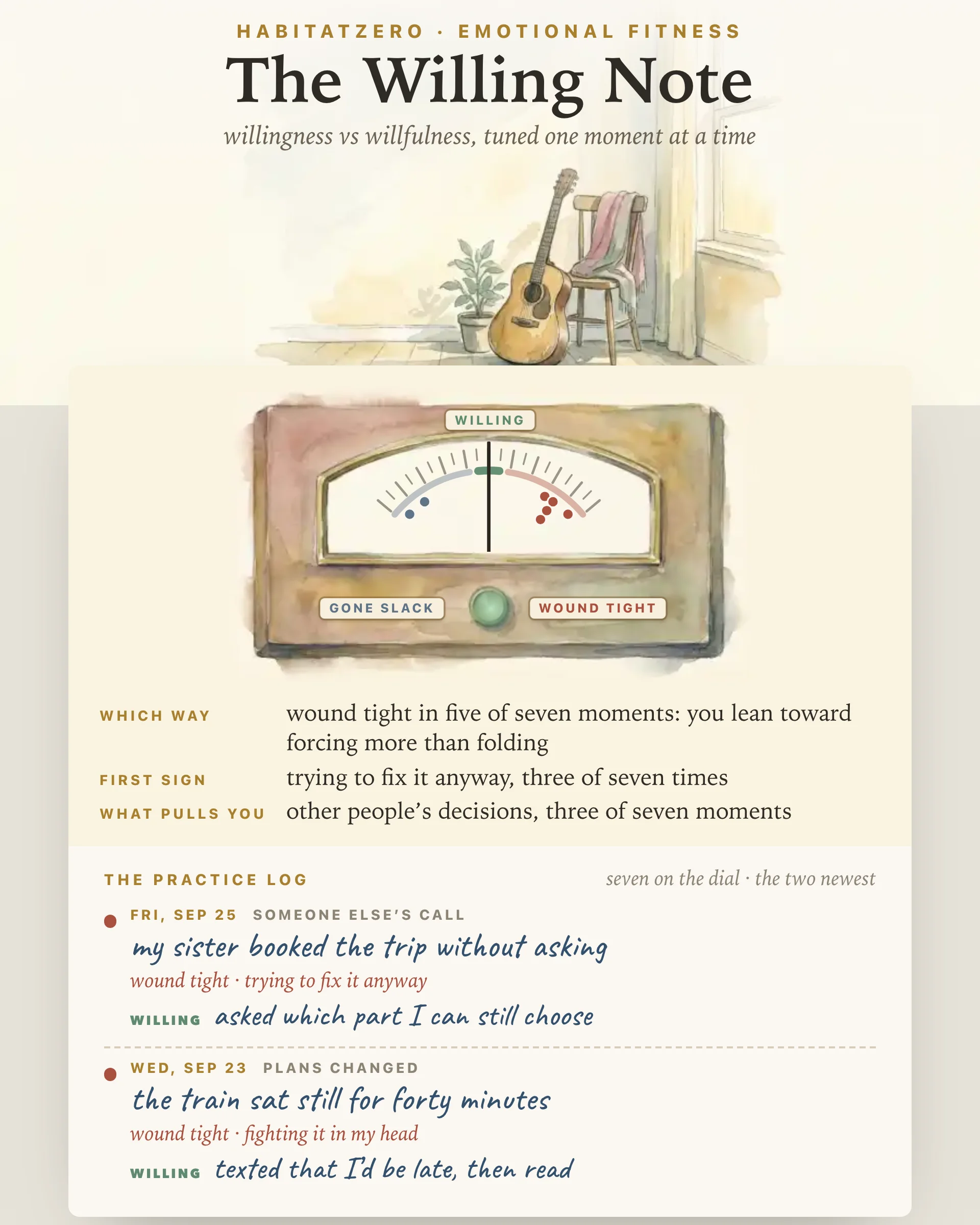
So this page draws willfulness the way a musician hears a string that is out of tune: wound past its note, or gone slack below it. Neither one plays. Willingness is the string in tune, giving the moment no more effort and no less than it asks for. The tuner is this page’s picture, not Linehan’s; her handout is a list.
Start with the moment. Tap what kind it was, from plans changed to a loss or an ending, and say what happened in a few words. Then pick the first sign you caught. Each sign has its own spoke on the dial, so the needle swings toward wound tight for fighting it in your head or a quick yes, but, and toward gone slack for sulking or sitting on your hands.
Then come four turns, one for each of Linehan’s steps: name the willfulness; let it be there, since you cannot fight willfulness with willfulness; turn toward willingness; and let your body lead with a half-smile or willing hands. Every turn brings the needle a quarter of the way home, and the fourth lights the lamp. Her fifth step, for willfulness that will not budge, is to ask what feels threatened, and it waits under the turns for the moments that stay stuck.
Last, write the willing note, meaning what the moment actually needed, and log it. The log keeps twelve moments, and each one leaves a dot on its spoke. From the third moment on, the tuner reads the log back: which way you usually go out of tune, the sign you tend to catch first, and the kinds of moments that pull you there. Linehan’s handout ends by asking where you notice your own willfulness. The log answers from what you wrote down rather than from memory.
Willingness has not been tested as a skill on its own, so treat what follows as nearby evidence rather than proof. In an experiment with sixty people who had anxiety and mood disorders, those asked to accept their emotions during an upsetting film felt about as distressed as those asked to suppress them, but their heart rate fell rather than rose, and they had less negative feeling in the minutes afterward. That fits the bargain willingness offers: the moment still hurts, and you stop paying extra to fight it.
The half-smile leans on facial feedback, the idea that your face informs your mood. A preregistered test with nearly four thousand people in nineteen countries found that deliberately smiling could both strengthen and start feelings of happiness, while the subtler pen-in-mouth version of the test gave less conclusive results. Expect a nudge, not a switch.
Use it in the moment, when you catch the set jaw or the curt “fine,” or the same evening while the details are fresh. If what you face is a crisis rather than a stubborn patch, Storm or Stone helps you choose between crisis skills and acceptance skills. For a fact you keep arguing with, The Open Hand practices radical acceptance. And when you cannot tell what the moment needs, Wise Mind is the place to look, since the handout ties willingness to acting from wise mind.
This page is practice, not treatment. DBT skills are best learned with a DBT therapist, and a few weeks of this log make a useful thing to bring to one. If giving up starts to feel like giving up on yourself, call or text 988 in the US, or your local emergency number, and let someone help you carry it.
Willingness takes a moment as it actually is and gives it what it asks for, wholeheartedly, no more and no less. Willfulness answers the same moment with a no: fighting it, trying to fix what cannot be fixed, insisting on control, or giving up on what still needs doing. The difference lies in your answer to the moment, not in the moment itself.
In DBT, willfulness is refusing a moment that has already arrived. Sometimes it looks forceful, like replaying why a canceled flight should never have been canceled or redoing a coworker’s share of a project. Sometimes it looks passive, like a curt “fine,” a sulk, or leaving the tax forms unopened for another week. This tuner calls those two faces wound tight and gone slack.
Willing hands is a DBT posture for accepting with the body: fists opened, palms turned upward, fingers loose, whether your hands rest on your thighs or hang by your sides. Linehan pairs it with the half-smile, a relaxed face with the corners of the mouth lifted just enough to feel. On this page, trying either one counts as the fourth turn back to willing.
No. Linehan’s own version is Distress Tolerance Handout 13, Willingness, in her DBT Skills Training Handouts and Worksheets from Guilford Press, and she credits the pair of words to Gerald May’s 1982 book Will and Spirit. The Willing Note is a practice tool made by HabitatZero, with no involvement or endorsement from Linehan, Guilford or May’s publisher.
The sample tuner on this page is free for anyone to explore. Personalizing it in HabitatZero, also free, is what keeps your own log so the dial can fill in and read your pattern back.
By the team behind Fabulous, the science-based self-care app used by over 30 million people.


