Leaves on a StreamEmotional Fitness · ~3 min
About this template · Updated September 2026
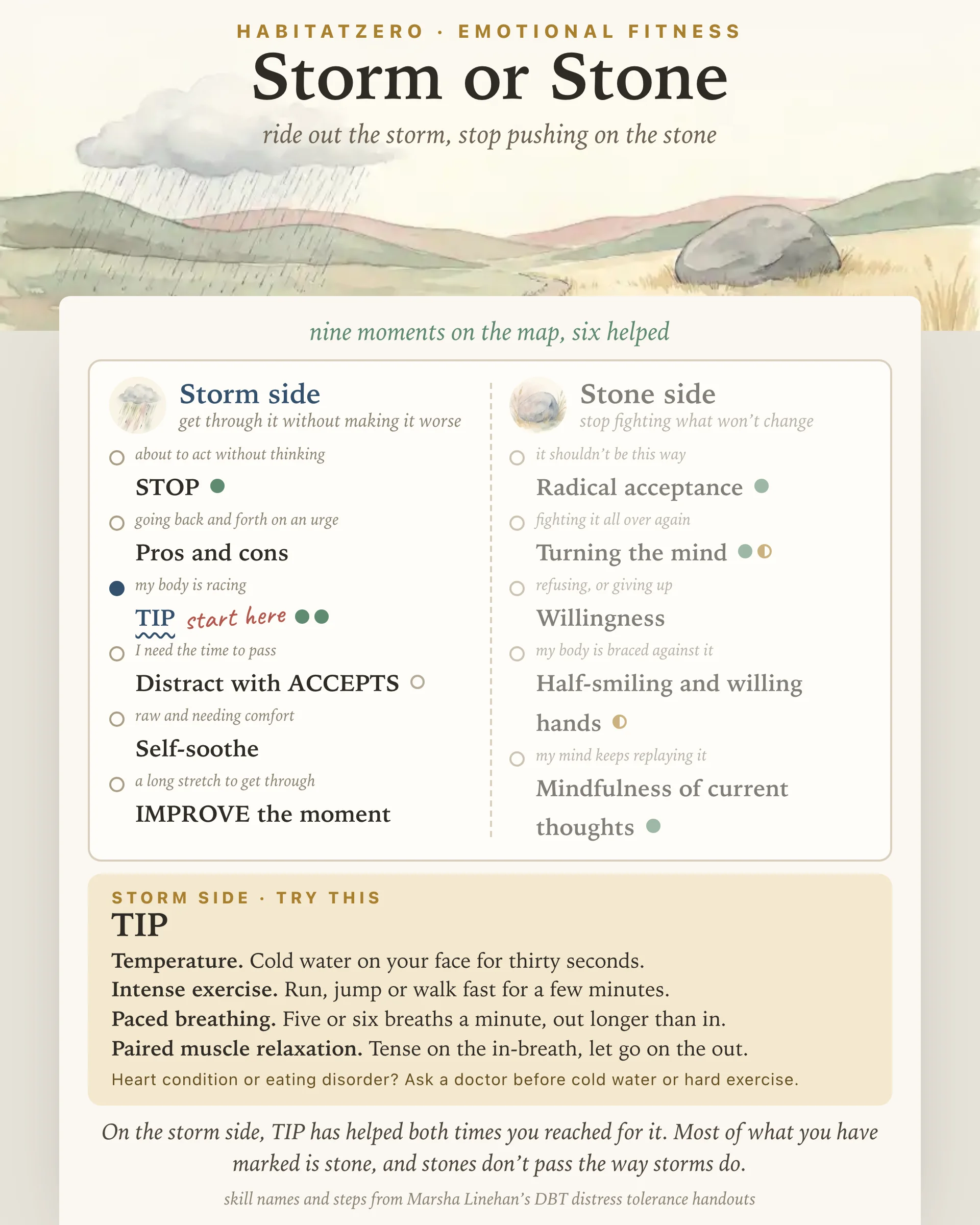
Distress tolerance is one of the four skill sets in dialectical behavior therapy (DBT), the treatment psychologist Marsha M. Linehan developed, and every skill on this map takes its name and steps from the distress tolerance handouts in her DBT Skills Training Handouts and Worksheets, following the 2015 second edition. Storm or Stone is HabitatZero's own tool; Dr. Linehan and her publisher had no part in it and have not endorsed it.
Linehan's first two goals for the module split it in half: survive crisis situations without making them worse, and accept reality, trading suffering for ordinary pain.
That split is this page's first question. A storm is what Linehan calls a crisis: highly stressful, short-lived, and pressing you to act now. It will pass, but it can wreck things on the way, so the job is to get through without adding damage. A stone is a fact that will not move, like a loss or a decision that went against you. Pushing on it only wears you out.
Often both arrive together. A breakup is a stone; the night you want to send ten messages about it is a storm. Get through the storm first, then come back for the stone.
The six crisis survival skills, in Linehan's order:
These are for the next hour, not for everyday problems or fixing a whole life. To pack them in your own words ahead of time, use The Crisis Survival Tin.
The reality acceptance skills are, in Linehan's words, "skills for how to live a life that is not the life you want":
For radical acceptance on its own, The Open Hand teaches it through a press-and-hold.
Tap storm or stone and that half of the map lights up. Each stop is labeled with the moment it serves, like my body is racing, so you choose by what you notice rather than by recalling acronyms. The card gives the steps in Linehan's order. Afterward, mark how it went.
Marks gather as dots beside each skill, and one that has helped at least twice, more than any other on its side, earns a start here flag. The record keeps twelve moments, and a short reading names what carries you. When most of what you mark is stone, it says so: acceptance is practiced again and again, not done once.
A review in Psychological Bulletin called distress tolerance an emerging candidate risk factor for many psychological difficulties, while noting that researchers define and measure it in different ways.
The skills are mostly studied inside full DBT. For skills training on its own, a systematic review of seventeen trials found preliminary evidence that it helps with a range of problems, and methodological limits that ruled out strong conclusions.
Half-smiling leans on the idea that your face feeds back into how you feel; a meta-analysis of more than a hundred facial feedback studies found that effect real but small and inconsistent. Nobody has tested this particular map; the record is how you find out what works for you.
Open the map mid-moment, when you know a skill would help but cannot think which. Mark what happened once things ease, and read the record on a calmer day. To see distress tolerance beside the other three DBT modules, try The Skills Compass.
This page is practice, not treatment, and DBT is best learned with a trained therapist. If storms come most days, or a stone feels too heavy to carry alone, bring the record to a clinician. If you are in crisis or thinking about hurting yourself, call or text 988 (US) right now, or reach your local emergency number. In that moment a person comes ahead of any skill on this page, so tell someone you trust as well.
They are the DBT skills for getting through pain you cannot fix right away, developed by Marsha Linehan. Crisis survival skills (STOP, pros and cons, TIP, distracting with ACCEPTS, self-soothing and IMPROVE the moment) help you survive a crisis without making it worse. Reality acceptance skills (radical acceptance, turning the mind, willingness, half-smiling and willing hands, and mindfulness of current thoughts) help you stop fighting facts that will not change.
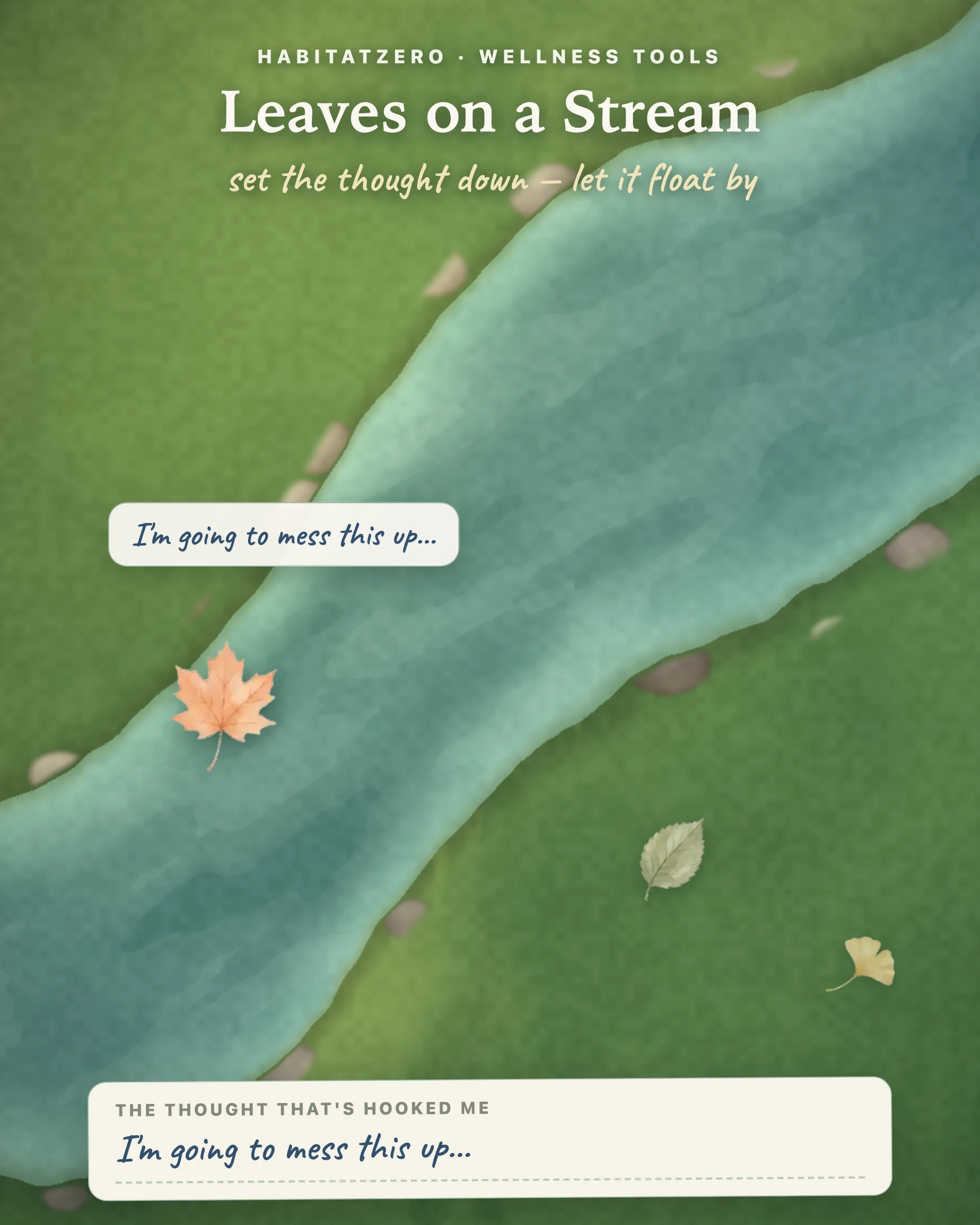
Willingness means doing just what a situation calls for, wholeheartedly and without dragging your feet. Willfulness is its opposite: refusing to tolerate the moment, giving up, insisting on control, or trying to fix everything. Linehan's steps are to notice the willfulness, accept that it is there, turn your mind toward willingness, and try a half-smile with open hands.
It means choosing acceptance again each time you catch yourself fighting reality. Linehan compares it to a fork in the road where you keep turning toward acceptance, and she adds that the choice alone is not yet acceptance; it only puts you on the path. Bitterness and thoughts like why me are the usual signs that you have drifted.
Relax your face from forehead to jaw and let the corners of your lips turn up just enough to feel it. For willing hands, unclench and turn your palms up, resting them on your lap if you are sitting or loose at your sides if you are standing. Research on facial feedback shows a real but small effect, so expect a nudge rather than a switch.
Linehan's own handouts are printed in her DBT Skills Training Handouts and Worksheets from Guilford Press. This page is the interactive version: anyone can read the example map above, and your own map, marks and record are kept once you personalize it in HabitatZero, which costs nothing.
By the team behind Fabulous, the science-based self-care app used by over 30 million people.