Leaves on a StreamEmotional Fitness · ~3 min
About this template · Updated September 2026
Every skill on this page traces back to one person. Dialectical behavior therapy, and the skills curriculum inside it, was developed by psychologist Marsha M. Linehan at the University of Washington; the Behavioral Tech Institute, which she founded to train clinicians in the treatment, is the home of that work. The Skills Compass is a study aid HabitatZero built on its own initiative. Dr. Linehan and her institute have not reviewed it, endorsed it, or had any part in it.
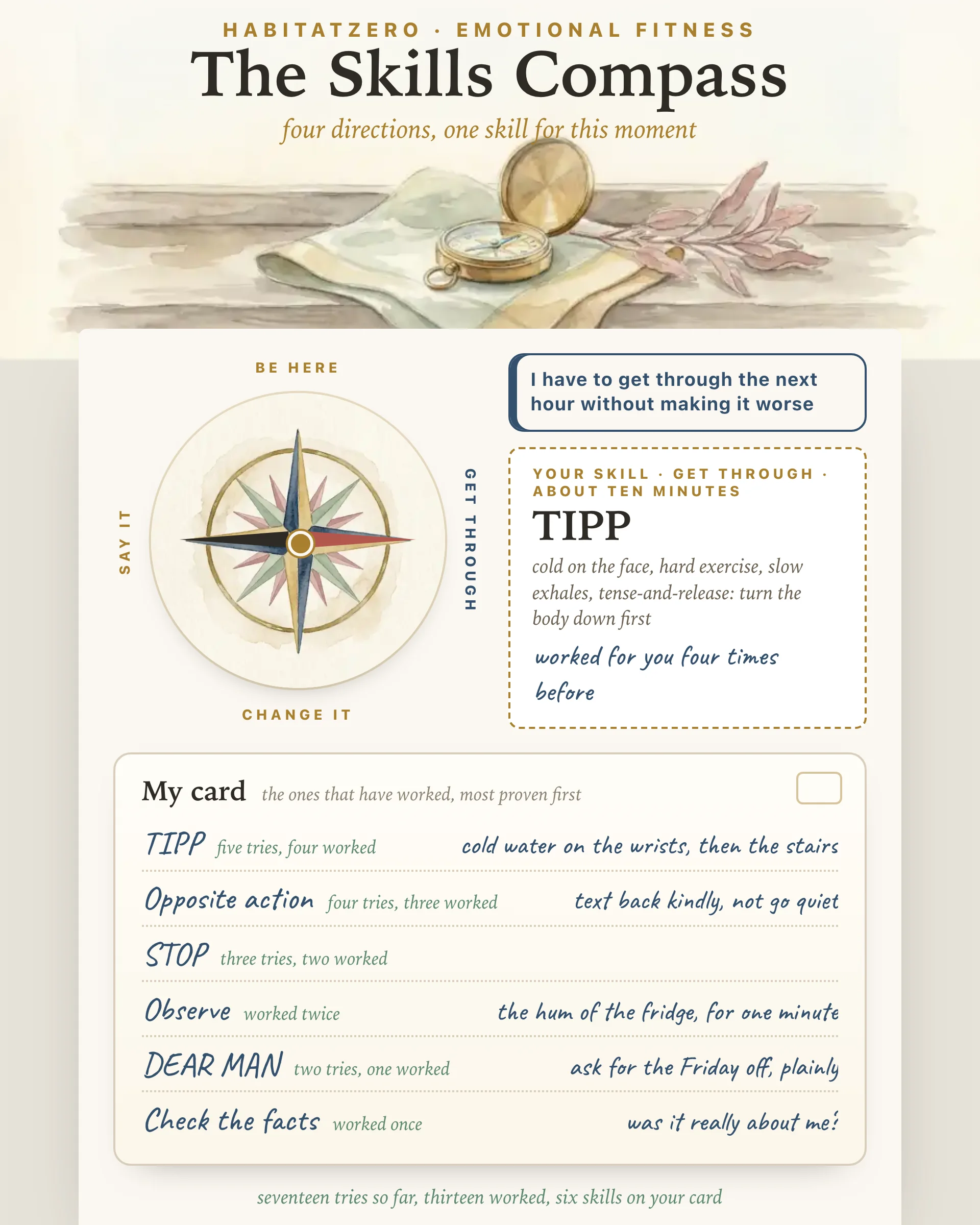
DBT skills usually arrive as a list, and the list is long: two dozen acronyms across four modules, taught over roughly six months of weekly group. A list is fine in a classroom. At two in the morning it is useless, because what you need is not the list but the one line on it that fits this hour. The compass is built for that hour. It puts the four modules on a rose, asks what the moment is like, and hands you one skill.
Linehan sorted the skills into four modules, and the compass keeps her map.
Mindfulness sits at north because everything else runs on it. DBT splits it in two. The what skills say what you do: observe (notice without words), describe (put plain words on what you noticed, no verdicts), participate (throw yourself into the one thing you are doing). The how skills say how you do it: non-judgmentally, one-mindfully, effectively. Wise mind, the place where feeling and knowing agree, is the module's compass inside the compass.
Distress tolerance, east, is for the hour you cannot fix and only need to survive without making worse. STOP, TIPP, distracting with ACCEPTS, self-soothing through one sense, IMPROVE the moment, and a written pros and cons are the crisis kit. Radical acceptance is the slower skill at the back of the module, for what has already happened.
Emotion regulation, south, is for a feeling that is running the show. Check the facts first. If the feeling does not fit them, opposite action; if it does, problem solving. Accumulating positives, building mastery, coping ahead and the PLEASE body-care list lower the baseline so fewer feelings reach that size.
Interpersonal effectiveness, west, is for the moments with another person in them. Decide which matters most this time, the outcome, the relationship or your self-respect, then DEAR MAN for the ask, GIVE for the relationship, FAST for yourself.
DBT itself routes with three questions: can the situation be changed right now, does the feeling fit the facts, and is someone else involved. The four moment buttons are those questions in plain clothes. Tap one and the needle swings to its module. Then say how much room you have, a minute, ten minutes or longer, and only skills that fit that window stay in the running.
Press hand me a skill and you get one name with a one-line reminder of how it goes. Ask for another if it lands wrong. After you have tried it, say whether it worked. That verdict is the part a printed cheat sheet cannot do. Each win is counted, the skill lands on your card, and the next time the needle points the same way the compass offers your proven skills before the untried ones. Over a few weeks the card stops being Linehan's list and becomes yours: the four or five moves that have actually worked, with your own version of each written beside it.
The skills are not decoration on the therapy; they appear to be part of how it works. In Linehan's own trial data, the more people used the skills over treatment, the more their suicide attempts and depression fell and their anger control improved, and skills use accounted for part of that change. A later trial pulled the treatment apart into its components, and the two versions that included skills training did better than the version without it on several outcomes. Skills groups have also been tried on their own, and a systematic review of those studies found encouraging results from small and uneven trials.
Read those findings carefully, because they are about DBT delivered by trained clinicians: individual therapy, a weekly skills group, phone coaching between sessions, and a consultation team for the therapists. A compass on a web page is none of that. It is a reference and a practice log. It will remind you what opposite action is when you need it; it treats nothing, and it is no reason to skip a therapist when the feelings you are routing are large or frequent. DBT skills were designed to be learned with a person, and a person is still the right way to learn them.
Several skills on the compass have a page of their own here. Radical acceptance gets its own press-and-hold practice in The Open Hand. The dialectic itself, holding two true things at once, is the balance in Both/And. Opposite action is the closing move of the Steadying Practices sheet. When the trouble is an urge rather than a feeling, Urge Surfing is the neighboring practice, from the relapse-prevention tradition rather than from DBT itself.
If you are in crisis or thinking about hurting yourself, call or text 988 (US) right now, or reach your local emergency number.
Mindfulness, distress tolerance, emotion regulation and interpersonal effectiveness. Mindfulness is the core the other three depend on. Distress tolerance is for the hour you cannot fix and only need to get through. Emotion regulation is for feelings that are too strong or do not fit the facts. Interpersonal effectiveness covers asking, refusing, and keeping both the relationship and your self-respect.
They are the two halves of the mindfulness module. The what skills name what you do: observe (notice without words), describe (put plain words on it) and participate (throw yourself into the activity). The how skills name how you do it: non-judgmentally, one-mindfully, and effectively, meaning you do what works rather than what proves a point.
DBT routes by three questions. If you cannot change the situation in the next hour, go to distress tolerance. If the feeling does not fit the facts, or fits them but is too big, go to emotion regulation. If another person is in it, go to interpersonal effectiveness. When you are spinning in your head, start with a mindfulness skill. The compass on this page asks those questions for you and hands you one skill.
You can learn what the skills are and practice them, and a review of skills-only programs found encouraging results. Full DBT is something else: individual therapy, a weekly skills group, coaching between sessions and a clinician consultation team, all run by trained therapists. Treat this page as a study card and a practice log, not as treatment.
The version embedded on this page is a locked preview filled with example tallies. Personalizing it in HabitatZero unlocks the needle, the verdict buttons and a card that remembers your own counts. There is no charge for that.
By the team behind Fabulous, the science-based self-care app used by over 30 million people.