The Overwhelm Recovery ProtocolWellness & Routines · ~5 min
About this template · Updated July 2026
Credit first, because the metaphor has an author: urge surfing comes from the late G. Alan Marlatt, the University of Washington psychologist whose relapse-prevention work reframed how clinicians think about craving. His insight was a piece of applied oceanography: an urge is not a rising tide that only grows until you feed it — it is a wave. It builds, it crests, and if nobody obeys it, it passes. The skill he taught was not resisting the wave but riding it, and a brief mindfulness study he co-authored with Sarah Bowen found that even a short urge-surfing exercise measurably changed how student smokers related to their cravings in the days that followed.
One honest line before the practice: this page teaches a skill, not a treatment, and it makes no claims about addiction. If the urges you are riding involve substance use, or acting on them puts you or anyone at risk, a professional belongs in the picture — this practice travels well into that room, but it does not replace it.
Every urge arrives with the same forecast: this will keep growing until you give in. It is a persuasive forecast, because the first few minutes seem to confirm it — the wanting builds, the body leans, the reasons multiply. So we act, the urge subsides, and the sequence teaches us the wrong lesson: that acting is what made it stop.
The wave was going to break anyway. Urges are appetitive weather, not debts; observed instead of fed or fought, they crest and subside on their own schedule — usually far sooner than the forecast claimed. But you cannot learn that from an argument. You can only learn it from a ride you stayed on while the forecast failed.
That is all this sheet is: a place to watch the forecast fail, fifteen minutes at a time.
Name the urge plainly. The scroll, the snack, the cigarette, the message you should not send. One phrase, no euphemism. A named urge becomes a thing you are watching instead of a command you are hearing.
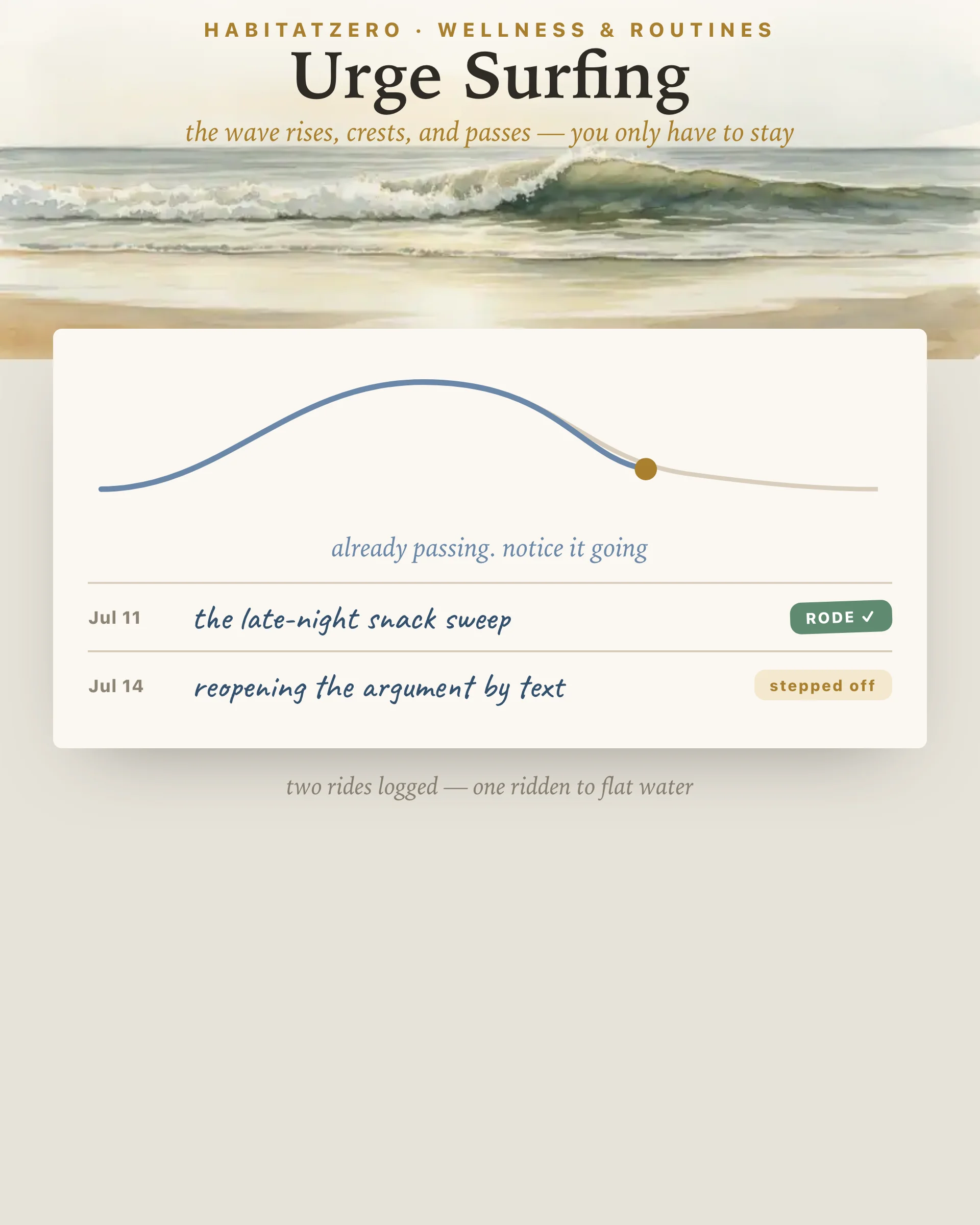
Start the wave. The arc rises toward its crest and falls to flat water over fifteen minutes, and the copy under it tells you where you are: it builds — that is the wave doing what waves do. The crest — it will not get higher than this. Already passing. Your job is not white-knuckled resistance; it is curious observation. Where does the urge sit in the body? What exactly is it promising? What does minute nine feel like compared to minute two?
The difference between surfing and suppressing matters. Fighting an urge is still a relationship with it — often one that feeds it. Surfing is closer to bird-watching: interested, unhurried, and not taking orders.
When the water flattens, write one line. Did the urge outlive the wave? Usually it did not, and that line — dated, in your own words — becomes evidence. The ledger under the wave accumulates your rides, and after a handful it holds something no worksheet could have told you: your own tide tables. Which urges are loudest at which hours. How far the crest really is from the start. How rarely the forecast comes true.
Stepping off is logged too, without shame. The button exists because pretending it doesn't helps no one. A stepped-off ride recorded honestly teaches more than an abandoned page — and waves come in sets; the next one starts from everything this one taught you.
The live ride is never saved anywhere — close the page mid-wave and the ride simply dissolves, like the urge it was tracking. Only what you choose to log persists. And nothing here counts streaks, scores abstinence, or grades you: the sheet's only currency is noticing, because noticing is the part that generalizes.
Urge surfing sits in a family of watch-it-pass practices. If thoughts rather than urges are what carry you off, leaves on a stream is the sibling exercise for letting them float by, and when the urge arrives inside a spike of anxiety, sixty seconds of box breathing first can make the board much easier to stand on.
Name it. Start the wave. Stay curious for fifteen minutes — and let the water do what it was always going to do.
A mindfulness practice for riding out an urge instead of acting on it or fighting it. The image comes from psychologist G. Alan Marlatt's relapse-prevention work: urges behave like waves — they rise, crest, and pass on their own — and the skill is staying present through the arc rather than being pulled under. This page turns that arc into a fifteen-minute timer you can actually ride.
Most urges crest and noticeably subside well inside that window when they are observed rather than fed — feeding an urge is what resets its clock. Fifteen minutes is long enough to watch a full arc and short enough to promise yourself honestly. Some waves run longer; the ledger will teach you your own tide tables.
Log it — stepping off is information, not failure. A ledger with honest stepped-off entries teaches you more than a flattering one: which urges are hardest at which hours, how far into the wave you got, what helped. Waves come in sets; the next ride starts from everything this one taught you.
No — and this page makes no treatment claims. Urge surfing is one mindfulness skill studied within relapse-prevention research, and it is genuinely useful as a skill; it is not a substitute for treatment. If the urges you are riding involve substance use, or acting on them puts you or anyone else at risk, the right tool is a professional — bring this practice to that conversation rather than in place of it.
Yes. Name the urge, ride the wave on the page, and your logged rides save as you go — or print the sheet and keep the ledger in pen.
By the team behind Fabulous, the science-based self-care app used by over 30 million people.