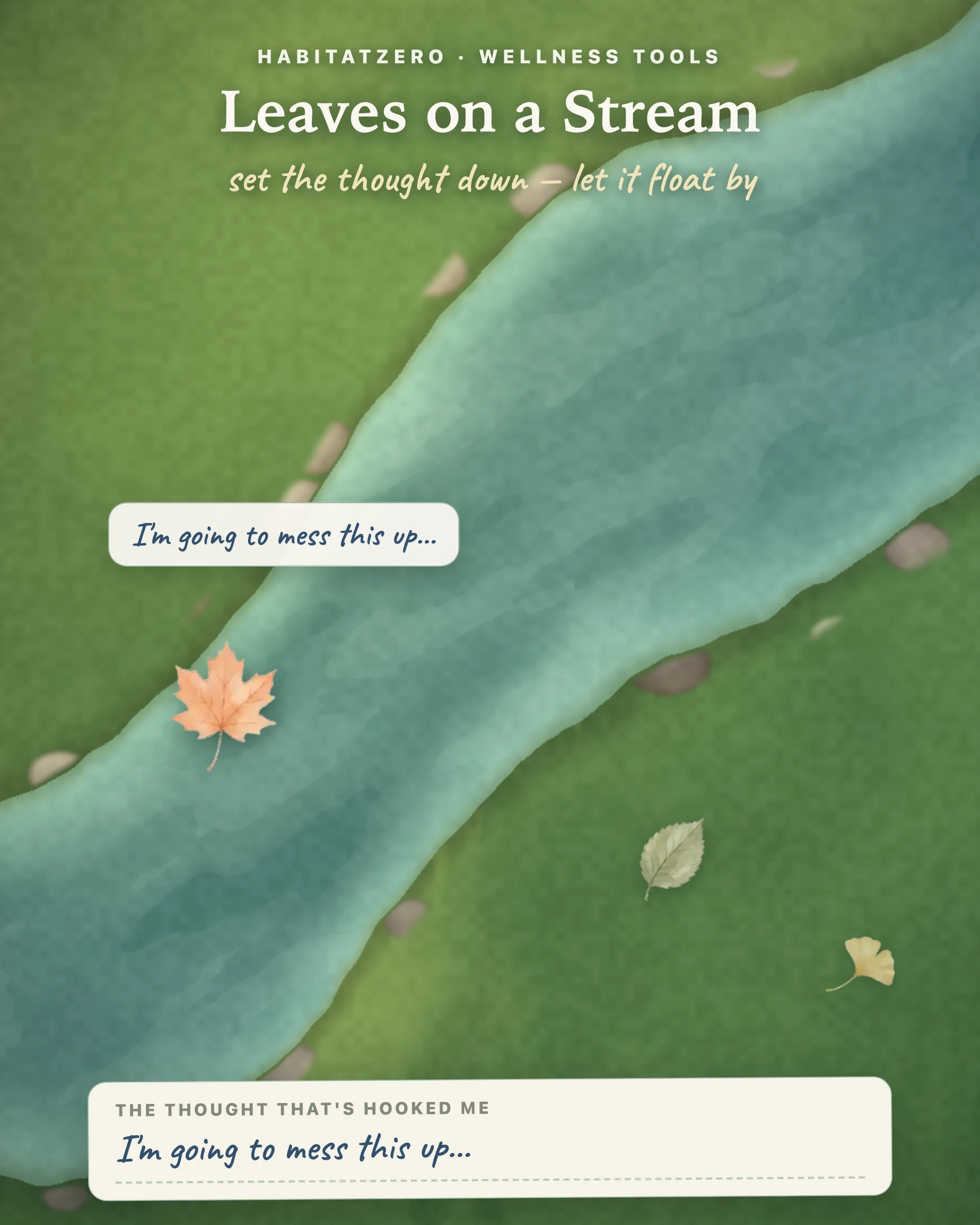
Leaves on a StreamEmotional Fitness · ~3 min
About this template · Updated July 2026
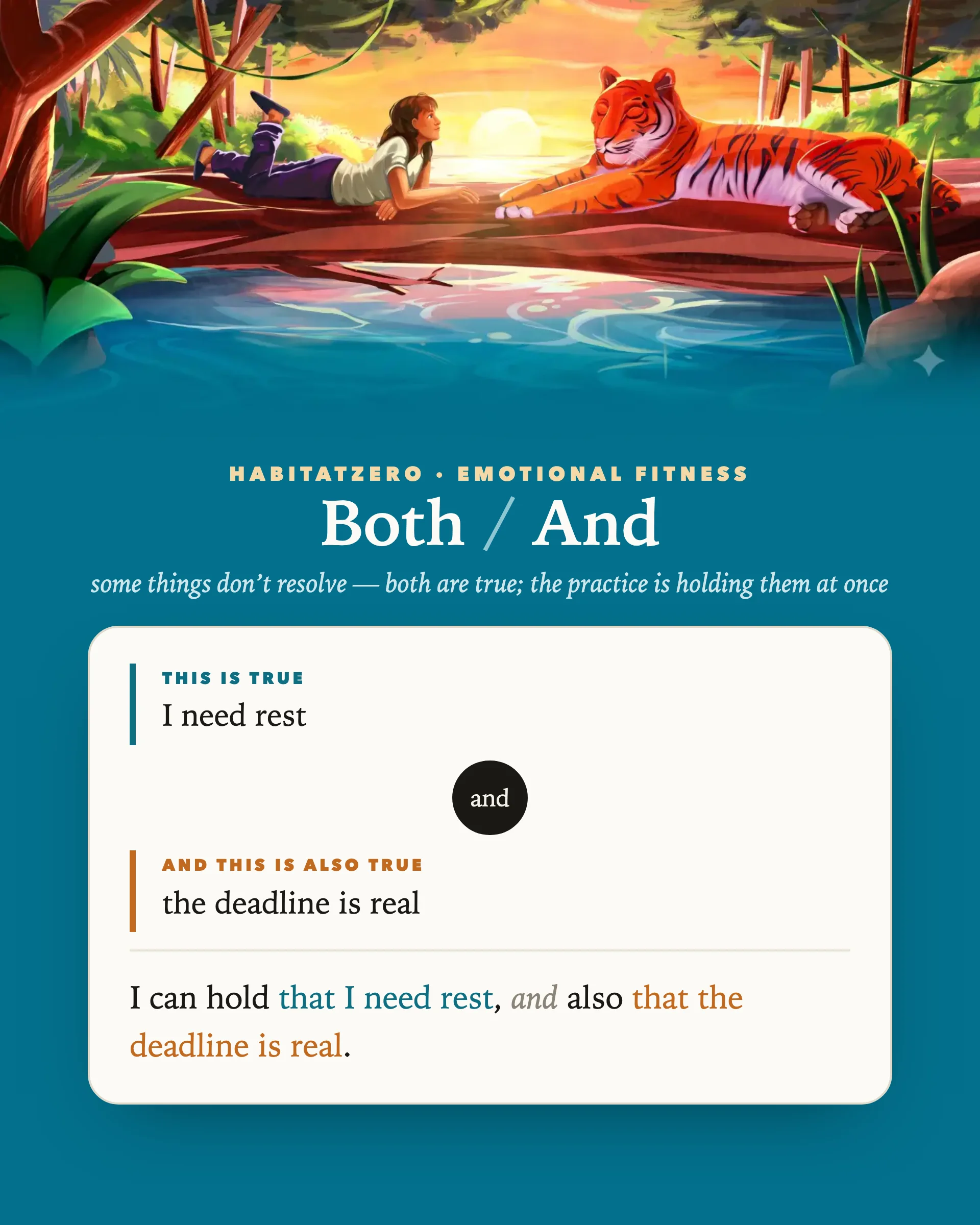
Two things can be true at once. You know this — and an anxious mind at 11 p.m. does not. I need rest and the deadline is real start slugging it out for the same evening, and whichever wins, you lose the other. Dialectical thinking is the skill of refusing that fight, and this exercise, Both/And, teaches it with a balance you cannot rig. You write the two truths. You try, honestly, to choose between them. And the balance does the teaching: it will not stay on one side, because neither will you.
Dialectical thinking is the first idea in dialectical behavior therapy — it is the D in DBT, the treatment Marsha Linehan built, and one of the best-evidenced treatments in clinical psychology. Linehan put a specific observation at the center of it: the most painful mental knots are usually two true things being forced to fight. I am doing my best versus I need to do better. I want closeness versus I need space. Either/or thinking resolves the tension by dropping one truth — and the dropped truth does not become false, it just goes underground and runs the show from there. The dialectical move is the conjunction swap: not but, which quietly deletes the first clause, but and, which keeps both alive. I am doing my best, and I need to do better. Both stand. Nothing was deleted. The sentence is heavier and truer.
DBT's adolescent and family adaptation made this skill its own module — Walking the Middle Path — teaching families to find the both/and between acceptance and change, and that adaptation has trial evidence of its own. The middle path is not a compromise where each side loses half; it is the discovery that the two poles were never competing for truth, only for attention.
The exercise's centerpiece is a slider that invites you to do the thing your mind has been trying to do all day: pick a side. Drag it toward the heavier truth and the other one dims and shrinks — exactly the way a dropped truth behaves. Hold it there. Then let go.
It springs back. Every time. The spring is not a gimmick; it is the most honest physics on the page. A mind holding two real truths cannot actually park on one of them — the abandoned side pulls, at 2 a.m. or mid-argument, until it gets carried again. The exercise just makes the pull visible and fast, and then hands you the alternative in a single sentence assembled from your own words: I can hold that I need rest, and also that the deadline is real. Notice what that sentence does not do. It does not resolve anything. Some things don't resolve — both are true, and the practice is holding them at once.
The balance saves nothing, on purpose. Springing back to center is the entire lesson, and every visit starts balanced.
Dialectical thinking has a lazy cousin it gets mistaken for: reflexive both-sidesing. They are not the same. The both/and applies to truths — two accurate statements genuinely coexisting — not to decisions, which still need making, and not to claims, some of which are simply wrong. You do not need a balance for "should I take the job" (a choice) or "was that fair" (sometimes: no). You need it for the feeling and the fact, the love and the anger, the grief and the gratitude — the pairs where dropping either one costs you information you will pay to recover later.
If the two truths you keep writing are a feeling and a verdict about yourself, the thought record journal works that pair the CBT way; and if what you need is to let one loud thought pass through rather than hold two, leaves on a stream is the neighboring practice.
This exercise borrows one skill from a full clinical toolbox, as self-help; it is not DBT and does not treat anything. Most two-truth knots loosen with practice. But if the poles you keep writing are extreme — worthless and fine, unbearable and pretending — or if holding any two things at once feels impossible more days than not, that is a real signal, and it deserves a professional rather than a page; DBT skills in particular were built to be learned with one. If you are in crisis or thinking about hurting yourself, call or text 988 (US) right now, or reach your local emergency number.
Holding two things that are both true at the same time, without forcing one to cancel the other. It is the first skill of dialectical behavior therapy — the dialectic in DBT — built on the observation that most real dilemmas are not either/or but both/and: you can be doing your best and need to do better; you can love someone and be angry at them. The opposite of dialectical thinking is the all-or-nothing snap, and most of its pain comes from dropping a truth that refused to stay dropped.
You write two truths that are fighting for the same moment, one on each side. Then a balance invites you to choose between them: drag it toward either truth, as far as you like, and watch the other side dim and shrink. When you let go, the balance springs back to center — every time. The design is the argument: a real dialectic will not let you abandon one side, and the exercise ends with both truths in one sentence, joined by and.
It is DBT's name for living dialectically — the module, originally built for the adolescent and family version of the treatment, that teaches finding the both/and between extremes: acceptance and change, independence and connection, being validated and being challenged. The middle path is not a compromise where both sides lose; it is the recognition that the two poles were never actually in competition for truth, only for attention.
No. Dialectical thinking is for truths, not choices or claims. Some questions have one right answer, and some claims are simply false — no balance needed. The both/and applies where two accurate statements genuinely coexist: the feeling and the fact, the love and the anger, the need and the obligation. Decisions still get made; they just get made by someone carrying all the true information instead of half of it.
Free, in your browser — this public page shows a locked preview with an example pair. Inside Fabulous, your two truths save privately to your account. The balance itself deliberately saves nothing: springing back to center is the whole lesson, and every visit starts balanced on purpose.
By the team behind Fabulous, the science-based self-care app used by over 30 million people.