Leaves on a StreamEmotional Fitness · ~3 min
About this template · Updated September 2026
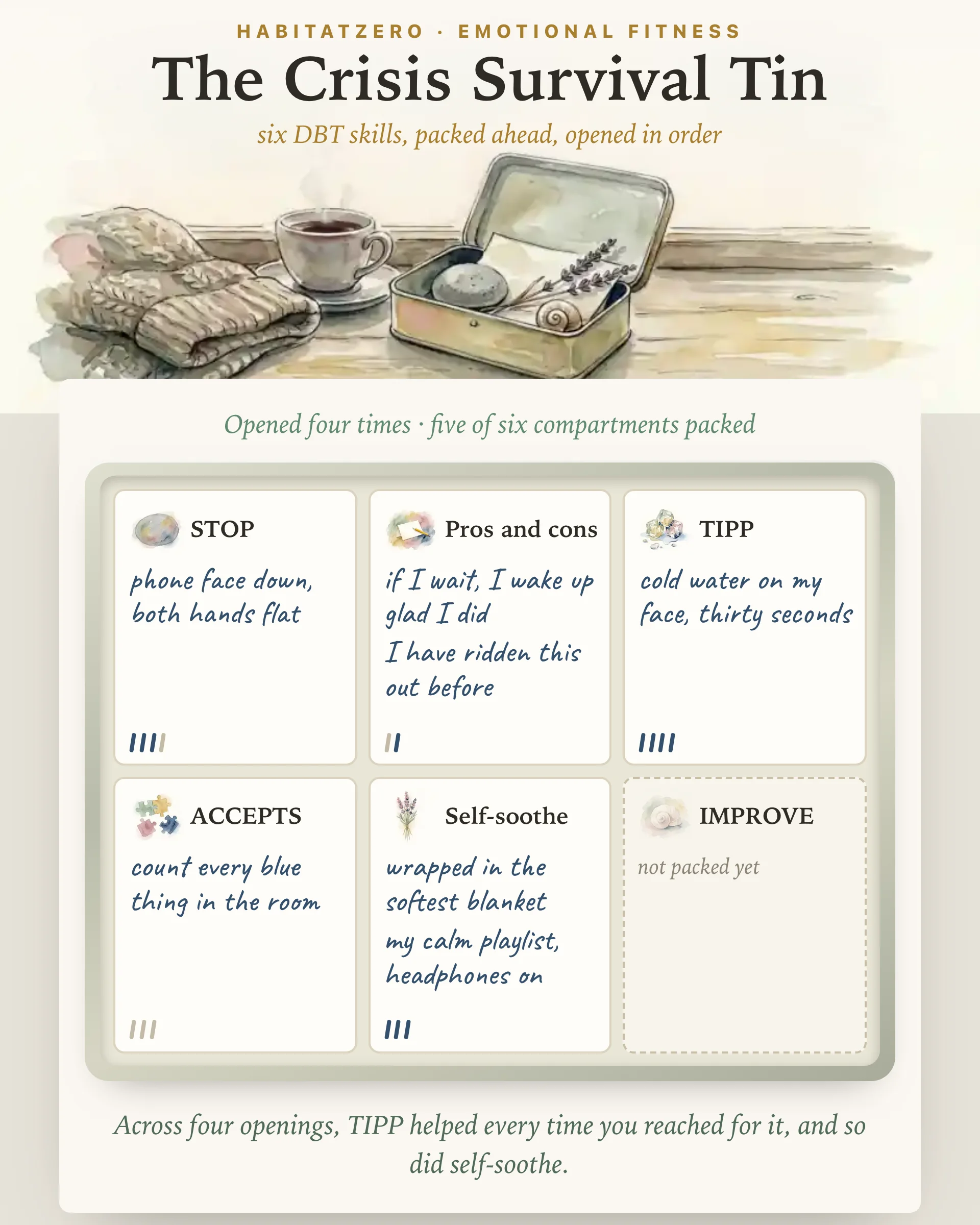
Crisis survival skills belong to dialectical behavior therapy (DBT), the treatment psychologist Marsha M. Linehan developed, and the six skills in this tin follow the distress tolerance handouts in her DBT Skills Training Handouts and Worksheets, 2015 second edition. Two details come from the teen version by Jill Rathus and Alec Miller, which spells TIP with a second P and adds movement to the senses you can soothe. HabitatZero made the tin on its own. Dr. Linehan, Behavioral Tech (the training company she founded) and every other DBT organization had no part in it and have not endorsed it.
Linehan defines a crisis narrowly: highly stressful, short-lived, and pressing you to resolve it right now. The skills are for "tolerating painful events, urges, and emotions when you cannot make things better right away," in her words, not for everyday problems. Their job is smaller and harder: getting you through the next hour without doing something that makes tomorrow worse. Urges peak and then fall, and the skills are there to carry you across the peak.
It is not treatment, and it is not a safety plan. If thoughts of suicide or self-harm are part of your crises, reach a person first, and build a safety plan with a clinician; the Stanley-Brown Safety Planning Intervention is a short plan you write together, covering warning signs, ways to cope, people and crisis services to contact, and how to make your surroundings safer. DBT itself is best learned with a therapist, usually alongside a skills group. If you are in crisis or thinking about hurting yourself, call or text 988 (US) right now, or reach your local emergency number.
Very cold water slows the heart quickly and hard exercise speeds it up. The handout asks you to talk to a doctor before using those two if you have a heart or other medical condition, a heart rate lowered by medication, an eating disorder or an allergy to cold, or if you take a beta-blocker, and to keep the water above fifty degrees.
At the peak of a crisis, choosing is the part that fails, so the tin moves the choosing to a clearer day. Tap a compartment and give it a line or two in your own words, the version you would really do: cold water on your face for thirty seconds, not "temperature." Two lines is the ceiling, and a line lives in only one compartment, so the tin reads at a glance.
When a crisis comes, press open the tin. The packed skills come up one at a time in the handout's order, each with a short reminder. Do the step, mark whether it helped or skip it, and put the tin away once the worst has passed. Every opening leaves notches on the skills you reached for, dark where they helped and pale where they did not, and a line under the tin reads the pattern back, so after a few hard nights you know which compartments carry you. The print button makes a pocket copy.
Most research looks at DBT as a whole rather than at these six skills one by one. Pooling three of Linehan's randomized trials, her team found people in DBT reported three times as much skills use by the end of treatment as people in comparison treatments, and that the rise statistically accounted for the drop in suicide attempts and depression. A later study of seventy people in a year of DBT found more frequent skills use went along with less self-harm at the same time, though the authors could not say which caused which. Both studies followed adults with borderline personality disorder in intensive treatment, so the lesson is modest: skills seem to help when used, and it pays to know which ones you use.
Pack it on a steady evening and look it over once a month. Open it when an urge or a wave of pain is pushing you to act and nothing can be fixed tonight. To ride a single urge out against a clock, Urge Surfing pairs well with the tin. Once the crisis has passed but the fact behind it remains, The Open Hand turns to radical acceptance, the slower skill that follows in the same module, and The Skills Compass shows where these six sit in the rest of DBT.
Six skills from the distress tolerance module of dialectical behavior therapy: STOP, pros and cons, TIP (often written TIPP), distracting with wise mind ACCEPTS, self-soothing through the senses, and IMPROVE the moment. They are meant to carry you through a short, intense crisis without making it worse, not to solve the problem underneath.
Reach for them when the pain is intense and cannot be fixed quickly, when acting on an urge would make things worse, or when you are overwhelmed but still have things you must do. Marsha Linehan is clear that they are not for everyday problems; other DBT skills handle those.
Temperature, intense exercise, paced breathing and paired muscle relaxation. Cold water on the face slows the heart fast and hard exercise speeds it up, so ask a doctor before trying those two if you have a heart condition, a low resting heart rate, an eating disorder or a cold allergy, or take a beta-blocker.
Once your tin is packed, the print button gives you a pocket copy: your own lines in each compartment plus a one-sentence reminder of every skill. Carrying it follows Linehan's own advice to write your pros and cons ahead of time and keep them with you.
The sample tin on this page is open to read. Packing your own compartments, opening them in order during a crisis and keeping the notches all happen after you personalize the template in HabitatZero, at no cost.
By the team behind Fabulous, the science-based self-care app used by over 30 million people.