Leaves on a StreamEmotional Fitness · ~3 min
About this template · Updated September 2026
Wise mind belongs to Marsha M. Linehan. It is one of the mindfulness skills at the center of dialectical behavior therapy, the treatment she developed, and it is taught in her DBT Skills Training Manual. Behavioral Tech, the company she founded, trains mental health professionals to deliver DBT. HabitatZero built this worksheet by itself; Dr. Linehan and Behavioral Tech have not reviewed it and have no connection to it. DBT proper is delivered by trained clinicians, in individual therapy and weekly skills groups. This page is not therapy. It is a place to practice one of its ideas.
DBT describes three states of mind. In emotion mind, a feeling holds the wheel: thoughts run hot, the urge to act feels like certainty, and facts that spoil the mood get left out. In reasonable mind, logic holds the wheel: you plan and count costs, and whatever you feel or care about is treated as a distraction. Most people have a home side.
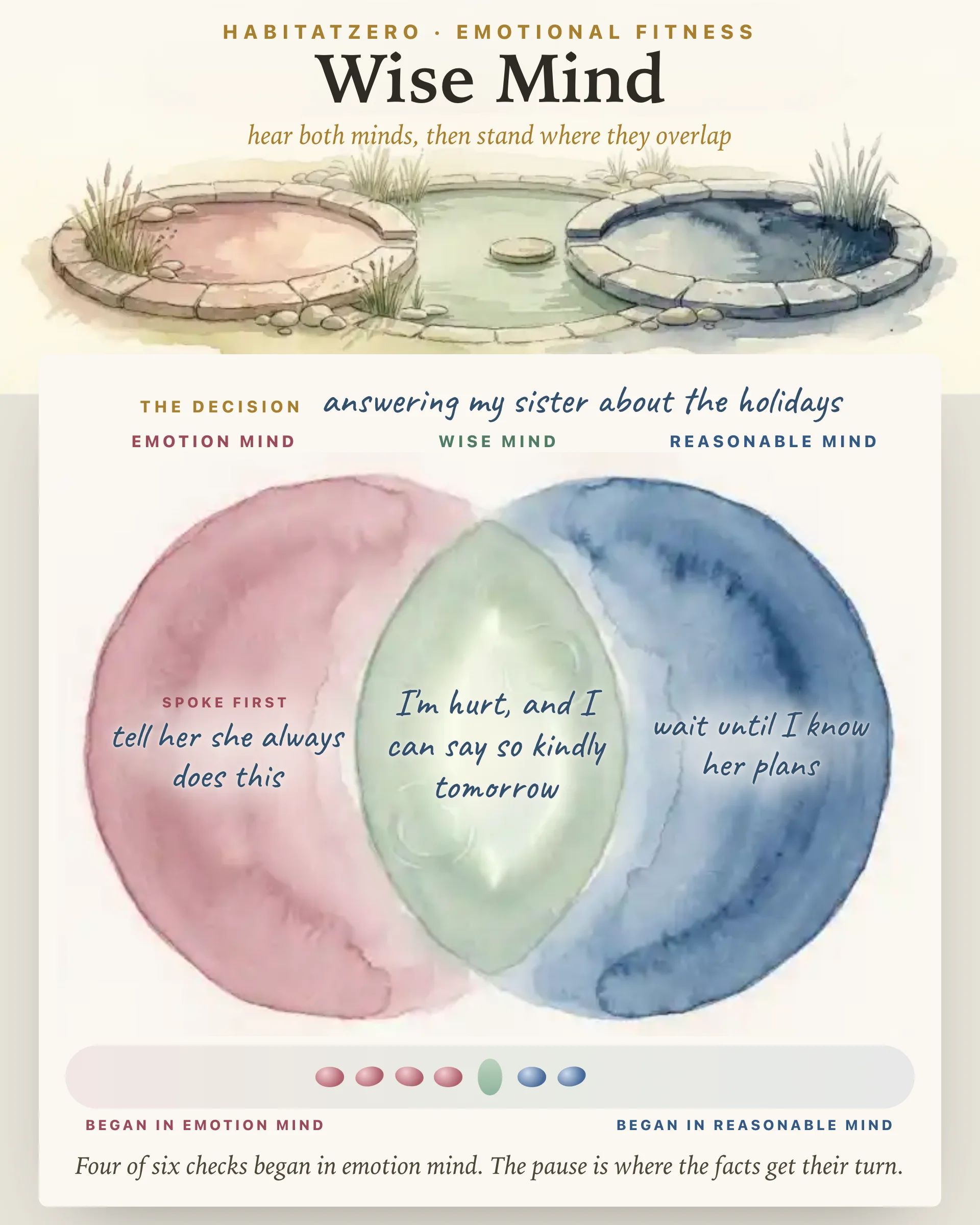
Wise mind is the overlap, which is why the classic wise mind diagram is two circles with a shared middle. It is not a compromise in which each side gives up half its case. It is the state where you see the feeling and the facts at once, and something settles: you know what to do, usually without the pressure that comes with emotion mind. Linehan's handouts call it the wisdom within each person. It is not a rare talent; it is somewhere you already go, and practice shortens the way there.
Wise mind does not always side against the feeling. Sometimes it agrees with the urge and adds the one fact that makes acting on it safe.
The page is built around that diagram, painted as two pools. You bring one decision and tap whichever mind is talking loudest, because that is the one you are standing in. Then you name the decision and give each mind one line in its own pool, from a suggestion or in your own words. The pools refuse to hold the same sentence twice; if both minds agreed, there would be nothing to decide.
Next comes the pause, silent and about a minute long: six slow breaths while a light in the overlap swells as you breathe in and fades as you breathe out. Ask your question on each in-breath and listen on each out-breath without pushing for an answer. That asking and listening is adapted from one of the practices in Linehan's handouts; the pacing and the wording are the page's own. Then you write what you know in the overlap and keep the check.
Every kept check drops a pebble on a shore below the pools, on the side that spoke first, so after a handful you can see your lean, which a printed wise mind worksheet cannot show you. If most pebbles sit on the emotion side, the pause is your most important step. If they collect on the reason side, your work is letting the feeling finish its sentence before you decide.
A major review of decision research found that emotions shape judgment and choice in powerful and fairly predictable ways, sometimes for the worse and sometimes for the better, and proposed a model in which feeling and rational calculation both feed the final choice. Switching emotion off is not an option, and letting it decide alone is not a plan.
On DBT's own mindfulness skills, a scoping review of eleven studies found that mindfulness as taught in DBT raised self-reported mindfulness, non-judgmental awareness in particular, alongside improvement in some clinical symptoms. It also points out that not every study controlled for the group setting, the amount of practice or the rest of the therapy, and that how the change happens is still unclear. None of that tests wise mind on its own, and no page can promise that a minute of breathing produces good decisions. What the practice can do is slow the moment enough for both minds to be heard.
Reach for it before decisions that feel urgent or stuck: the reply you want to send, the favor you want to refuse, the purchase you keep circling. If there is no decision at all, only two true things pulling against each other, Both/And fits better. If you are not sure which DBT skill this moment needs, The Skills Compass will point you to one. And if strong feelings run most of your days, or the choice in front of you carries real risk, bring it to a DBT-trained therapist rather than a page.
Wise mind is a core mindfulness idea in dialectical behavior therapy, the treatment developed by Marsha Linehan. It names the state where emotion mind and reasonable mind overlap, so you can weigh the feeling and the facts together and know what to do. It tends to feel quiet and settled rather than urgent.
In emotion mind, a mood or an urge is steering, so the next move feels obvious and facts that do not fit get dropped. In reasonable mind, logic and plans are steering, and what you feel or value gets treated as noise. Each one carries real information. Wise mind keeps both in view at once.
A message stings at midnight: emotion mind wants to fire back, reasonable mind notes that nobody is awake, and wise mind knows the reply can wait for daylight. You are worn out before a class you paid for: wise mind says go, and go gently. You want concert tickets: yes, paid from the fun budget.
Slow the moment down before you act. Say what the feeling wants and what the facts say, then breathe slowly, asking your question as you inhale and listening as you exhale without forcing an answer. A calm, steady sense of knowing is a good sign, while a pressured, hurried one usually means emotion mind is still driving.
This page lets you look through a filled example of the pools, the pause and the pebble log. Running checks of your own, with the pause and your pebbles saved between visits, happens once you personalize it in HabitatZero, which is free.
By the team behind Fabulous, the science-based self-care app used by over 30 million people.