
The Overwhelm Recovery ProtocolWellness & Routines · ~5 min
About this template · Updated November 2026
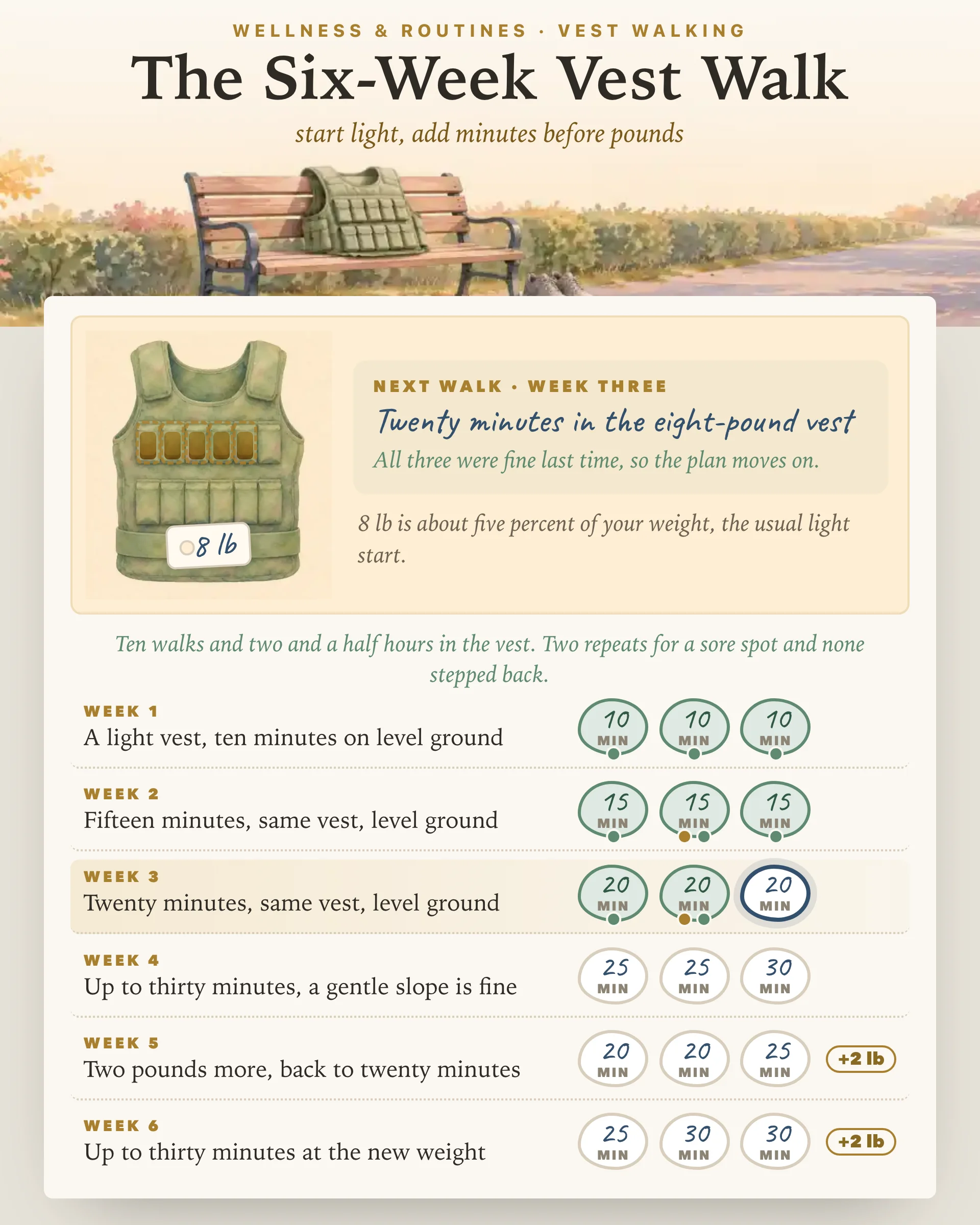
A weighted vest turns an ordinary walk into a slightly harder one. The load sits close to your center, so your arms stay free. The catch is how easy it is to start too heavy and go too long. This page gives you six weeks that begin light, add minutes before they add pounds, and listen to your back, knees and feet after every walk.
Talk with your doctor or a physical therapist first if you have fallen, had dizzy spells, had a joint replaced, or live with a heart or blood pressure condition or pain that keeps coming back. If you have back or neck problems, pelvic floor symptoms such as leaking or a heavy, dragging feeling, or any heart trouble, leave the vest off until a clinician says it suits you. Stop any walk that hurts. Buckle the vest on beside a counter or a sturdy chair you can hold, and check your stance there before you step outside.
A vest also assumes a walking habit is already in place. If half an hour of walking without one still feels like work, build that first. UCLA Health's advice on walking with a weighted vest makes the same point, and suggests keeping your first weighted walks to less than half the length of your usual one.
UCLA Health suggests starting with a vest of about five percent of your body weight, which is seven and a half pounds at most if you weigh a hundred and fifty. Lighter is fine. On the page, slide to your weight and the painted vest outlines five pockets, one for each percent. Set your vest's weight and the pockets fill with gold inserts; from seven percent up they turn rust red, and the sheet suggests a lighter start.
Wear it snug and high, with the load spread evenly front and back. Stand tall before you set off: ribs stacked over your hips, shoulders easy, chin level. If you catch yourself leaning forward or rounding your shoulders, the vest is too heavy or the walk has run too long.
You walk with the vest three times a week, with a day off between. The page counts walks rather than dates, so a missed day simply waits.
The days between are rest from the vest, not from walking.
When you get home, mark three places as fine, a little sore or pain: back and shoulders, knees and hips, feet and ankles. Your answers set the next walk. All three fine, with the full minutes walked, moves the plan on a step. A little soreness anywhere, or a walk cut short, repeats the same walk. Pain anywhere rests the vest and steps the plan back a week, which in week five also means the lighter vest again. If the pain was sharp, or it lingers past a couple of days, get it looked at before you carry weight again.
Every walk lands on a stone along the six-week path, with a dot for each try. After eighteen good walks, round two begins at ten minutes with the weight you finished on.
A vest does make walking harder. In a treadmill study of ten young adults, vests of ten to twenty percent of body weight raised oxygen use and the force through the legs at each step. That was a small lab study, in people far younger than most vest walkers, over minutes rather than months.
Bone is where the claims run ahead of the evidence. A five-year follow-up of nine women who wore vests while jumping found their hip bone density held steady while a comparison group lost some, but that was jumping, not walking, and the groups were tiny. A 2025 randomized trial in 150 older adults who were losing weight had one group wear a vest about seven hours a day for a year, and it did not stop the hip bone loss that came with their weight loss. UCLA Health's article is plain about it: how much the extra weight helps bone is not yet known.
So wear the vest because it makes your walks more of a workout and you like how that feels, not for a promise of stronger bones or a lighter scale. Any change in your weight depends on what you eat, how you sleep and how long you keep moving.
If you are not yet walking on most days, four weeks of unweighted walks builds that base first. Standing tall is half of wearing a vest well, and The Plumb Line Posture Plan works on it with five slow moves. For strength work on the days between, try a twelve-week strength plan for women over 50. And to check your pace without the vest, The Brisk Walking Metronome marks your steps a minute against the brisk line.
A common starting point is a vest of about five percent of your body weight, so no more than seven and a half pounds if you weigh a hundred and fifty. Lighter is fine too. Spend a few weeks adding minutes before you add any weight, and then add it a pound or two at a time.
Keep the first weighted walks well under half of your usual walk without one. This plan opens with ten minutes, three times a week, and works up to thirty over six weeks, always with a day off between vest walks.
The evidence is thin. One older study saw hip bone hold steady in nine women who wore vests while jumping, not walking, for five years. A 2025 randomized trial in older adults who were losing weight found that a vest worn most of the day did not stop hip bone loss. If bone is your reason, ask your doctor what suits you.
It can be, for women who already walk comfortably and stand tall without strain. Back or neck trouble, pelvic floor symptoms such as leaking or a feeling of heaviness, and any heart condition are reasons to get a doctor's clearance first. Start light and stop if anything hurts.
A vest makes each walk a little harder, and a small lab study found it raised the energy walking took. Whether that shows up on the scale depends on what you eat, how you sleep and how long you keep going, so treat the vest as one part of the picture rather than a shortcut.
By the team behind Fabulous, the science-based self-care app used by over 30 million people.


