
The Overwhelm Recovery ProtocolWellness & Routines · ~5 min
About this template · Updated November 2026
Water walking asks nothing you don't already know how to do. You climb into the shallow end, stand tall and walk. What changes is everything around the step: the water carries part of your weight, so your feet land softly, and it pushes back against every stride and every swing of your arms. That pairing suits people easing back into exercise and anyone whose knees or hips grumble on a sidewalk.
This page turns that into six weeks of pool days, from ten minutes to thirty, and keeps your record as a tiled pool floor, one tile for every minute you walk.
The clearest trial is small but careful. Researchers in Western Australia randomly assigned older adults who had not been exercising to land walking, water walking or no exercise, with three center-based sessions a week for six months, building to 150 minutes a week at matched effort. Both walking groups gained aerobic fitness compared with the group that stayed still, and the water walkers gained about as much as the land walkers. Six months after the sessions ended, those gains had mostly faded: a fair case for a habit you can keep over a burst you can't.
Why does slower walking through water still count? A review of forty-two studies on shallow water walking found that walking in water up to the lower chest used more energy than walking on dry land, while the impact through the legs went down. At waist depth the estimate pointed the same way but was less certain.
For people with knee or hip osteoarthritis, a Cochrane review of thirteen trials found that exercise in water brought small improvements in pain, everyday function and quality of life, measured soon after programs that averaged twelve weeks. Small is the honest word. None of this shows that water walking prevents falls, mends a joint or changes your weight, and the trials ran structured programs that may not match a solo visit to the pool. Treat it as good, gentle exercise rather than a treatment.
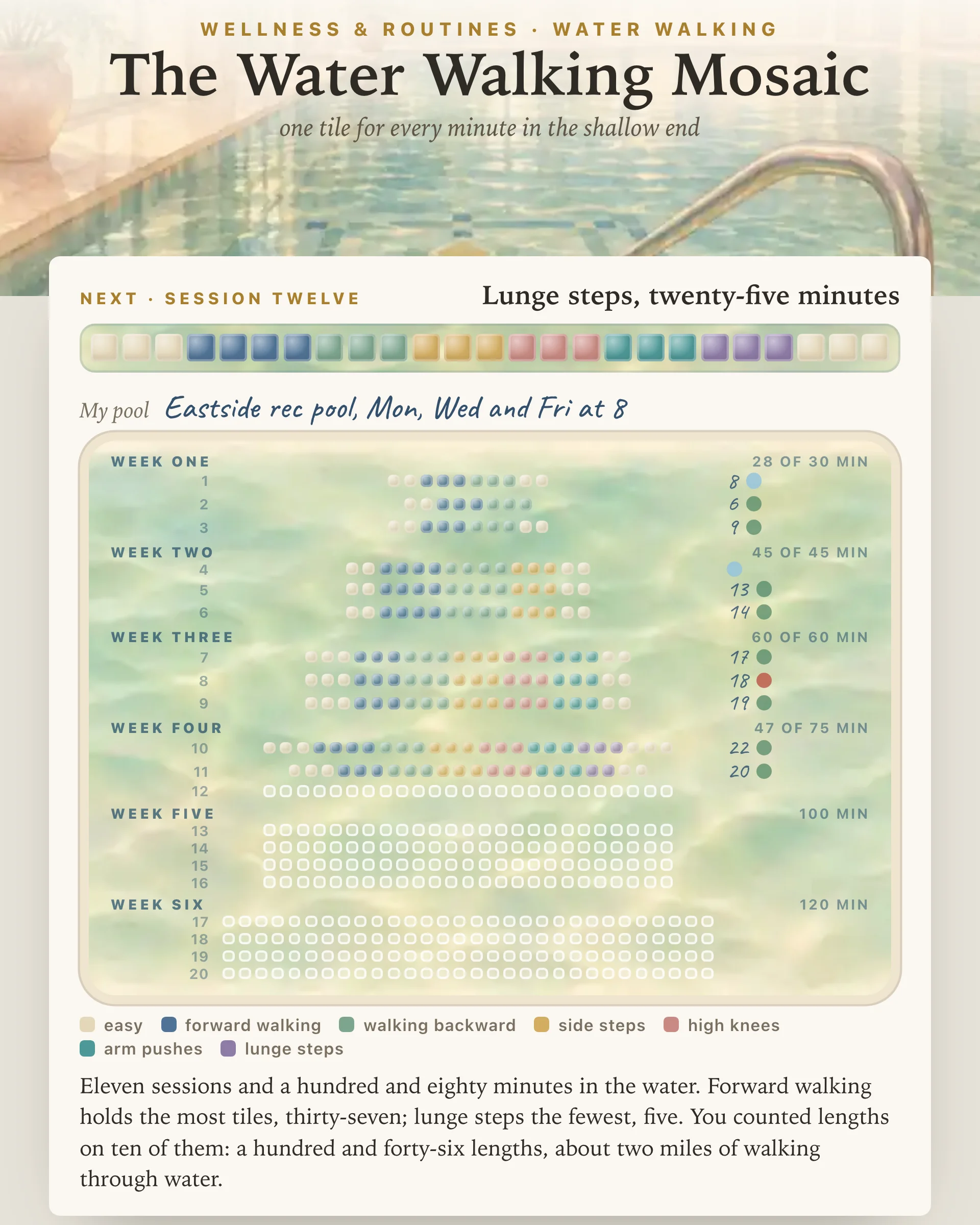
The card at the top is your next session, laid out as a strip of tiles, one per minute: easy walking to warm up, an even share for each move you have kept, and easy walking to cool down. Tap a move to leave it out for now, and switch between waist-deep and chest-deep water to read what changes.
If your phone comes poolside, start the pool clock and set it on your towel at the end of the lane. It keeps real time even with the screen locked and names each move as its turn arrives. Or follow the pool's wall clock and the minutes on the card.
Afterward, set the session into the floor: the minutes you walked, your lengths if you kept count, your pool's length and the talk test. The row fills with colored tiles, and the reading turns your lengths into a distance and notices which moves you lean on and which you skip.
The floor counts sessions rather than dates, so a missed pool day waits for you instead of leaving a hole.
Forward walking means heel down, roll through to the toes. Walking backward goes toes first, with short steps and a glance over your shoulder. Side steps cross the pool sideways; turn around to lead with the other leg. High knees bring each knee toward hip height. Lunge steps are long strides with the back knee bending toward the floor. Arm pushes bring in your upper body: palms press the water ahead, then sweep back.
For effort, use the talk test. Halfway through, you should be able to talk but not sing. If a song would come out easily, walk a little faster or push more water; if only a few words come out, slow down.
Go when a lifeguard is on duty. If you do not swim, stay in the shallow end, where the water reaches your chest at most. Wear water shoes, since decks and pool floors are both slick, and take the steps with a hand on the rail. Before your first pool day, talk with a doctor or physical therapist if you have had a fall, dizziness, a joint replacement, a heart or blood pressure condition, or pain. Keep the wall or the rail within reach for any move that tests your balance, and stop if anything hurts.
Open the card at the pool, set the tiles once you have dried off, and let the floor fill over six weeks. On days the pool is closed, The Living Room Mile keeps you walking at home, and The Balance Ladder works on steadiness at a counter. For gentle land sessions between pool days, try The Low-Impact Stepping Stones. And when walking in the water feels easy, The Poolside Card lays out a full water aerobics session for waist-deep or chest-deep water.
It is walking upright through the shallow end of a pool, usually in water somewhere between your waist and your chest. The water holds up part of your weight, so each step lands softly, while its drag makes your legs and arms work harder than the same pace would on a sidewalk.
Begin with forward walking, heel first, and walking backward with short steps. Side steps, high knees, long lunge steps and arm pushes through the water join over the next few weeks. Changing direction every few minutes uses different muscles and keeps a session from turning into plain laps.
For fitness, it can be. In a six-month trial with older adults who had not been exercising, three weekly sessions of water walking raised aerobic fitness about as much as land walking done at the same effort. The gains faded once people stopped, so a steady pool habit matters more than any one session.
Waist-deep is the easiest place to start, because your feet grip the floor and balance comes naturally. Chest-deep water carries more of your weight and resists more, which can feel kinder to sore knees but asks more of your balance. If you do not swim, keep to the shallow end with a lifeguard watching.
Yes. The picture shows a floor eleven sessions in, and your own copy costs nothing to personalize. It keeps your depth, your moves, your pool length and every session you set, along with the lengths you counted along the way.
By the team behind Fabulous, the science-based self-care app used by over 30 million people.


