
The Overwhelm Recovery ProtocolWellness & Routines · ~5 min
About this template · Updated November 2026
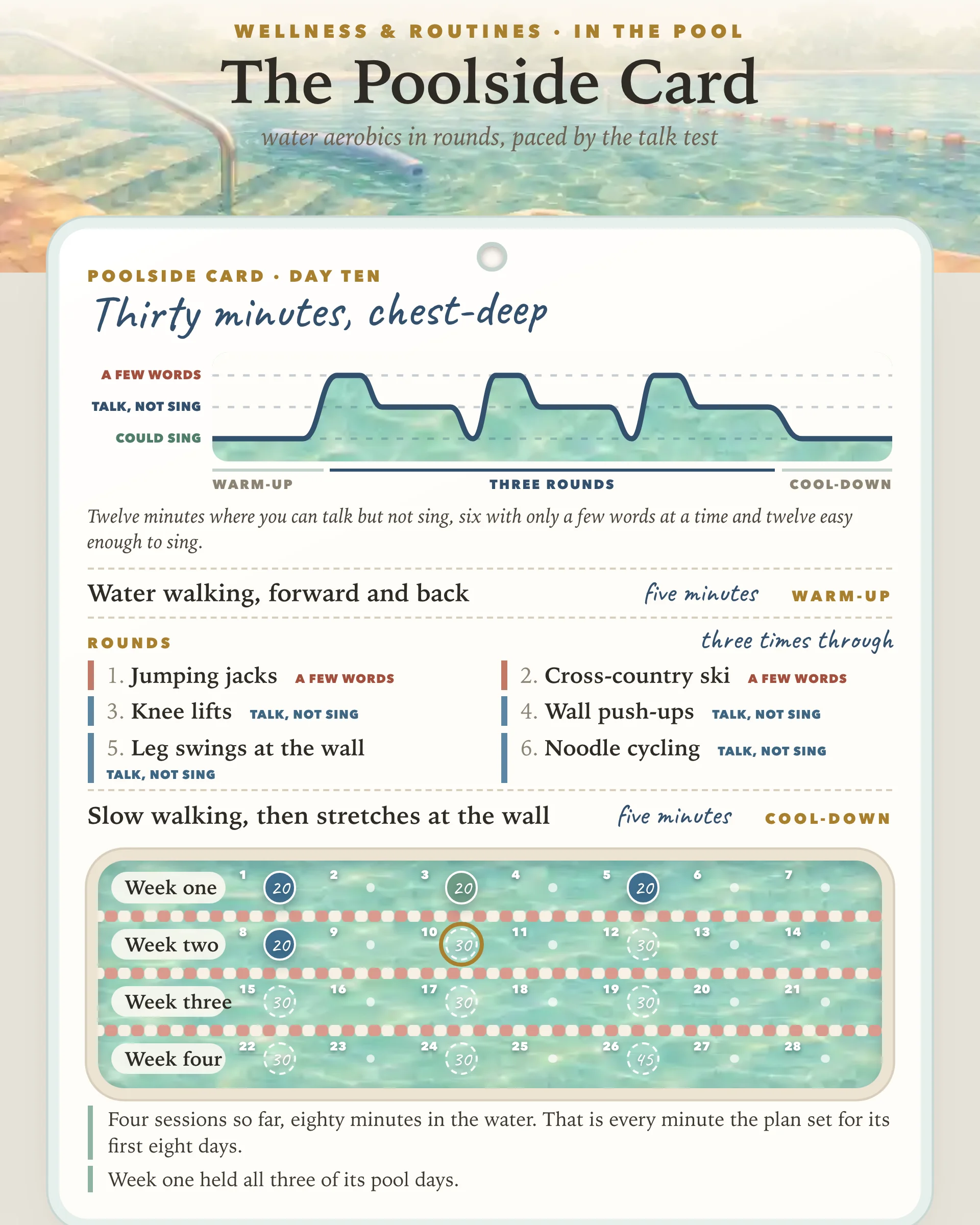
Water aerobics is exercise you do standing in a pool, somewhere between waist and chest depth. The water does two jobs at once: it holds up part of your weight, so landings arrive softly, and it pushes back against every arm and leg you move, so faster moves work your muscles harder. This page turns a short list of water aerobics exercises into a card you set before a pool day and carry with you.
Each round uses three to six of these, one minute apiece:
Every session opens with water walking forward and back, and closes with slow walking and two stretches at the wall.
Waist-deep water at the shallow end gives firm footing and easy balance, with a little more impact on each landing. Chest-deep water carries more of your weight and works your arms harder but sways you more. Pick one, then pick twenty, thirty or forty-five minutes, and the card does the arithmetic: a minute per move, an easy minute of walking between rounds, as many rounds as fit, and the leftover minutes shared between warm-up and cool-down. Thirty minutes with six moves becomes a five-minute warm-up, three rounds and a five-minute cool-down.
A wave across the card draws the session minute by minute at the effort each part aims for, and the line under it adds the minutes up. For that thirty-minute session: twelve where you can talk but not sing, six with only a few words at a time, and twelve easy enough to sing.
The card paces you by your voice. If you could sing, the effort is easy. If you can talk in sentences but not sing, that is moderate, and most rounds belong there. If only a few words come between breaths, you are working hard, which suits a minute of jumping jacks but not a whole session. A review judged the talk test a valid, reliable and practical way to set exercise intensity for healthy adults and people with heart disease. Those studies used treadmills, bikes and stair machines, not pools, so treat it here as a sensible guide rather than a measurement.
The plan gives you three pool days a week with a rest day after each. Week one is three twenty-minute sessions to learn the moves, week two stretches two of them to thirty, week three holds three sessions of thirty, and week four ends with a first forty-five. That is twelve pool days and three hundred thirty-five minutes in the water.
Each week is a lane of a painted pool. After a session, tap its day, say how the talk test went and log it, and its float fills in with a color for your answer. The reading under the lanes totals your minutes against the plan and tells you when to ease off or push the water harder.
A meta-analysis of twenty-four trials of exercise in water in healthy older adults, average age sixty-six, found a moderate benefit for physical function compared with control groups, and results at least as good as exercise on land. Many of those trials carried a high risk of bias, so the real benefit may be smaller. For knee and hip osteoarthritis, a Cochrane review found small gains in pain, disability and quality of life by the end of aquatic exercise programs, with no serious harms reported.
Falls are a separate question. A Cochrane review of exercise for preventing falls in older people found the clearest benefit from balance and functional exercises, and it did not single out pool programs. This card makes no promise about falls. If steadier footing on dry ground is your aim, pair pool days with balance practice on land, such as The Balance Ladder.
Talk with your doctor or a physical therapist before your first session if you have had a fall, dizzy spells, a joint replacement, a heart or blood pressure condition, or pain that keeps coming back. Choose a pool with a lifeguard on duty. If you can't swim, stay in the shallow end, and go chest-deep only where your feet stay sure on the bottom. Keep the wall within reach for knee lifts, leg swings and anything else that tests your balance. Climb out and rest if you feel dizzy or faint, if your breathing frightens you, or if anything hurts.
Set the card the evening before a pool day and log the session once you are home. On the days in between, a short session from the Low Impact Workout plan or The Whole-House Strength Routine keeps you moving on dry land. To add up a week of moving minutes, pool days included, The Aerobic Wreath fills a weekly ring.
Begin with moves that keep your feet on the pool floor and the wall close by: water walking forward and back, knee lifts, wall push-ups, leg swings while holding the edge, and side steps. Once you feel steady, jumping jacks and cross-country ski raise your breathing. A minute of each, two or three times through, is a full first session.
A review of two dozen trials in healthy older adults found that exercising in water improved physical function compared with control groups, and did at least as well as similar exercise on land, though the trials were often of low quality and may overstate the benefit. The water also holds up part of your weight, which people with stiff knees or hips often find kinder.
Somewhere between your waist and your chest. Waist-deep water gives firmer footing and easier balance, while chest-deep water takes more of your weight and cushions jumps but rocks you more. If you cannot swim, stay in the shallow end, where your feet stay planted and the pool wall is within reach.
Twenty to forty-five minutes, two or three times a week, suits most people starting out. This plan opens with three twenty-minute pool days and works up to a first forty-five-minute session in week four, with a rest day after every pool day. Walking or other movement on the days between counts too.
Go by the talk test. If you could sing, the effort is easy. If you can talk but not sing, that is moderate, which is where most of the rounds should sit. If only a few words come at a time, you are working hard, which is fine for a short burst of jumping jacks but a sign to ease off if a whole session feels that way.
By the team behind Fabulous, the science-based self-care app used by over 30 million people.


