
The Overwhelm Recovery ProtocolWellness & Routines · ~5 min
About this template · Updated November 2026
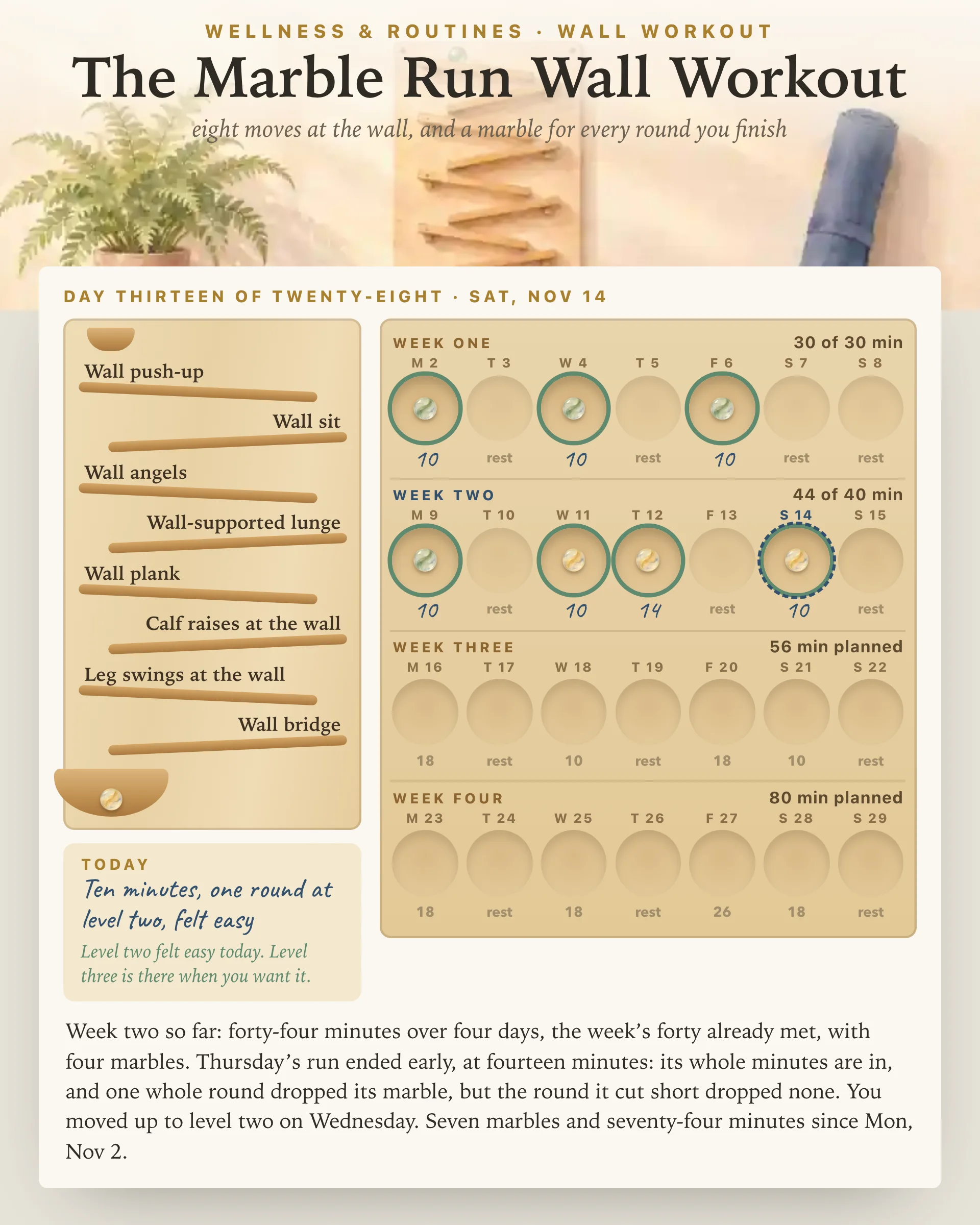
A bare wall is one of the most useful pieces of exercise equipment in your home. It holds part of your weight when you push against it, keeps your back straight when you slide down it, and is right there when you need a hand to steady yourself. These wall exercises make that into a short full-body circuit: eight moves, one minute each, with a tracker that fills as the weeks go by.
The page is built like a wooden marble run hung on the wall, and each of its eight ramps is one move. When you roll the marble, it waits in the funnel through a two-minute warm-up of marching in place, shoulder rolls and ankle circles. Then it rolls along the first ramp while you do the first move, and drops to the next ramp while you rest and read what comes next.
Every ramp lasts sixty seconds, and your level decides how they are split: twenty seconds of work and forty of rest at level one, thirty and thirty at level two, forty and twenty at level three. A round always takes eight minutes, so the plan holds whichever level you choose.
A finished round drops its marble into the cup at the bottom and into today's hollow in a four-week tray. The color tells you the level: sage, gold or rose. After each run, the page asks whether it felt easy, about right or too much, and suggests staying put or trying the next level.
The timer keeps real time, even if your screen locks, and a pause stops it outright. Only what you finished counts: a run you stop early keeps its whole minutes, a move counts once its work time runs out, and a round drops its marble only if every move and rest in it ran to the end. Skip a move that hurts, and that round simply goes unmarked.
From top to bottom, the ramps are a wall push-up, a wall sit, wall angels, a lunge with one hand on the wall, a wall plank on your forearms, calf raises, leg swings, and a wall bridge with your feet on the wall while you lie on the floor. Upper body, legs and trunk take turns, so one rests while the next works.
Each move shows an easier version and a support note. The wall sit can be a few inches of bend. The plank can be done on your hands, standing nearly upright. The bridge has a standing version for anyone who would rather not get down to the floor. If one move appeals, The Wall Push-Up Ladder builds a whole plan around pressing away from the wall, and The 28-Day Wall Pilates Challenge uses the wall for slower core and mobility work.
Week one is a single round, ten minutes in all, on three days. Week two adds a fourth day. In week three, two of the four days take two rounds, and in week four most days do, with one day of three rounds at twenty-six minutes. A run on a rest day still counts, and rounds done away from the page can be added by hand.
The World Health Organization's 2020 physical activity guidelines advise muscle-strengthening work for the major muscle groups on two or more days a week, and for people over 65 they add varied activity that trains balance and strength on three days or more. A wall circuit three or four times a week fits inside that advice; it does not replace walking or other activity that raises your heart rate.
A 2017 review of circuit resistance training pooled ten studies of middle-aged and older adults, about 360 people in all, training roughly three times a week. Lower body strength rose clearly and upper body strength rose a little. The authors noted that shorter, lighter circuits may be easier to keep up than traditional weight training. Those studies did not use wall exercises, and the number of trials was small.
A 2023 analysis of 270 randomized trials found that every type of exercise it looked at lowered resting blood pressure on average, with isometric holds lowering it most, and the isometric wall squat ranked highest for the top number. Those trials ran programs of repeated holds lasting weeks, not a mixed circuit, so this page cannot promise the same result. A hold also raises blood pressure while you do it, which is one more reason to breathe through it.
Use it on any day you have ten minutes and a clear stretch of wall. Keep a sturdy chair within reach, and wear shoes with grip or go barefoot on a floor that is not slippery. If balance is your main concern, The Balance Ladder works on it directly. If the wall sit becomes your favorite, The Sunflower Wall Sit Challenge builds that one hold over thirty days.
Talk to a doctor or physical therapist before you begin if you have had a fall, dizziness, a joint replacement, a heart or blood pressure condition, or pain that does not settle. Stop any move that hurts, and take the easier version for as long as you need it.
They are moves that use a wall to hold some of your weight, steady you or give you something to push against: leaning into it, sliding along it, sitting against it or pressing your feet into it. Because the wall does part of the balancing, they make a gentle way to start strength work at home with no equipment.
For someone starting out, holding a wall sit or pressing away from the wall gives the legs, chest, shoulders and core real work. Once a level feels easy, you make it harder by taking more seconds of work, adding a round or standing farther from the wall. When even level three feels light, weights or harder versions keep you progressing.
Ten minutes is a fair start: two minutes of marching and shoulder rolls, then one round of eight one-minute ramps. This plan adds a second round in week three and a third round once in week four, so the longest day is twenty-six minutes, three or four days a week.
Take the easier version shown under every move, or skip that move and let the round go unmarked. The wall bridge has a standing version done with your hands on the wall. If you have had a fall, dizziness, a joint replacement, a heart or blood pressure condition, or pain, check with a doctor or physical therapist before starting.
Only how each minute is split. The ramp stays sixty seconds long, so a level two or three run takes the same time as level one but asks for more seconds of work. After each run you can say whether it felt easy, about right or too much, and the page suggests whether to stay or move.
By the team behind Fabulous, the science-based self-care app used by over 30 million people.


