
The Overwhelm Recovery ProtocolWellness & Routines · ~5 min
About this template · Updated November 2026
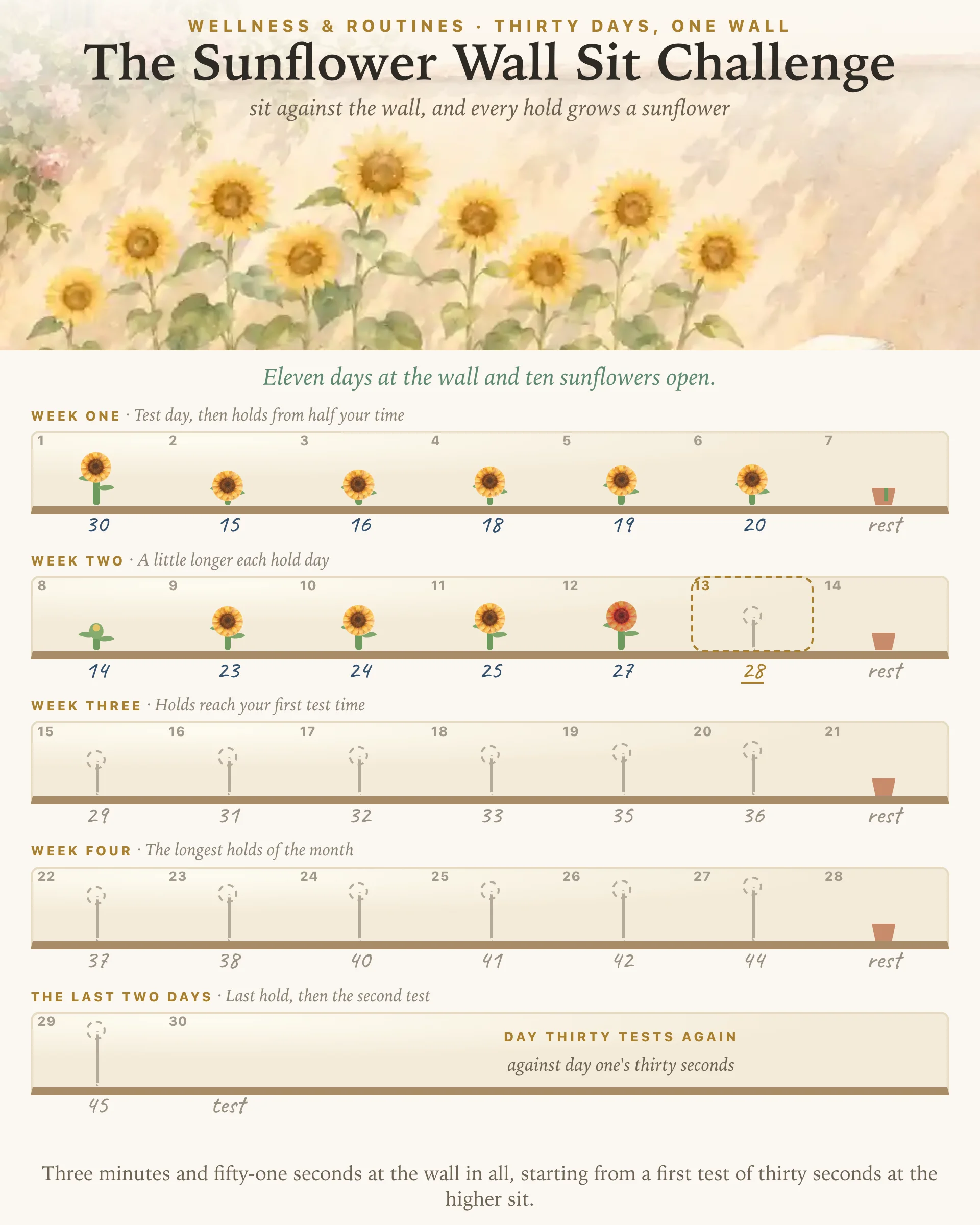
A wall sit asks for almost nothing: a stretch of bare wall, a clock and somewhere between ten seconds and a few minutes of your day. You lean your back on the wall, walk your feet out and slide down as if a chair were waiting under you, then stay there while your thighs do all the work. The tricky parts are knowing how long to hold and turning a month of short holds into something you can see. This page takes care of both.
Stand with your back and the back of your head against a smooth wall, feet about hip-width apart. Walk your feet out roughly two feet, then slide down until your knees sit right over your ankles. Rest your hands on your thighs and breathe the whole time. To finish, push through your heels and slide back up.
Start with a higher sit: knees bent about halfway, hips still well above your knees. The classic picture, thighs level with the floor and knees at a right angle, is the harder version and comes once the higher sit feels easy.
The common mistakes are easy to fix. Knees drifting past your toes means your feet need to go a little farther from the wall. Heels coming up means you slid too low. If you catch yourself holding your breath, count your breaths out loud.
Day one is a test. Tap start, step back to the wall and slide down during the five-second get-set, then hold as long as good form lasts and tap stand up. Those seconds set every target that follows: half your test time on day two, growing a little each hold day to one and a half times your test by day twenty-nine. A thirty-second test means fifteen seconds on day two and forty-five on day twenty-nine. Days seven, fourteen, twenty-one and twenty-eight are rest days, and day thirty repeats the test beside day one.
The timer runs from the real clock, so a phone that locks mid-hold still counts the seconds you actually sat. A hold day stops by itself at its target. Stand up early and the page records only the whole seconds you held, never the target you were aiming for.
Every hold grows a sunflower on the painted wall, as tall as the seconds behind it: yellow for a full hold at the higher sit, amber for one with thighs level. A hold that stopped short stays a bud with its real number underneath, and you can go again right away; the wall keeps whichever hold ran longer. Days still ahead stand in pencil at their target height.
After each hold, say how it felt. Two easy holds in a row at the higher sit is your cue to slide a little lower. A knee that hurt sends you back to the higher sit, with a nudge to check with a clinician if it happens again.
There is no standard number everyone should reach. Your own first test is the honest starting line, which is why the whole plan hangs from it. Targets here stop at three minutes. Past that point, a lower sit asks more of your legs than another minute at the same depth.
A 2023 network meta-analysis of 270 randomized trials found that isometric exercise lowered resting blood pressure more than the other training types it compared, and the isometric wall squat ranked as the most effective form for systolic pressure. A smaller trial had twenty-eight healthy men do four two-minute wall squats, three times a week, at home for four weeks, and their resting pressure dropped by a few points on average.
Read those findings for what they are: group averages under set protocols, such as those four two-minute holds, which ask more than this challenge does. They promise nothing about your own readings. If you live with high blood pressure, treat a new routine as a topic for your doctor and never as a swap for treatment. Your pressure rises during the hold itself, so anyone with a heart or blood pressure condition should check before starting.
Knees deserve the same care. A lab study of weighted wall squats measured more force behind the kneecap at deeper knee angles and suggested a shallower bend when sparing that joint is the goal. Those were moving squats rather than a still hold, but the advice points the same way as the page: begin higher, go lower only when it feels easy, and stand up at once if a knee hurts.
Use it when you want a leg routine that needs no equipment and fits between other things: while the coffee brews, before a shower, during a long call. It pairs well with a four-week push-up plan done at the wall for your upper body. If you would rather keep your legs moving, a squat challenge built on stones and columns trains the same muscles through motion, and if holding still is too much right now, a gentler leg routine with seated and supported versions is a good place to build up first.
Lean your back and head on a wall with your feet hip-width apart, walk your feet out about two feet, and slide down until your knees are right above your ankles. Rest your hands on your thighs, keep breathing, and push through your heels to stand back up. Beginners do best with knees bent about halfway rather than all the way to a right angle.
There is no single right time, so measure your own first. This plan starts each month with a test and asks for half that time on day two, building to one and a half times it by day twenty-nine. Targets stop at three minutes, because past that a slightly lower sit challenges your legs more than extra time does.
A month of short daily wall sits that get a little longer as you go. Most versions follow a fixed chart that ignores where you start. Here the chart grows from your own day-one test, with a rest day every week and a second test on day thirty to compare against the first.
Mostly the quadriceps on the front of your thighs, which hold you up the whole time. Your glutes, hamstrings and calves help keep the position, and your trunk works to keep your back against the wall. Because nothing moves, it is a strength hold rather than a cardio workout.
For most people they are fine with good form, but deeper bends put more load behind the kneecap. Start with the higher sit, keep your knees over your ankles rather than past your toes, and stand up the moment a knee hurts. If you have a knee replacement or ongoing knee pain, ask a doctor or physical therapist first.
By the team behind Fabulous, the science-based self-care app used by over 30 million people.


