
The Overwhelm Recovery ProtocolWellness & Routines · ~5 min
About this template · Updated November 2026
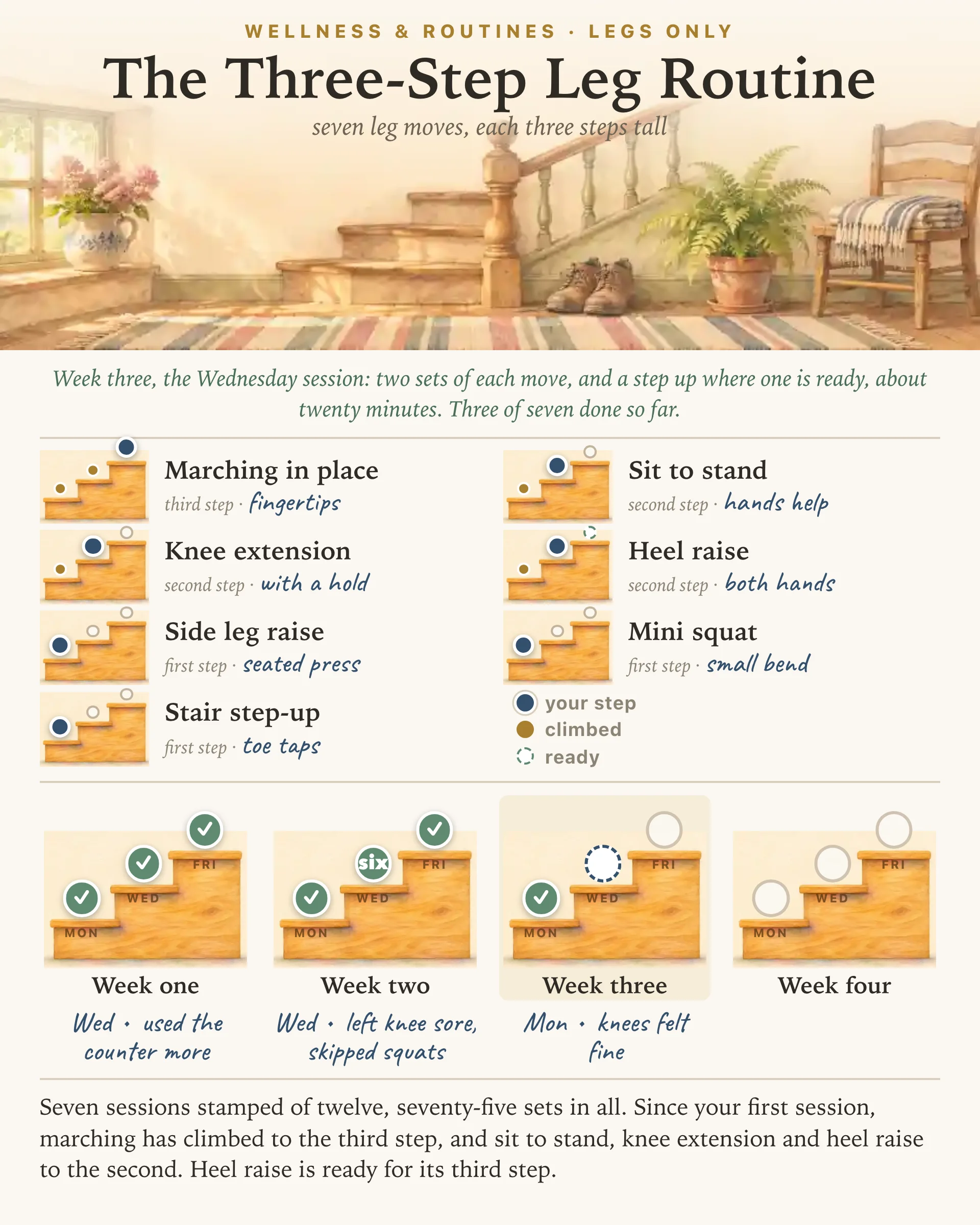
Most of what your legs do all day is push you up: out of the armchair, up the porch step, onto your toes for the top shelf. Leg exercises for seniors rehearse exactly those jobs, and they work best when every move has an easier way in. This page gives you seven leg moves, each drawn as a small staircase of three steps, and a four-week plan of three short sessions a week.
The first step of each move is the gentlest version, usually done sitting down. The second has you standing with both hands on the counter or the rail. The third keeps the support close but asks less of it, often just your fingertips.
No staircase at home? Swap the last move for an extra set of marching.
Each move in today's list has its own little painted staircase: a blue mark for the step it is on, gold marks for the steps it has climbed. Open a move for its one-line how-to and the repeats to aim for, then check a box for each set. Week one asks for one set of each move, weeks two and three for two, and week four for three where you feel steady.
After each move, say how it felt: hard to finish, about right, or easy. Two easy sessions in a row on the same step mark the next step as ready. You climb when you choose to, and staying put is always allowed. Two hard sessions in a row bring a suggestion to go gentler instead. Change a move's step partway through a session and the sets checked on the old version are cleared, because the new version is a different exercise.
Finishing stamps the session onto that week's stairs, along with any word you added. Pick Monday, Wednesday and Friday, or another three days with rest between them. Below the plan, a short reading counts your sessions and sets and names the moves that have climbed.
Leg muscles respond to training even very late in life. In a small and much quoted study, ten frail nursing home residents with an average age of ninety trained their thigh muscles hard for eight weeks, and the nine who finished more than doubled their strength. It had no comparison group and used weight machines at high effort, so it shows what is possible, not what this page will do.
Falls deserve careful wording. In a New Zealand trial, women aged eighty and over who were given an individually tailored home program of strength and balance exercises by a physical therapist had fewer falls over the following year than women who received social visits. A later Cochrane review of 108 trials found strong evidence that balance and functional exercise lowers the rate of falls in older people living at home, while the effect of programs built mainly on resistance training remained uncertain. This page is mostly leg strength, it is not tailored to you by a therapist, and it makes no promise about falls.
The World Health Organization's 2020 guidelines suggest that people over 65 do varied activity with an emphasis on balance and strength on three or more days a week. Three leg sessions cover part of that, and walking or balance practice on other days covers more.
Check with your doctor or a physical therapist before starting if you have had a fall, feel dizzy at times, have a replaced hip or knee, live with a heart or blood pressure condition, or have pain in your legs, hips or back. If any move hurts, stop it there and leave it out until someone has had a look. Breathe out as you push, wear shoes with good grip, and stand where a sturdy chair or the counter is close enough to grab.
Open the page on your three leg days, with the chair, the counter and the bottom stair close by. If you want the arms and back worked too, The Whole-House Strength Routine covers the whole body around your home. If standing is hard right now, The Chair Circuit keeps everything seated. And because the research leans toward balance for steadiness, The Balance Ladder makes a good partner on the days in between. To see how your legs are doing over the months, The Thirty-Second Chair is a short self-check you can repeat and compare only with yourself.
The ones that copy daily life pay back the most: getting up from a chair, rising onto your toes, straightening the knee, lifting a leg out to the side, a small squat, stepping onto a stair and marching in place. Every one of them here has a seated or easiest version, so nobody has to start in the middle.
Choose a handful of leg moves, repeat them two or three days a week, and make each one a little harder only once it feels easy. This page builds that in: three versions of every move, and a nudge to climb after a move has felt easy two sessions in a row.
Yes. Seated marching, knee extensions, heel raises, pressing the knees outward against your hands and a partial sit to stand all work from a sturdy chair, and together they form the first step of most moves on this page. Stay seated for as long as that feels right.
World Health Organization guidance asks people over 65 for balance and strength work on three or more days a week. This plan follows that rhythm with three short sessions and a rest day between them, from about fifteen minutes a session in week one to twenty-five in week four.
Plenty of people with achy knees do moves like these, but see a doctor or physical therapist first if you have knee pain, a replaced joint, a recent fall or dizzy spells. Keep each bend small, stop if anything hurts, and keep a hand near the counter whenever you stand.
By the team behind Fabulous, the science-based self-care app used by over 30 million people.


