
The Overwhelm Recovery ProtocolWellness & Routines · ~5 min
About this template · Updated November 2026
Walking with weights sounds like an easy upgrade: grab a pair of dumbbells, head out the door, and every walk counts for more. The truth is smaller and more useful. Light hand weights, moved through a real arm pattern, make a walk a little harder. Carried along at your sides, or squeezed tight, they mostly add strain. This page gives you six weeks of walks where the weights work one minute at a time, at one to three pounds, with a shoulder check after every walk.
Talk with a doctor or physical therapist before you start if you have shoulder, elbow or wrist pain, a heart or blood pressure condition, or trouble with your balance. Weights in your hands push blood pressure up a little, they load joints that may already be sore, and they keep your hands busy at the moment you might need them to catch yourself. If your balance is shaky, walk with your hands free. Stop the arm work if anything hurts, and end the walk if you feel dizzy or unusually short of breath.
One to three pounds in each hand is the whole range here. Heavier ones tend to pull the swing out of line and tug at your shoulders and elbows; save them for strength work done standing still. Week one is for learning the movement with empty hands or a single pound.
Hold the weights loosely, as you would carry a cup of coffee, fingers relaxed. A tight grip is a small effort of its own. Wrist weights strap on and spare your grip entirely, and so do soft weights with a hand strap.
Every walk opens with five easy minutes. Then come the arm minutes, each followed by two easy minutes with a natural swing:
Pick the patterns you like and the page rotates through them. Week one has two arm minutes in each twenty-minute walk. By week six there are six, on walks of thirty-five minutes, four days a week.
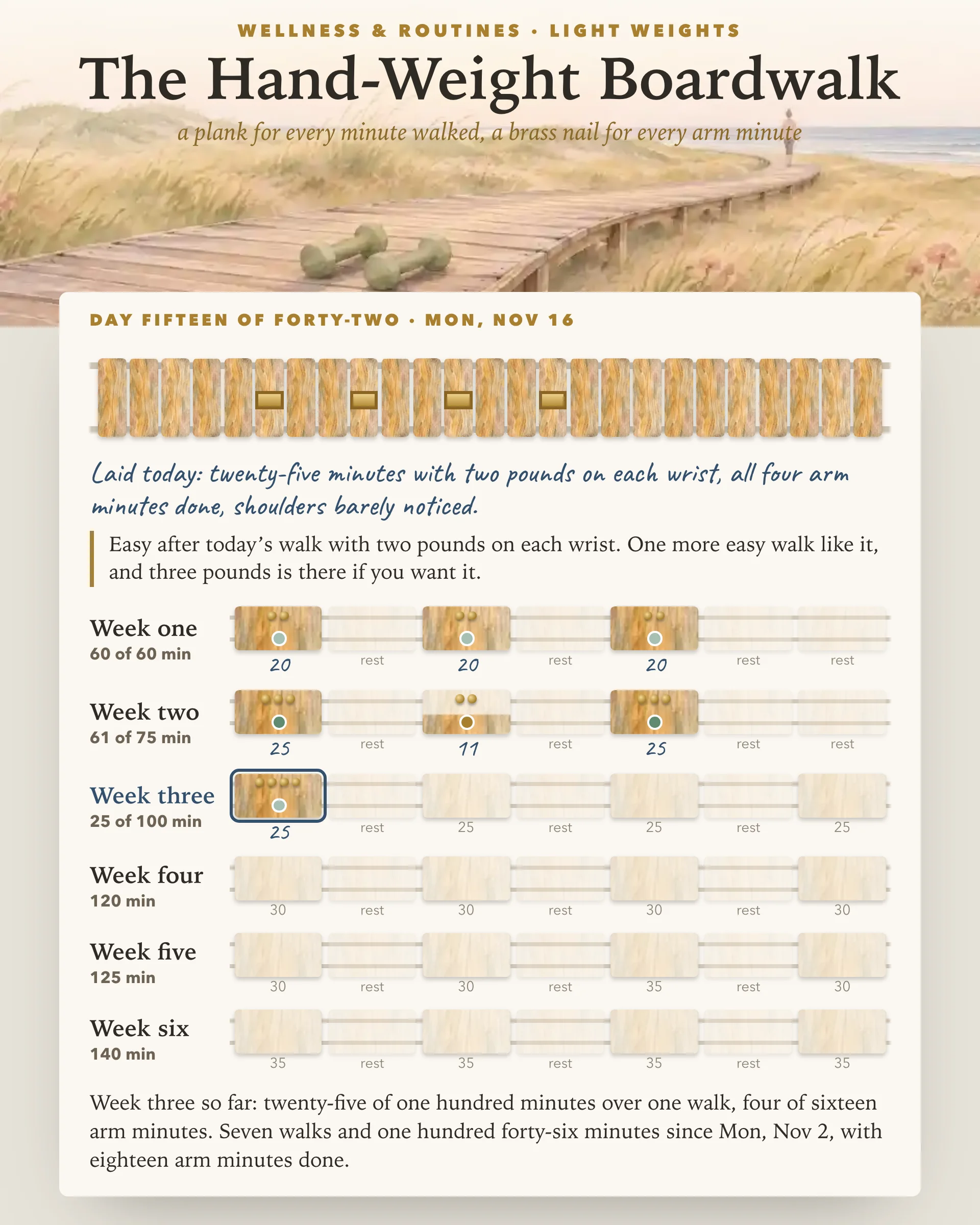
Today's walk is a row of painted planks, one for each minute, with brass bands across the arm minutes. Start it and it runs on a real clock, so a locked phone keeps true time, and a pause stops the clock outright. Each plank fills in as you walk its minute. An arm minute counts only once you finish all of it, and if you end a walk early, only your whole minutes go on the boardwalk.
Back home, say how your shoulders felt: barely noticed, worked but fine, achy, or sore, and the page suggests your next weight. Two easy walks in a row at the same weight offer one pound more. Achy shoulders suggest a pound less, or pumps in place of presses. Sore shoulders send you back to empty hands, and if the soreness lingers, to a doctor or physical therapist.
The six-week boardwalk lays one plank a day. It fills with the minutes you walked and takes a brass nail for each arm minute you finished.
Hand weights do make walking harder, though not by much. In a treadmill study of twelve sedentary young men, three-pound weights held in the hands or strapped to the wrists both raised oxygen use and heart rate above walking with nothing, though it felt no harder to them. Only the hand-held pair pushed diastolic blood pressure up, by about four points. When eleven adults with obesity walked for half an hour, hand weights raised the energy they used by roughly seven percent, and a bigger arm swing without weights changed nothing measurable. The authors called the gain small.
Age changes the picture. In nineteen adults averaging sixty-six years, heart rate and blood pressure climbed as the hand weights got heavier, starting at a single pound, while oxygen use rose only from three pounds up. The authors suggested hand weights may not suit older people with known or suspected heart disease.
All three were short lab sessions in small groups. None followed anyone for weeks, so they say nothing about whether hand weights build strength, protect bone or change body weight. For strength, the federal physical activity guidelines ask adults for muscle-strengthening activity, such as lifting weights or push-ups, on at least two days a week. Light weights on a walk keep your arms working for a few minutes; they don't stand in for that.
To carry the load on your body instead, The Six-Week Vest Walk builds up a weighted vest just as patiently. To check your pace before adding anything, The Brisk Walking Metronome has you tap each step for a minute. For real resistance on the days between, The Resistance Band Rack works your arms and legs in sets. If you would rather keep your hands free, The Half-Pound Ankle Cuffs adds light weight at the ankles instead.
It can make an ordinary walk a little harder. In small lab studies, light hand weights moved through a real arm swing raised heart rate and oxygen use a bit above the same walk empty-handed. The gain is modest, it comes from moving your arms rather than just holding the weights, and blood pressure rose a little too. Treat them as a way to vary a walk you already enjoy.
One to three pounds in each hand. Spend the first week with empty hands or a single pound while you learn the arm swing, and add a pound only after two walks in a row where your shoulders barely noticed the work. Anything heavier belongs in strength work done standing still.
Wrist weights strap on, so your fingers can stay open and relaxed the whole way. In one treadmill study they added about as much work as hand-held weights of the same size, and only the hand-held pair nudged diastolic blood pressure up. Small dumbbells are fine if you hold them loosely, like a cup of coffee.
Not much. A pound or two keeps your arms busy for a few minutes, but strength comes from heavier loads lifted with control. The national guidelines ask adults for muscle-strengthening activity, such as lifting weights or push-ups, on at least two days a week, alongside their walking.
Check with a doctor or physical therapist first if you have shoulder, elbow or wrist pain, a heart or blood pressure condition, or trouble with your balance. In a study of adults averaging sixty-six years, heart rate and blood pressure climbed as the weights got heavier, and an unsteady walker needs free hands to catch a stumble.
By the team behind Fabulous, the science-based self-care app used by over 30 million people.


