
The Overwhelm Recovery ProtocolWellness & Routines · ~5 min
About this template · Updated November 2026
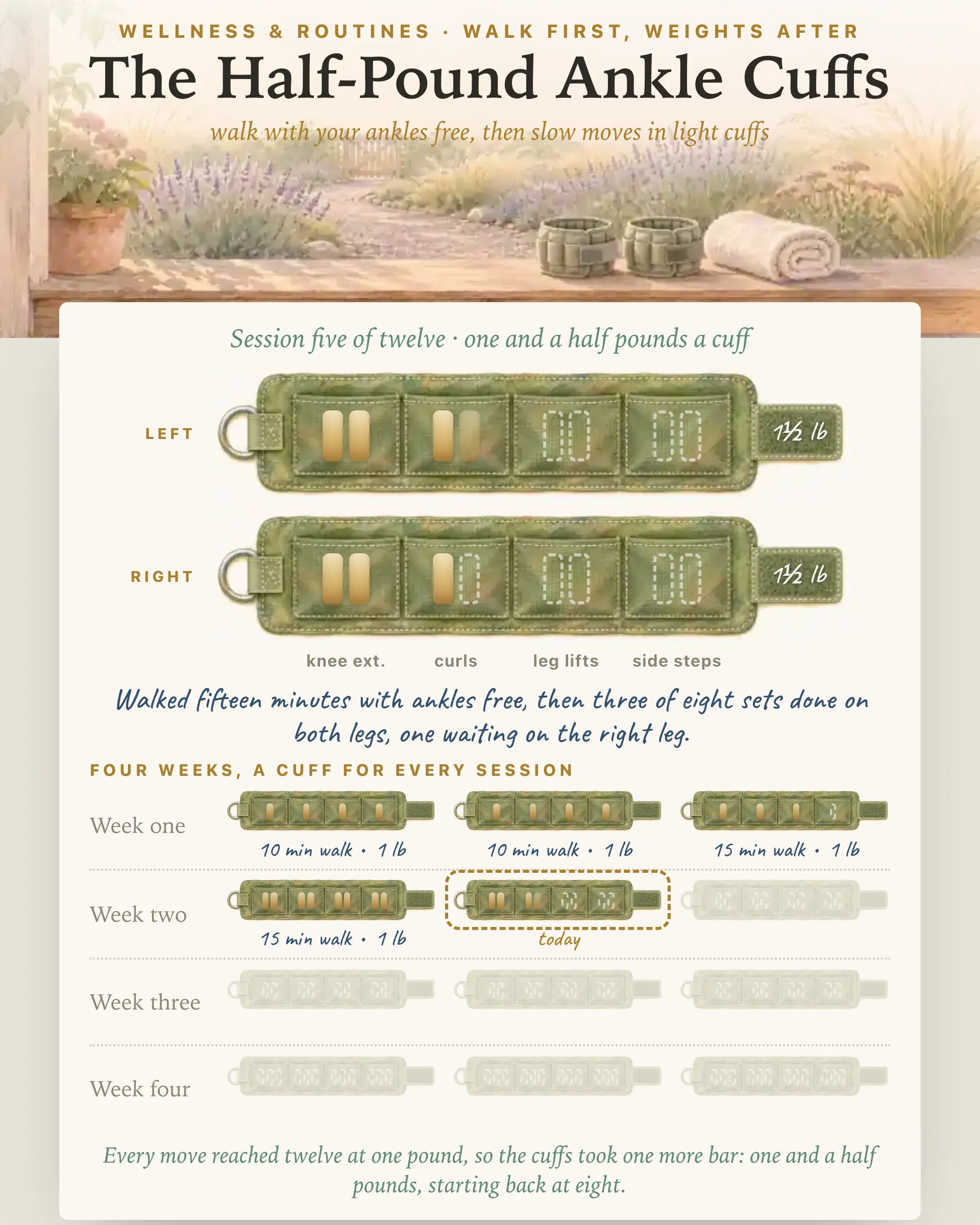
Walking with ankle weights looks like a free upgrade: same walk, more work. The trouble is where the weight sits. A cuff at the ankle rides at the far end of your leg, and every stride has to swing it forward and stop it again. This page splits the job in two. You walk with your ankles free, then you strap on a light pair for four slow leg moves at home, and the sheet keeps track of every set, leg by leg, for four weeks.
Think of your leg as a lever hinged at the hip. A pound near the hip barely changes the swing, while the same pound at the ankle asks the muscles that start and stop each stride to do noticeably more. A brisk pace repeats that extra effort a few thousand times an hour.
Lab work backs up the mechanics, within limits. When nineteen young adults walked with two or four pounds strapped to each shin or thigh, the lighter loads changed little, while the heavier ones changed how the knee and ankle moved early in each swing and how the hip moved through the whole stride. A physical therapist quoted in a medical school's consumer health guide advises against wearing them on walks at all, because the pull at the ankle can strain tendons and ligaments and the front of the thigh ends up doing more than its share.
Here is what the evidence does not show. No one has followed people who walk briskly in cuffs for months and counted sore knees or hips, so the caution rests on mechanics and clinical experience, not on injury trials. Some small studies even found gains: in a twelve-week trial with thirty-six older adults, those who added ankle weights to pole walking twice a week improved grip strength and muscle measures more than the poles alone, though not chair standing or walking speed. If you do walk in them, keep them light, the route level and the pace easy, and take them off when a joint complains. This plan simply keeps the walk free.
Slow moves, done with control, are where a pound or two makes sense. A Cochrane review of 121 trials with about 6,700 older adults found that progressive strength training two or three times a week raised muscle strength a good deal, helped people rise from a chair, and nudged walking speed up a little. Joint pain and muscle soreness were common where trials tracked them. Most of those programs also used heavier loads than a light cuff, so treat these weights as a gentle starting point rather than the dose the trials tested.
The four moves:
At the top, tap the half-pound bars in your cuffs, from none up to ten. Below them, two painted cuffs stand for your left and right legs, with a pocket for each move. Tap the minutes you walked, then work through the moves and check off each side as you finish it. A set counts only once both sides are done; until then its bar stays pale on the side you finished. While a set is half done, the weight stays locked, so every finished set keeps the weight you actually used.
After a move's sets, say how it felt. Easy or about right, with every set done, lifts that move from eight reps to ten, then twelve. When every move reaches twelve, the page suggests one more bar in each cuff and a fresh start at eight. A move that ached comes back next time with no cuff, and if it aches even then, the page tells you to leave it out and ask first. A short note carries over to your next session.
Logging leaves a small cuff on the four-week board, its pockets filled with the sets you finished, and a reading adds up the sessions, minutes and sets.
Open it three days a week with a rest day between. For more ways to shape the walk itself, The Walking Workout Ribbon times easy and brisk stretches. If any of these moves feels like too much standing, The Three-Step Leg Routine starts each leg exercise seated, and The Resistance Band Rack is another light way to add load. If you would rather carry the weight on your body than at your ankles, The Six-Week Vest Walk builds up a weighted vest slowly.
Talk to a doctor or physical therapist before you begin if you have had a joint replacement, a fall, dizzy spells, a heart or blood pressure condition, or pain in a knee, hip or ankle. Stop any move that hurts, and keep the counter or a solid chair within reach whenever you stand.
Nobody has followed people who walk briskly in ankle weights for months and counted knee or hip problems, so there is no firm answer. Lab studies show that heavier loads near the ankle change how the hip, knee and ankle move with each stride, and physical therapists often advise against walking in them. This plan keeps the walk weight-free and saves the cuffs for slow moves.
One to two pounds on each ankle, or none at all while the moves are new. Add half a pound only when every set of every move reaches twelve slow reps and feels easy or about right. This plan tops out at five pounds a leg.
Slow moves that load one muscle group at a time: seated knee extensions for the front of the thigh, standing hamstring curls for the back of it, and side leg lifts and side steps for the outer hip. Keep a hand on the kitchen counter for every standing move.
Two or three days a week, with a rest day in between, suits most people. Here that means three sessions a week for four weeks, each one opening with a walk and closing with the four moves.
Yes, personalizing it costs nothing. The filled sheet on this page shows week two halfway through, and your own copy keeps every cuff you log along with the weight of each set and your notes.
By the team behind Fabulous, the science-based self-care app used by over 30 million people.


