
The Overwhelm Recovery ProtocolWellness & Routines · ~5 min
About this template · Updated November 2026
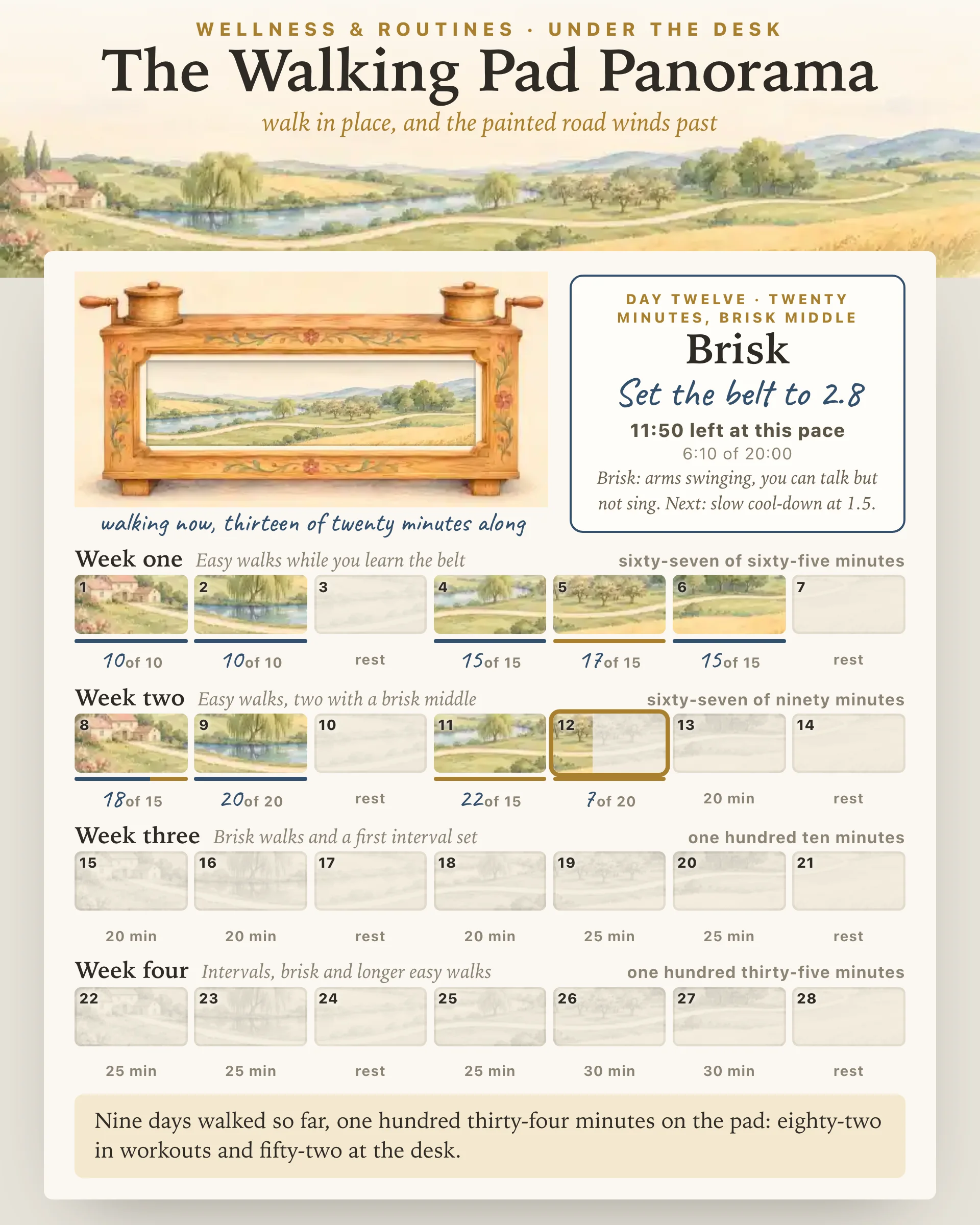
A walking pad is a slim, low treadmill that slides under a desk or a couch when you are done. Its belt is usually level and its top speed modest, so it suits steady walking, changes of pace and long easy stretches while you work. The trouble is that walking in place goes nowhere, and twenty minutes facing a wall can feel like an hour.
This page gives the walk somewhere to go. A small wooden scroll box sits at the top, the kind storytellers crank to show a painted journey through a window. Every whole minute you walk winds the painted road a little further, until today's planned minutes bring you to the far hills.
First choose how you are walking today. A workout is a set session of ten to forty minutes with one of three patterns: easy and steady, a brisk middle, or intervals of one brisk minute and two easy ones. The page lays out each stretch with the number to set on the belt and estimates how far those settings carry you. You set the slow, easy and brisk numbers yourself, since the same reading feels different on every pad.
Desk walking is for the workday. You stand up, roll the chair away, hold the desk while the belt starts at its slowest, and only then tap to start counting. Each stretch adds its whole minutes, so twelve minutes and forty seconds adds twelve. A pause for a phone call never counts, and a stretch ends itself at an hour so a forgotten clock cannot invent minutes.
The clock keeps real time. If your phone locks or the tab slips into the background, it catches up from the moment you started, less your pauses. End a workout early and it keeps the whole minutes you walked; run it to the end and it keeps the full length.
The plan runs five days a week for four weeks, from ten minutes a day to thirty. Week one is easy walking while you learn the belt, week two adds a brisk middle on two days, week three brings a first interval set, and week four mixes intervals with longer easy walks. Day one begins with your first walk.
Desk minutes count toward each day just as workout minutes do, but the page keeps them apart. Four strips of the same painted road hold the four weeks, one frame per day. A frame fills with color as that day's minutes reach the plan, and a thin line under it splits workout minutes from desk minutes. A short reading adds up your days and compares them with what the plan asked.
Easy should feel like a pace you could chat at. Brisk is a pace where you can talk but not sing, and the CDC's guide to measuring activity intensity lists brisk walking at about 2.5 miles an hour or faster as moderate intensity. With a level belt, speed is the only lever in the intervals. For desk walking, pick a setting slow enough that your hands stay steady on the keyboard.
If you would rather walk without a machine, the Indoor Walking Workout turns a living room into a marching route, and the Walking Workout times a walk outdoors or down a hallway. For a long goal outdoors, The Half Marathon Flyway builds toward 13.1 miles.
One study followed forty office workers at a financial services company in Minnesota for a year after they were given treadmill desks with a top speed of two miles an hour, half of them several months before the rest. Their time spent sitting still fell by about seventy-seven minutes a day, and both they and their supervisors rated their work a little higher after an early dip. Only about one in ten of the employees invited took part, the group was small, and nobody recorded how often each desk was used, so it shows what can happen for keen volunteers rather than for everyone.
In a single lab session, twenty young adults did office tasks both seated and walking at a treadmill desk: typing, mouse work and math scores dropped by six to eleven percent while walking, while attention and reading held steady. It says nothing about how that changes with weeks of practice.
A Cochrane review of ways to reduce sitting at work, covering 34 studies and 3,397 workers, found that treadmill desks combined with counseling seemed to cut sitting time, but that active workstations overall had unclear or inconsistent effects, on low-certainty evidence. It did not look at illness or weight, so none of this shows that a walking pad will change your health on its own.
Ask a doctor or physical therapist before you begin if you have had a fall or dizzy spells, a joint replacement, a heart or blood pressure condition, or pain when you walk. Keep the chair clear of the belt, start at the slowest setting, and hold the desk or rail each time you step on or off. Stop walking if you feel dizzy, short of breath, chest discomfort or any pain.
On days the belt stays folded away, Desk Exercises offers two-minute moves for an office chair.
Begin with ten minutes: two slow, six at an easy pace you could chat through, and two slow again. Add about five minutes a week, and bring in a brisk middle or short intervals once the easy pace feels comfortable on your feet.
Go by how the pace feels rather than one fixed number. Easy means you can hold a conversation, and brisk means you can talk but not sing, which the CDC places at about 2.5 miles an hour or faster. For walking while you type, choose a slower setting that keeps your hands steady.
Yes, if you keep the belt slow enough to type at. In a lab study, typing and mouse work ran a little slower while walking, while attention and reading held steady. Start with short stretches and keep a hand on the desk as you step on and off.
They do. A day's minutes can come from one workout, from several desk stretches, or from both. The page keeps workout minutes and desk minutes apart so you can see how each day was split, and it counts only whole minutes.
It can be, with care. Ask a doctor or physical therapist first if you have had a fall, dizzy spells, a joint replacement, or a heart or blood pressure condition. Start the belt at its slowest, hold on while stepping on and off, and stop if you feel dizzy, short of breath or any pain.
By the team behind Fabulous, the science-based self-care app used by over 30 million people.


