
The Overwhelm Recovery ProtocolWellness & Routines · ~5 min
About this template · Updated November 2026
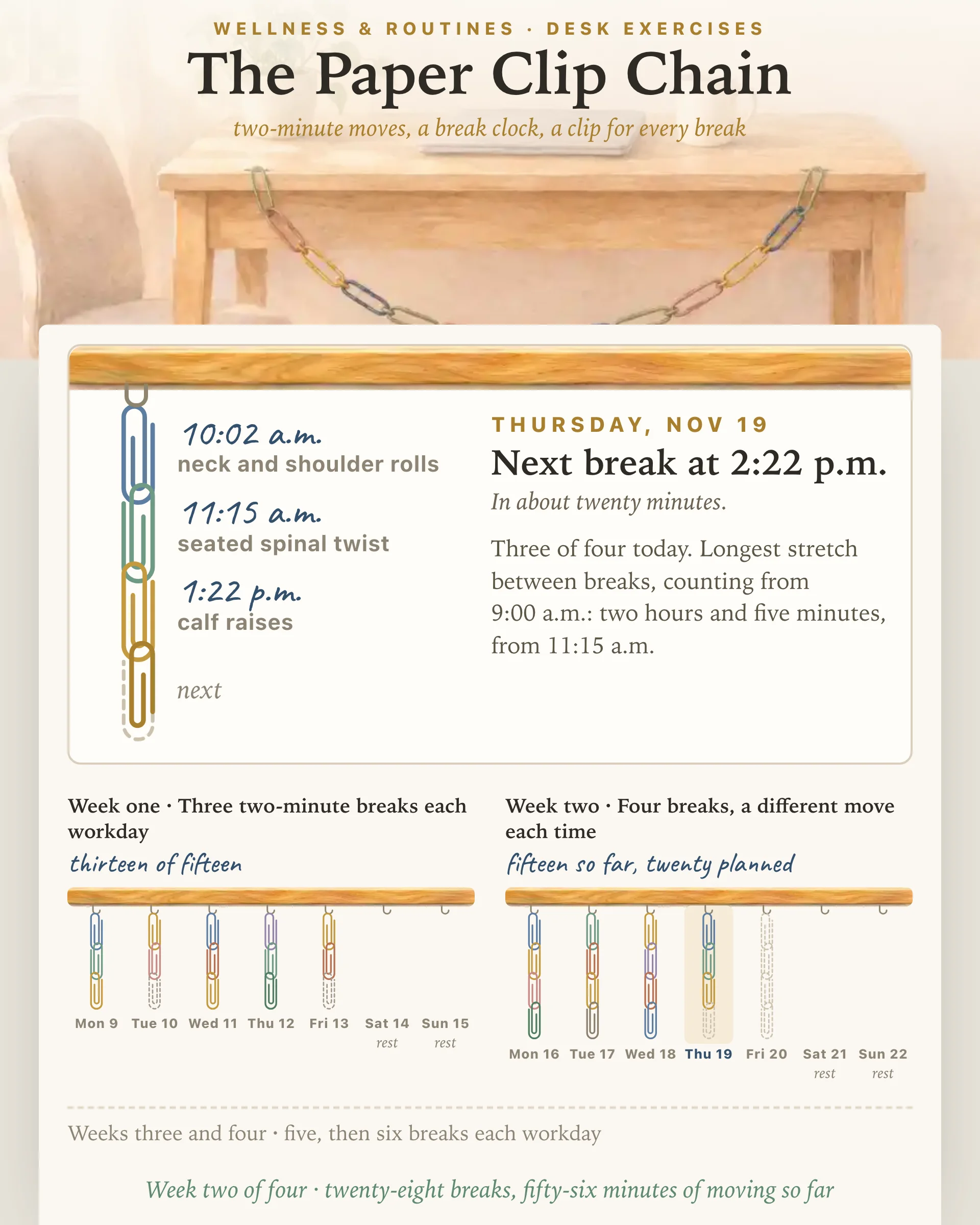
You sat down after the morning coffee, and the next time you noticed your body it was early afternoon: a stiff neck, tight hips, legs that felt borrowed. Desk exercises are the small answer to that: two minutes of moving, several times a day, in your chair or right beside the desk.
Here, every break you finish hangs one paper clip on today's chain, and four weeks of chains hang side by side on a rack, so a glance tells you which days you got up and which days the chair won.
Start by setting when your workday begins and ends, and whether a break comes due every forty-five, sixty or ninety minutes. Then switch on the clock. It works out from the real time when the next break is due, counting from your start time, the moment you switched it on, or your last finished break, whichever came latest. When the moment arrives, the card says so and the next dashed clip fills in.
One limit, plainly: the clock only works while the page is open. It makes no sound, sends no notifications and does nothing in the background. Because it reads the time instead of counting seconds, a tab left behind a spreadsheet still knows, when you look, that a break came due twenty minutes ago. Close the page and nothing reminds you.
Then pick a move. The menu holds ten, from neck and shoulder rolls and a seated spinal twist to desk push-ups, calf raises and a quick lap of the room. Six are seated desk chair exercises; four have you standing with a hand on the desk. Tap seated only if standing is not an option, or add up to three moves of your own, like one flight of stairs. When you cannot decide, pick for me suggests a move for a part of you that has not moved yet today.
Each move runs on a two-minute clock with three cues, forty seconds apiece. A clip goes on the chain only once the two minutes are done. Stop halfway and nothing is added; pause for a phone call and the time waits. That rule keeps the chain honest.
The rack follows a plan that grows slowly: three breaks each workday in week one, then four, five and six, close to one for every working hour by week four. Weekends are rest days, though a Saturday break still hangs. The card also reports today's longest stretch between breaks, counted from your start time. Lunch is often where it hides, and seeing it is the first step to breaking it up.
The general case for moving more is broad. The World Health Organization's 2020 guidelines advise adults to limit the time they spend sitting and to replace some of it with physical activity of any intensity, light movement included. They name no best interval for breaks.
In a crossover trial with nineteen adults, interrupting a long sit with two minutes of light or moderate walking every twenty minutes lowered blood sugar and insulin after a test drink, compared with sitting straight through. That was one day in a lab with middle-aged adults carrying extra weight, so it says little about what a month of desk breaks will do for you.
For sore necks and shoulders, a randomized trial followed adults who worked at least thirty hours a week and had frequent neck and shoulder pain. As little as two minutes a day of resistance training with elastic tubing, five days a week for ten weeks, reduced pain and tenderness compared with weekly health information. Those were band exercises, not the moves here, so take it as a sign that small daily doses can count, not as proof about this menu.
The evidence on getting people to sit less at work is thin. A Cochrane review of workplace programs found low-quality evidence that sit-stand desks cut sitting time. In one study, one- to two-minute breaks every half hour cut sitting more than two long breaks a day did, while results for screen prompts and counseling were mostly inconsistent. A reminder only helps if you answer it, which is why this page counts the breaks you finish rather than the ones it suggested.
Talk with a doctor or physical therapist before you begin if you have pain, a recent injury, a joint replacement, a heart or blood pressure condition, or have had a fall or dizziness. Keep every move slow and small, and stop anything that hurts. Desk push-ups belong against a heavy desk that cannot roll or slide, or a wall. If your chair swivels or rolls, plant both feet before you twist, and keep a hand on the desk for anything done standing.
For a longer seated session, The Chair Circuit times a fuller routine around a sturdy chair. If your shoulders creep forward by mid-afternoon, The Plumb Line Posture Plan works on that over several weeks. And when the work is finished, the Workday Shut-Down Ritual helps you close the laptop on purpose instead of drifting into the evening.
Short ones you will actually repeat. This page keeps ten, each about two minutes: neck and shoulder rolls, a seated spinal twist, seated leg lifts, a seated march, a chest opener, wrist and finger stretches, desk push-ups, calf raises, a standing hip stretch and a quick lap of the room.
Tap seated only and the menu keeps the six moves you can do from a work chair: shoulder rolls, the twist, leg lifts, the march, the chest opener and the wrist stretches. If your office chair swivels or rolls, plant both feet so it stays put while you turn or raise a leg.
No single interval has been proven best. The World Health Organization advises adults to limit time spent sitting and to swap some of it for movement of any intensity. Many people settle on a short break every half hour to hour; this page lets you choose forty-five, sixty or ninety minutes and change it whenever you like.
No. The clock only runs while the page is open in a tab. It reads the real time, so a tab left in the background still knows a break is due the moment you look at it, but it never makes a sound or sends a notification.
Talk to a doctor or physical therapist before you begin if you have pain, a recent injury, a joint replacement, a heart or blood pressure condition, or have had a fall or dizziness. Keep every move small and slow, use the desk for support when standing, and stop anything that hurts.
By the team behind Fabulous, the science-based self-care app used by over 30 million people.


