The Overwhelm Recovery ProtocolWellness & Routines · ~5 min
About this template · Updated July 2026
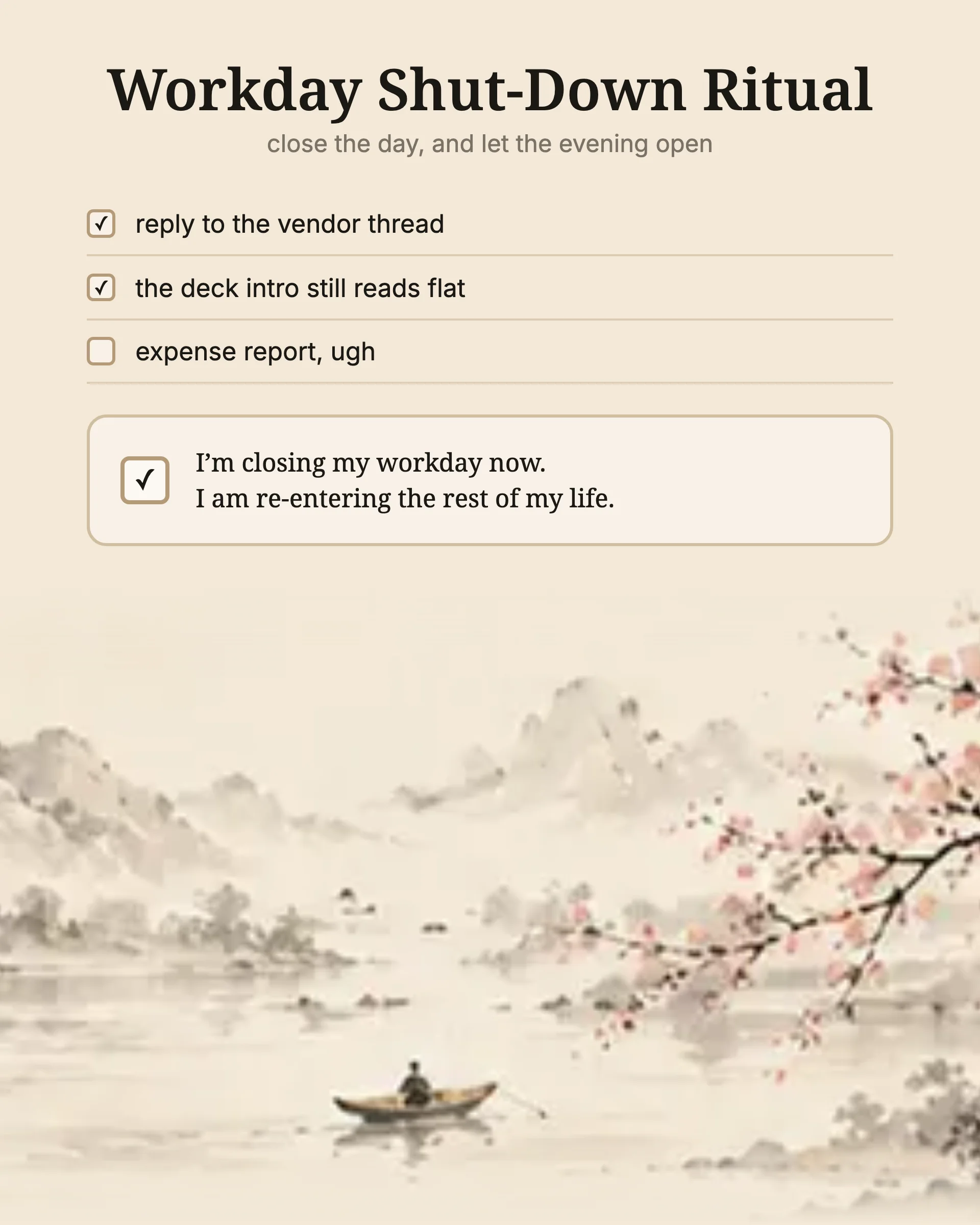
Credit first: the shutdown ritual is Cal Newport's coinage. His book Deep Work gave the practice its name and its most famous detail — a spoken phrase that formally ends the working day — and made the case that knowledge workers need a hard edge on the day the way factories need a closing whistle. This page is an independent interactive worksheet in that tradition, built by Jazmin Quill for Fabulous, with credit given plainly; it is not affiliated with, endorsed by, or connected to Cal Newport.
What it borrows is the insight. What it adds is a sheet you can actually run at 5:47 p.m. with your coat half on.
Most knowledge work has no natural finish line. The inbox refills itself, every project could absorb one more hour, and so the day doesn't end — it just fades, thinning out through dinner, flaring up in the shower, dying somewhere around midnight with the phone still warm. The cost isn't only the evening. A mind that never fully leaves work never fully rests, and a mind that never rests does worse work tomorrow.
The shutdown ritual attacks this with a claim that sounds too simple: the workday should have a last event, performed the same way every day, after which work is over — not paused, over.
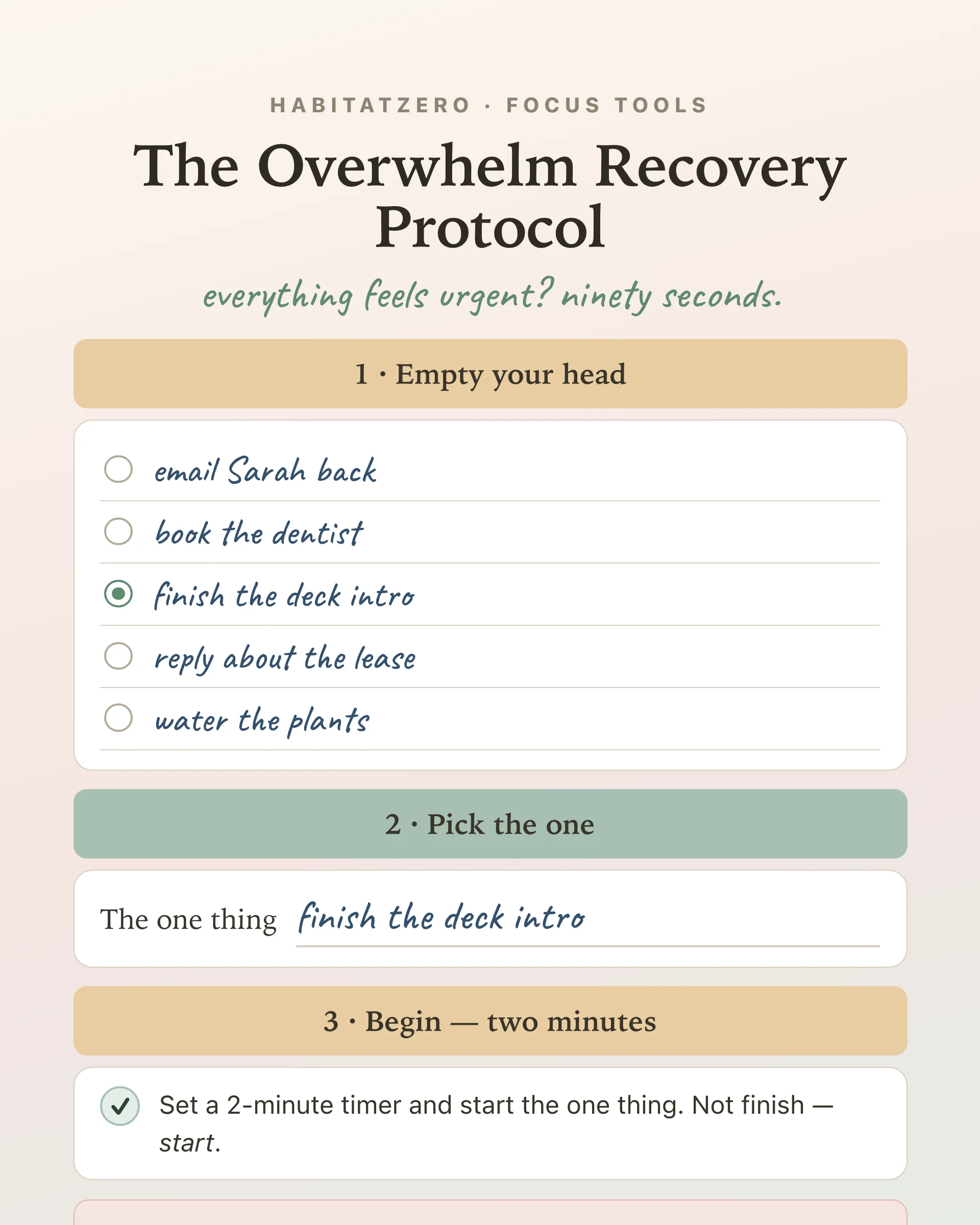
The ritual's first move is emptying the open loops: everything unfinished, owed, or quietly nagging goes onto five lines. This is the part with the strongest science behind it. Unfinished tasks are famously sticky — the mind keeps re-raising what it fears losing track of. But in a series of experiments on unfulfilled goals, E.J. Masicampo and Roy Baumeister found the intrusions stop once a specific plan exists for the task — not once the task is done. The brain doesn't need the loop closed tonight. It needs to believe the loop is held somewhere reliable.
That is exactly what the tick beside each loop means: not finished, but parked where tomorrow will find it. Write the vendor thread down, decide it lives on tomorrow's list, tick it — and notice the small quiet that follows.
The same logic powers tomorrow's first three. Deciding where tomorrow starts while today's context is still warm costs two minutes now and saves the coldest, most expensive minutes of tomorrow morning — the ones usually spent re-deriving your own priorities from an inbox.
Between the loops and the list, the sheet asks a question that has nothing to do with productivity: what's worth keeping from today? Days that end only in unfinished business teach you, entry by entry, that your work is an unpayable debt. One kept moment — a win, a kindness, a demo that landed — is a small correction with compounding returns.
Then the door: a card that says I'm closing my workday now. I am re-entering the rest of my life. Tap it and mean it. Newport's own version uses a spoken phrase, and the theatricality is not a bug — a boundary that is never declared never quite exists. The declaration deliberately doesn't save or accumulate; it isn't data, it's a threshold, and tomorrow evening it will be waiting to be crossed again.
Does urgent work sometimes reopen the door? Of course — the ritual is a boundary, not a vow. What it removes is the default leak: the evening half-worked in your head out of vague unease, every night, forever.
The shutdown ritual is the evening half of a day that starts on purpose. If your mornings need the same deliberate opening, the morning routine checklist is this sheet's mirror twin, and the productivity journal holds the during-hours story the shutdown closes. When the loops you park keep turning out to be the same overwhelming project every night, the task usually needs shrinking before it needs scheduling.
Empty the loops. Keep the good thing. Set the first three. Say the line — and let the evening open.
No. The shutdown ritual is Cal Newport's coinage — his book Deep Work describes his own version, complete with a spoken closing phrase — and this page is an independent interactive worksheet in that tradition, with credit given plainly. It is not affiliated with, endorsed by, or connected to Cal Newport. For his method in his words, read Deep Work.
Because unfinished tasks keep a claim on your attention after hours — the mind reruns what it fears losing. Research on unfulfilled goals found that the intrusions stop not when tasks are finished but when there is a concrete plan for them. Parking each loop where tomorrow will find it is that plan; the tick is your permission to stop rehearsing it.
Say it, tap it, mutter it at the laptop — but mark the moment somehow. A boundary that is never declared never quite exists, and evenings leak. The slightly ceremonial ending is the feature: it gives the brain an unambiguous signal that the workday has a last event, and this was it.
Then handle it — the ritual is a boundary, not a vow. What it prevents is the default state where work never ends because it never officially ends, and every evening is half-worked in your head. A rare genuine emergency does not undo that; reopening the laptop nightly out of vague unease does.
Yes. Run it on the page at the end of each workday — the loops and tomorrow's three save as you go — or print it and keep the ritual in pen beside the keyboard.
By the team behind Fabulous, the science-based self-care app used by over 30 million people.