
The Overwhelm Recovery ProtocolWellness & Routines · ~5 min
About this template · Updated November 2026
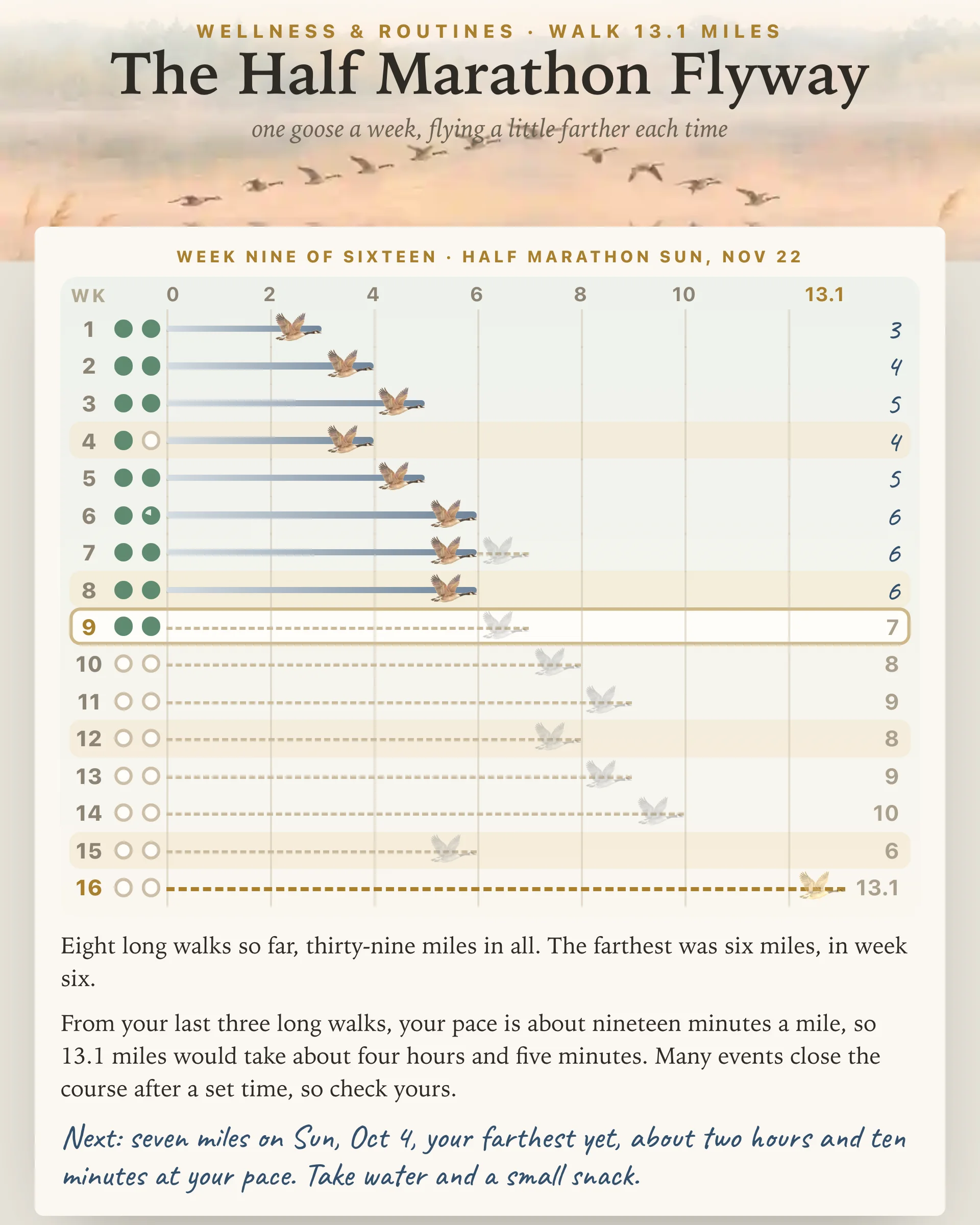
A half marathon is 13.1 miles. At fifteen minutes a mile you are on your feet for about three and a quarter hours; at twenty minutes a mile, about four hours and twenty minutes. Nobody walks that far on a whim, but plenty of people get there with a few months of steady walks and a date on the calendar.
This page builds those months from the longest walk you can manage now and the day of your event: twelve to sixteen weeks of three walks each. Every week is a goose on a flyway: pale at the distance the plan asks for, painted where your own miles put it.
Talk with a doctor before the long walks if you have a heart, kidney or blood sugar condition such as diabetes, or if effort brings chest discomfort, unusual breathlessness, dizziness or fainting. The American College of Sports Medicine's updated screening advice turns on exactly those things: how active you are now, whether you have symptoms or known heart, metabolic or kidney disease, and how hard you plan to work. It is expert guidance, not a trial of walkers. A recent fall, a joint replacement or pain that walking makes worse also deserve that conversation.
Each week holds two shorter walks in minutes, growing from thirty to forty-five, and one long walk in miles. The long walk starts at the distance you chose and climbs to ten miles two weeks before your event, never more than a mile above the week before. Every fourth week is a mile shorter, and the week after it builds back from that shorter walk instead of leaping ahead. The week before the event is lighter still, so you reach the start rested.
Ten miles is this page's own ceiling: it keeps the longest training walk near three hours at an everyday pace. From three miles the climb takes fourteen weeks, from four miles thirteen, and from five or more twelve. If your date leaves fewer, the page says so instead of squeezing the plan, and suggests a later event or a 5K or 10K on that day. From one or two miles even sixteen weeks fall short, so it suggests building to three miles first.
Gradual is a sensible default, not a guarantee. In a trial of 532 novice runners training for a four-mile event, a gentler 13-week build that followed the 10 percent rule had about the same injury rate as a standard eight-week build, roughly one in five in each group. Those were runners aiming at a far shorter distance, so it says little about walkers, but it is a good reason to repeat a week when your feet, hips or knees ask.
A review of the talk test found that, in healthy adults and in people with heart disease, comfortable speech was usually still possible below the point where breathing starts to labor, and that the test behaved the same way across walking, jogging and cycling. Walk the long ones at a pace where you could chat in full sentences; in the brisk middle of the second shorter walk, you can talk but would struggle to sing. The review measured effort, not finishing times or injuries.
After each walk, one tap records how much you could talk, and a long walk that left you with only a few words brings a note to slow the next one.
Drink when you feel thirsty, not at every table. In a study of 488 runners in the 2002 Boston Marathon, 13 percent finished with low blood sodium, and in the fuller analysis it was linked with gaining weight during the race, taking more than four hours, and a body mass index at either extreme. That was one race of runners, and a link is not a cause, but a half marathon walker can easily spend four hours on course, so finishing heavier than you started is the thing to avoid. Past about ninety minutes, eat a little every hour, snacks you have tried on training walks.
Blisters can end a long walk early. A systematic review of blister prevention in hikers, marchers and runners found eleven trials of socks, antiperspirants and barriers, and little strong evidence for any of them; paper tape over blister-prone spots had the best support. So train in the shoes and socks you will wear on the day, and cover a hot spot the moment you feel it.
Begin a walk at your door. The clock reads real time, so a locked phone loses nothing, a pause never counts, and a walk keeps its whole minutes only. Then tap or type the miles: the long walk's goose lands at that distance, and once long walks have their miles in, the page works out your pace and how long 13.1 miles would take at it. Many events close the course after a set time, so compare that figure with yours.
If two miles still feels long, start smaller. The 5K Balloon Arch counts eight weeks back to a 3.1-mile event in minutes, and The Three-Mile Walking Stick builds from one mile to three over six weeks. This page starts roughly where those finish and counts its long walks in miles, because on the way to 13.1, distance is what you are building. For everyday walking that is not training, The Hollyhock Hour climbs gently toward an hour a day.
At fifteen minutes a mile it is about three hours and fifteen minutes, and at twenty minutes a mile about four hours and twenty. This page works out your own figure from the walks you log with their miles. Many events set a course time limit, so look yours up before you sign up.
This plan runs twelve to sixteen weeks. From a walk of three miles it asks for fourteen, from four miles thirteen, and from five or more twelve. From one or two miles, build to three first with a shorter plan. If your date leaves too few weeks, the page says so and suggests a later event or a 5K or 10K that day.
Here the long walk tops out at ten miles two weeks before the event, about three hours at an everyday pace. The week after is lighter, so you reach the start rested, and the last stretch of the 13.1 comes on the day itself.
Not as it stands. The weeks are built for 13.1 miles, and a full marathon of 26.2 asks for longer long walks over more months. Walking a half first is a sensible step, and the pace it gives you is a good start for planning the longer event.
Carry water once a walk passes an hour and drink when you feel thirsty rather than at every chance. Past about ninety minutes, eat a little each hour, and use the training walks to find snacks that sit well before race day.
By the team behind Fabulous, the science-based self-care app used by over 30 million people.


