
The Overwhelm Recovery ProtocolWellness & Routines · ~5 min
About this template · Updated November 2026
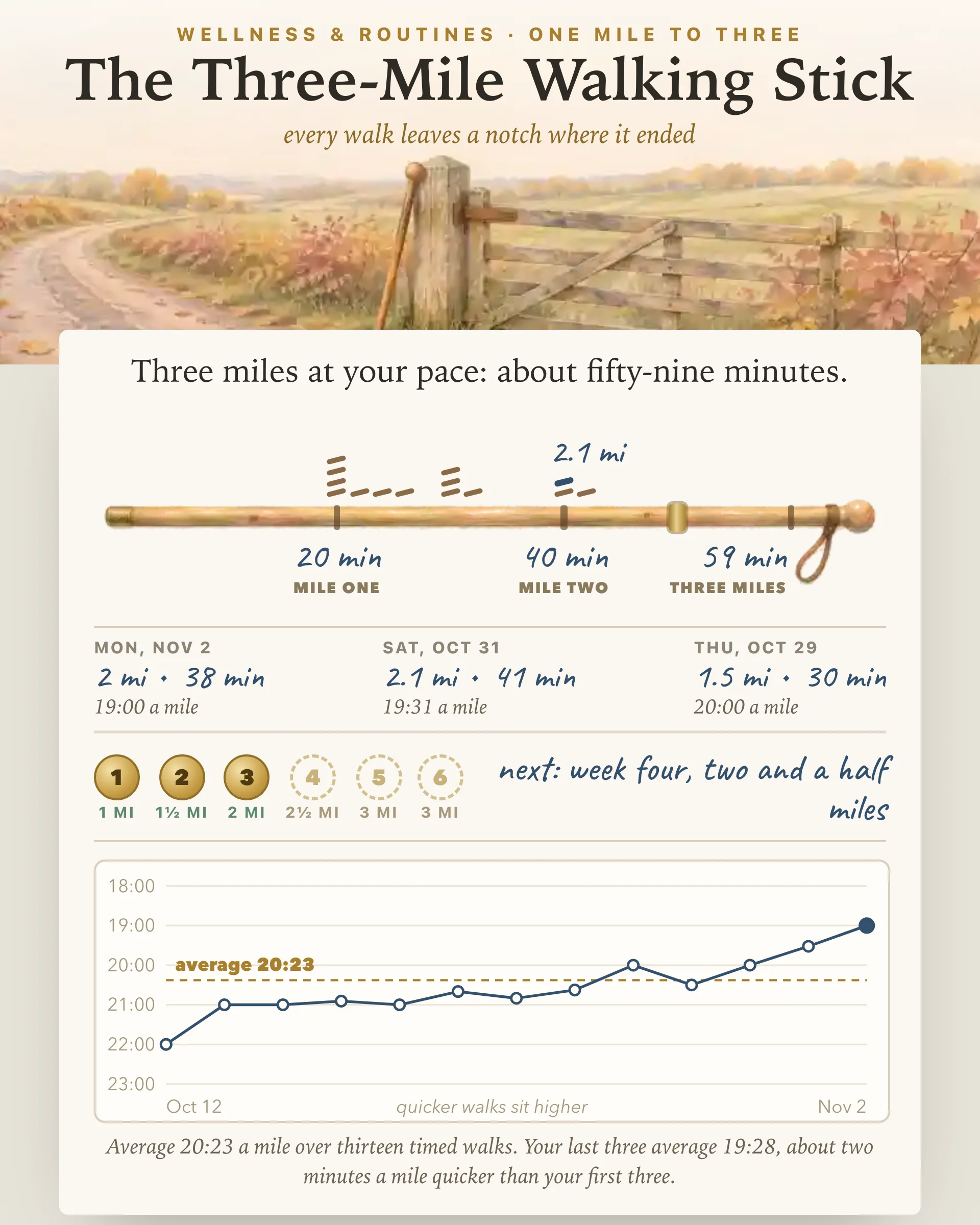
Three miles is a good distance to aim for: a real outing that still fits before work or after dinner. For most people it takes close to an hour. The old English league, usually reckoned at three miles, may even have begun as roughly an hour on foot.
This page works out how long three miles takes at your own pace, gives you six weeks of walks that build from one mile to three, and keeps every walk you carve on a painted walking stick and a line of your pace.
Pace is minutes divided by miles. Walk one and a half miles in 33 minutes and your pace is 22 minutes a mile, so three miles would take you about 66. The sheet does this sum from any walk you remember, then writes the minutes under each carved ring: mile one, mile two, and the handle at three miles.
For a sense of the range, a meta-analysis of normal walking speed pooled more than 23,000 healthy adults and found everyday speeds running from about 1.43 meters a second for men in their forties down to about 0.94 for women over eighty. That works out to roughly nineteen to twenty-eight minutes a mile. Those speeds were timed over short courses of a few yards, not miles outside, so treat them as a loose picture rather than a target. Your own walks are the better guide, so the minutes under the stick follow your last five timed walks.
Week one is four walks of one mile. After that the longer days grow by about half a mile a week: one and a half in week two, two in week three, two and a half in week four, your first three-mile walk at the end of week five, and three walks of three miles in week six. Rest days sit between the longer walks.
A walk fills its spot when it reaches the planned distance. A shorter one still goes on the stick at the distance you actually covered, and the spot waits for your next try. If two miles already feels easy, start from two miles instead, which skips the first two weeks and leaves four.
No study has settled the right way to build walking distance, so treat these steps as a sensible default. If a week leaves your feet or knees sore, walk it again before moving on.
Tip to handle is three miles. Every walk you carve leaves a small notch above the stick where it ended, so the notches pile up wherever you walk most and drift toward the handle as the weeks go on. The newest notch is inked in blue, the farthest walk carries its distance in handwriting, and a brass band marks your next walk.
The walk clock is for walks you don't time another way. Start it as you leave, pause it at a long stop, and finish when you are back. It reads the real clock, so it keeps counting while your screen is off, and it records whole minutes only, so a walk stopped before a minute adds nothing. Then add how far you went, from a map or a route you know, and carve it. A walk with no minutes still counts for its distance; it just gets no pace.
Each timed walk adds a point to the pace line, with quicker walks sitting higher and your average drawn dashed. Longer walks often bring a slightly slower pace, and that is normal.
The US Physical Activity Guidelines ask adults for 150 to 300 minutes of moderate activity a week. By week six of this plan you are walking a little under four hours a week at an everyday pace, which lands inside that range.
A review of randomized trials of walking programs in people who were inactive at the start found that walking raised fitness and lowered blood pressure and waist size by modest amounts, though it did not change blood fats. Those are averages across many studies, not a promise for any one walker.
A pooled analysis of fifteen cohorts linked more steps a day with lower mortality, leveling off at around 6,000 to 8,000 steps for adults sixty and over and 8,000 to 10,000 for younger adults. That is an association in people followed over several years, so it cannot show that the steps themselves made the difference, and its findings on stepping speed were mixed once total steps were counted.
If rain or ice keeps you in, the living room version lays out up to three miles of walking indoors. To know when you will reach somewhere on a route with hills and stops, a trail signpost that times each leg does that sum, and on days you want a shorter outing with quicker stretches built in, a timed ribbon of easy and quick minutes fits better. And if you want to walk faster rather than farther, a six-week plan of power bouts that fills a windmill sail builds speed in short stretches.
Walk at a pace you could still talk at, wear shoes you have already walked a mile in, and stop if anything hurts. If you have a heart or lung condition or a joint that troubles you, or you have had a fall, talk with your doctor before the longer weeks.
For most people somewhere between forty-five minutes and an hour. An everyday pace of about twenty minutes a mile makes it an hour, a quick fifteen-minute mile brings it nearer forty-five, and the sheet works out your own figure from a walk you have already done.
About forty minutes at an easy pace and closer to thirty when you walk quickly. Two miles is the second carved ring on the stick, and week three of the plan has two walks of that length.
Three miles takes most adults close to an hour, so three or four of those walks a week land inside the 150 to 300 weekly minutes of moderate activity in the US guidelines. Large studies tie more daily steps to longer lives, though they show a link rather than a promise for any one person, and rest days still belong in a good week.
It depends on the length of your stride, so the honest answer is to count it once: walk a measured mile, note the steps, and multiply by three. Shorter strides take more steps to cover the same ground, which is why two people on one route rarely match.
Yes, given a few weeks. If one easy mile feels fine today, four walks a week for six weeks will take you to three. If two miles already feels comfortable, start at week three and you will get there in four.
By the team behind Fabulous, the science-based self-care app used by over 30 million people.


