
The Overwhelm Recovery ProtocolWellness & Routines · ~5 min
About this template · Updated November 2026
Power walking is ordinary walking with the dial turned up. You take shorter, quicker steps, bend your elbows and let your arms drive, roll from heel to toe, and hold yourself tall. It asks more of your heart and legs than a stroll, yet one foot stays on the ground the whole time, so there is none of the landing shock that comes with jogging. This page turns it into a six-week plan with a timer that calls each part of the walk and a row of windmills that fill with what you actually did.
Four habits do most of the work. Practice one at a time.
The pace check is simple: at power pace you can still talk in short phrases, but singing a verse would be out of reach. Down to a word or two, ease off.
Each walk has the same shape: five easy minutes, your power bouts with easy minutes between them, two slow minutes, then four stretches of forty-five seconds for the calves, the fronts and backs of the thighs, and the chest. Keep a wall, fence or bench within reach for the standing stretches.
The bouts are what change. Week one asks for four bouts of one minute, a twenty-minute walk. Weeks two and three stretch each bout to two and then three minutes. Week four switches to three bouts of five minutes, week five to two bouts of ten, and in week six they join into twenty-five minutes at power pace, thirty-five minutes in all. You walk four times a week, ideally with a rest day after each of the first two.
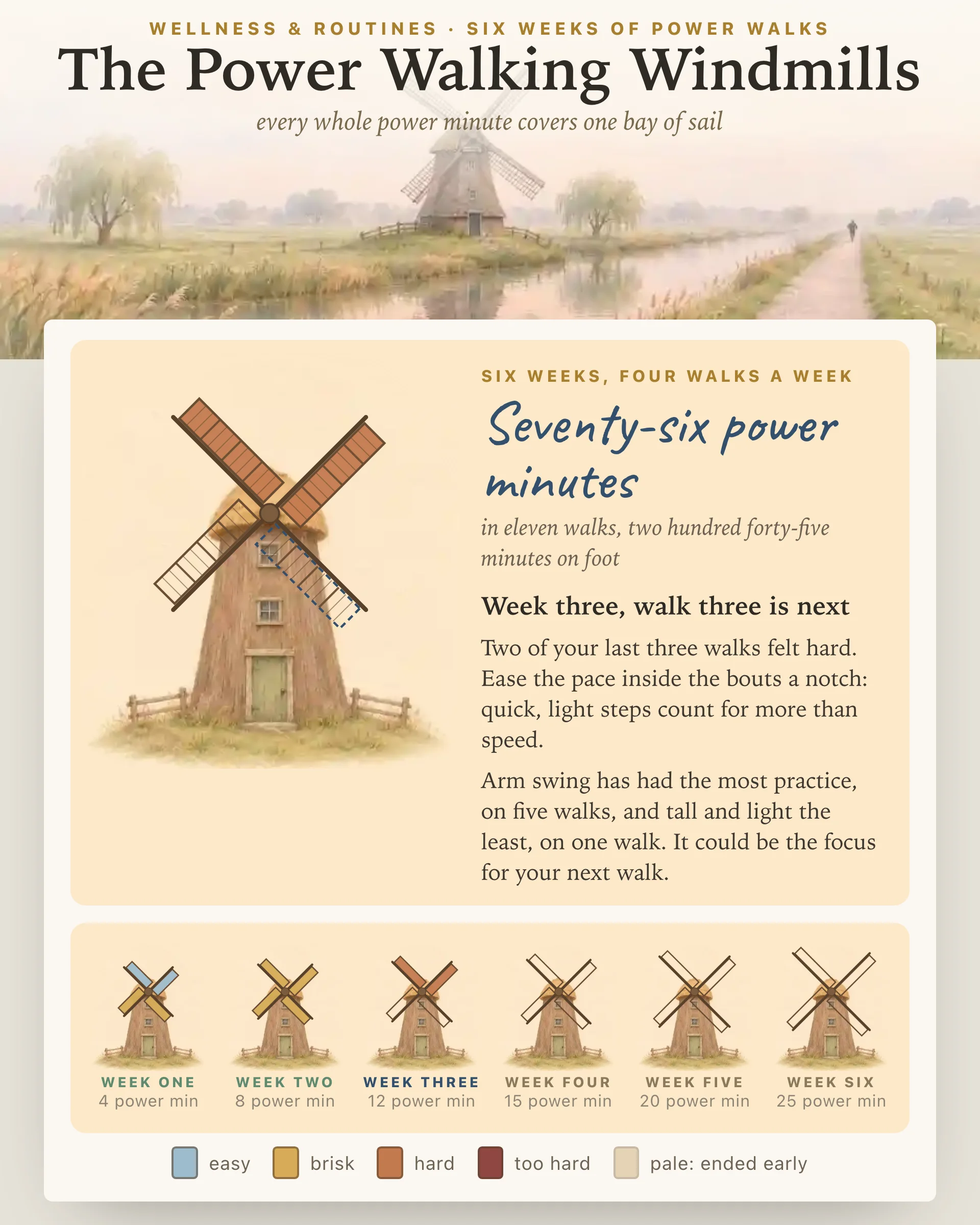
Every week is a windmill and every walk is one of its four sails. A sail is as long as that week's power minutes, so the mills grow taller sails as the plan goes on. Pick one part of the technique as your focus and press start: the timer calls the warm-up, each bout, the easy minutes and the stretches, and keeps your cue in view while you push. It runs from the real clock, so a locked phone loses nothing.
Each whole minute at power pace covers one bay of the sail with cloth, and the color comes from how hard you say the bouts felt. A walk counts in full once all its bouts are done. End early and the whole minutes you managed go on the sail in pale cloth, while the same walk comes up again next time. After a few walks the sheet reads them back, including which part of the technique has had the least practice.
A review of randomized walking trials in adults who were inactive at the start found that regular walking raised aerobic fitness and lowered blood pressure, waist size, weight and body fat, though each change was modest and blood fats did not move. A five-month trial in adults averaging sixty-three found that three-minute stretches of fast walking, alternated with slow ones, built more thigh strength and fitness than steady moderate walking and lowered systolic blood pressure further. Many people in every group missed their targets, and this plan follows its own pattern.
For pace, treadmill tests with forty-one to sixty-year-olds linked about one hundred steps a minute with moderate effort. The authors say that figure still needs checking in everyday walking, which is why this page trusts your breathing over a step count. The World Health Organization's 2020 guidance suggests at least one hundred fifty minutes of moderate activity a week. This plan climbs from eighty minutes to one hundred forty, so add a short walk on a rest day if you want to reach it.
None of this promises a set result. Power walking will not burn fat from one chosen spot, and your gains depend on where you start and how often you walk.
This plan suits you if a stroll feels too easy but jogging does not appeal. If twenty minutes of walking is still a stretch, start with the Walking Workout Ribbon. On wet days the Living Room Mile keeps you moving indoors, and the Daily Steps Ladder helps if you would rather grow your steps across the day. To check whether your everyday pace already counts as brisk, The Brisk Walking Metronome has you tap your steps for a minute.
If you live with a heart, lung or joint condition, or have not exercised in a long while, talk to your doctor before the bouts get long. Slow down straight away for chest pain, dizziness or a sharp ache. A walk that felt too hard is a reason to ease the pace inside the bouts next time, not to give up the plan.
It is walking with intent: a quicker beat of shorter steps, elbows bent and swinging from the shoulder, and a roll from heel to toe through each foot. It sits between a stroll and a jog, and one foot is always on the ground, which keeps the jolt on your knees and ankles low.
Fast enough that you can talk in short phrases but could not sing. Studies of step rate put the start of moderate effort at roughly one hundred steps a minute for most adults, and power walking usually runs above that. Your breathing is the better guide, since height, age and fitness all shift the numbers.
On this page every walk opens with five easy minutes, alternates power bouts with easy stretches of walking, and ends with two slow minutes and four stretches. Week one has four bouts of one minute each; by week six they have joined into twenty-five minutes at power pace.
In trials where inactive adults took up regular walking, aerobic fitness rose and blood pressure, waist size and body weight came down a little. In one five-month study of older adults, alternating fast and slow minutes built more leg strength and fitness than steady moderate walking. The changes build over weeks, so the plan matters more than any single walk.
Yes. The filled-in sheet above is a sample partway through week three. Personalize your own copy for free and it keeps every walk you log, the six windmills and the plan for your next walk.
By the team behind Fabulous, the science-based self-care app used by over 30 million people.


