
The Overwhelm Recovery ProtocolWellness & Routines · ~5 min
About this template · Updated September 2026
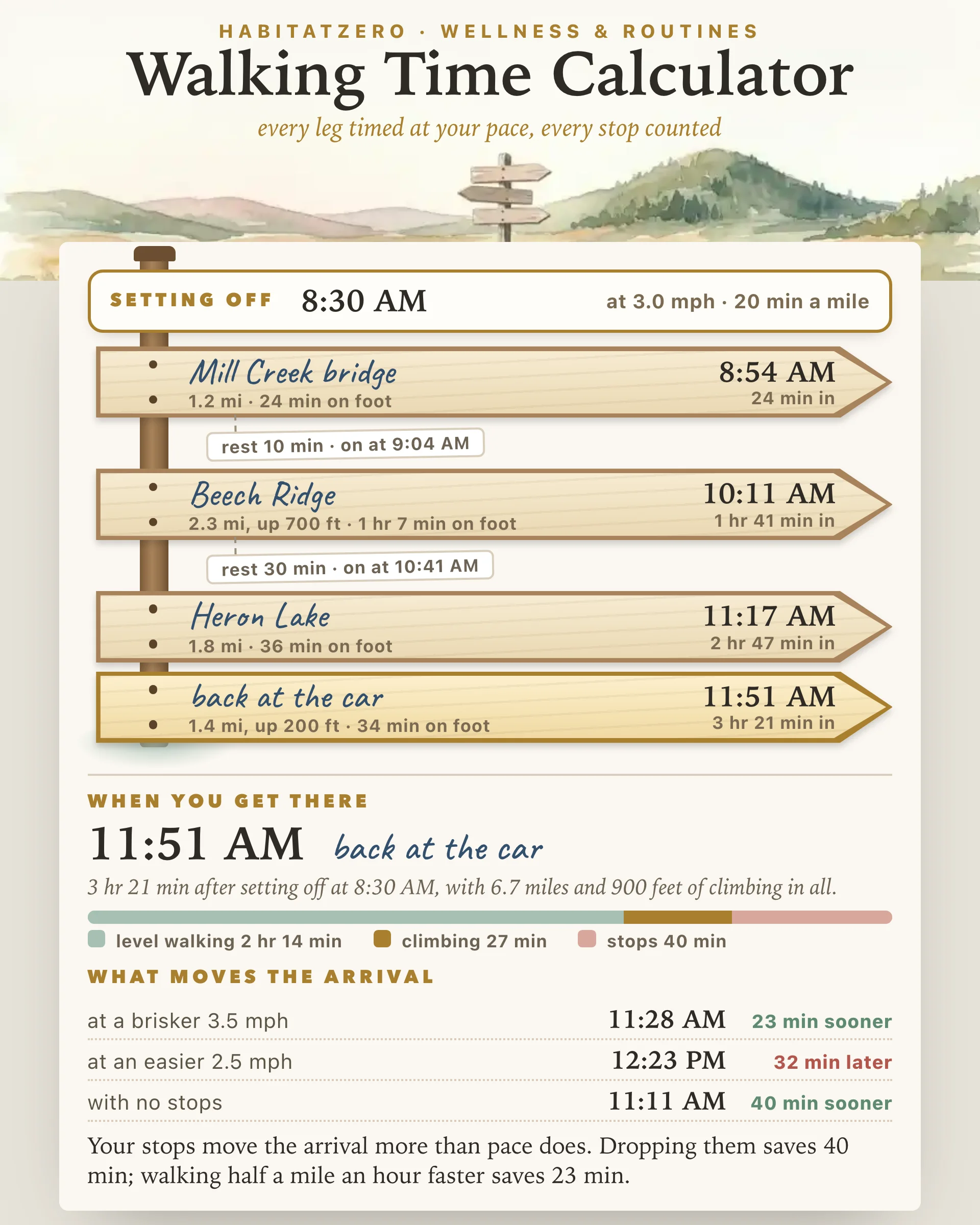
A walking time has three parts: the miles at your own pace, the extra effort of every climb, and the minutes you spend standing still. Plain distance-and-pace math covers the first part and drops the other two, which is how a two-hour hike ends by headlamp. This page puts all three on one trail signpost, one arm per leg, and the last arm tells you when you arrive.
Distance divided by speed gives the walking time. At 3 miles an hour a mile takes 20 minutes, so a 4.5-mile loop is 90 minutes on foot.
The time for climbs comes from William Naismith, a Scottish mountaineer. Writing up a solo walk over three peaks for the Scottish Mountaineering Club Journal in September 1892, he ended with a formula for "easy expeditions": an hour for every three miles on the map, with an additional hour for every 2,000 feet of ascent. His own day, on May 2 of that year, covered ten miles and 6,300 feet of climbing in six and a half hours including short halts, just what the formula gives. This calculator is an independent tool: nobody connected with Naismith or the club that printed his note reviewed or endorsed it, and it borrows only his allowance for climbing, applied at your pace instead of his three miles an hour.
Put another way, the rule says one foot of ascent costs as much time as 7.92 feet of level walking. Philip Scarf tested that ratio against records from British hill races and found the data broadly supported it. The sheet uses the ratio at your own speed, so 1,000 feet of climbing adds 30 minutes at 3 mph and about 26 at 3.5 mph.
Rests push every later arm back by their minutes, and a tag hanging under each arm says when you walk on. The sheet adds exact minutes first and rounds only the times it shows, to the nearest minute, so the arms never disagree with one another.
Pooling 41 studies and 23,111 healthy adults, one review found average normal walking speed ranging from about 3.2 mph for men in their forties to about 2.1 mph for women aged 80 and older. The green band on the slider marks that range. The CDC lists walking at 2.5 mph or faster as brisk, moderate-intensity activity, so the upper part of the band already counts as brisk.
Those speeds were timed over courses of 10 to 100 feet, which is a long way from three hours on a trail. Your own number beats any average. Walk a known distance at the pace you could hold all day and time it: four laps of a standard track come to just under a mile. Type the miles and minutes into the sheet, and it works out your speed from exactly what you typed.
Once the last arm has a time, the sheet reruns your route three ways: half a mile an hour brisker, half a mile an hour easier, and with no stops at all. On a day with a long lunch, the stops can move the arrival more than any realistic change of pace, and the reading tells you which lever is bigger on your route.
The filled example on this page is a 6.7-mile loop with 900 feet of climbing, walked at 3 mph from 8:30 AM. Walking takes 2 hours 41 minutes, 27 of them for the climbs, and two rests add 40 more. The sign puts you back at the car at 11:51 AM. Walking half a mile an hour faster would save 23 minutes; skipping both rests would save 40.
Sometimes the clock is fixed and the distance is the question. Give the sheet the minutes you can spare and it tells you how far they carry you at your pace, and where to turn around if you want to finish where you began. Fifty minutes at 3 mph covers 2.5 miles, so the turnaround sits 1.25 miles out.
Every figure here assumes steady walking on a clear path. Rough ground, heat, a heavy pack, a steep way down and a group moving at its slowest walker's pace can all stretch the day, and the formula counts none of them. Scarf's own analysis suggested a ratio nearer one to ten than one to eight for women, a reminder that the rule describes an average walker rather than you. Naismith checked his formula on a day with short halts only, so a lunch or a long view belongs on the sign as a rest of its own. Plan with the sheet, then leave spare daylight at the end.
Put up the arms the night before a hike, before a long walk to somewhere you need to reach on time, or while planning a charity walk. If walking is turning into a habit rather than an outing, the Walking Challenge gives it a route to ink in over four weeks, the Walking Plan for Weight Loss builds your minutes up week by week, and the Japanese Interval Walking Timer calls the switches when you want to train a quicker pace.
About 20 minutes at 3 miles an hour, the speed this sheet starts from. Dividing 60 by your speed gives your minutes per mile: roughly 17 at 3.5 mph and 24 at 2.5 mph. Five miles at 3 mph therefore takes an hour and 40 minutes before any climbs or stops.
Pooling 41 studies of 23,111 healthy adults, researchers found average normal walking speeds from about 3.2 mph for men in their forties down to about 2.1 mph for women aged 80 and older. Those speeds were timed over courses of 10 to 100 feet, so a walk you time yourself is the better number to plan a long day with.
Naismith's rule of thumb from 1892 allows an hour for every three miles plus an hour for every 2,000 feet of ascent. This calculator applies the climbing part at your own pace by counting each foot up as 7.92 feet of level walking, so 1,000 feet adds half an hour at 3 mph and a little less for a quicker walker. Descents are left out, as they were in the original rule.
No. William Naismith, a Scottish mountaineer, wrote the rule into a trip report in 1892, and no official version of it exists. This calculator was built independently and borrows only his allowance for climbing, so read its times as a plan to check against the trail rather than a promise.
The filled signpost on this page is yours to read and learn from. Putting up arms for your own route and keeping them for the next outing happens in HabitatZero, which costs nothing to open.
By the team behind Fabulous, the science-based self-care app used by over 30 million people.


