
The Overwhelm Recovery ProtocolWellness & Routines · ~5 min
About this template · Updated November 2026
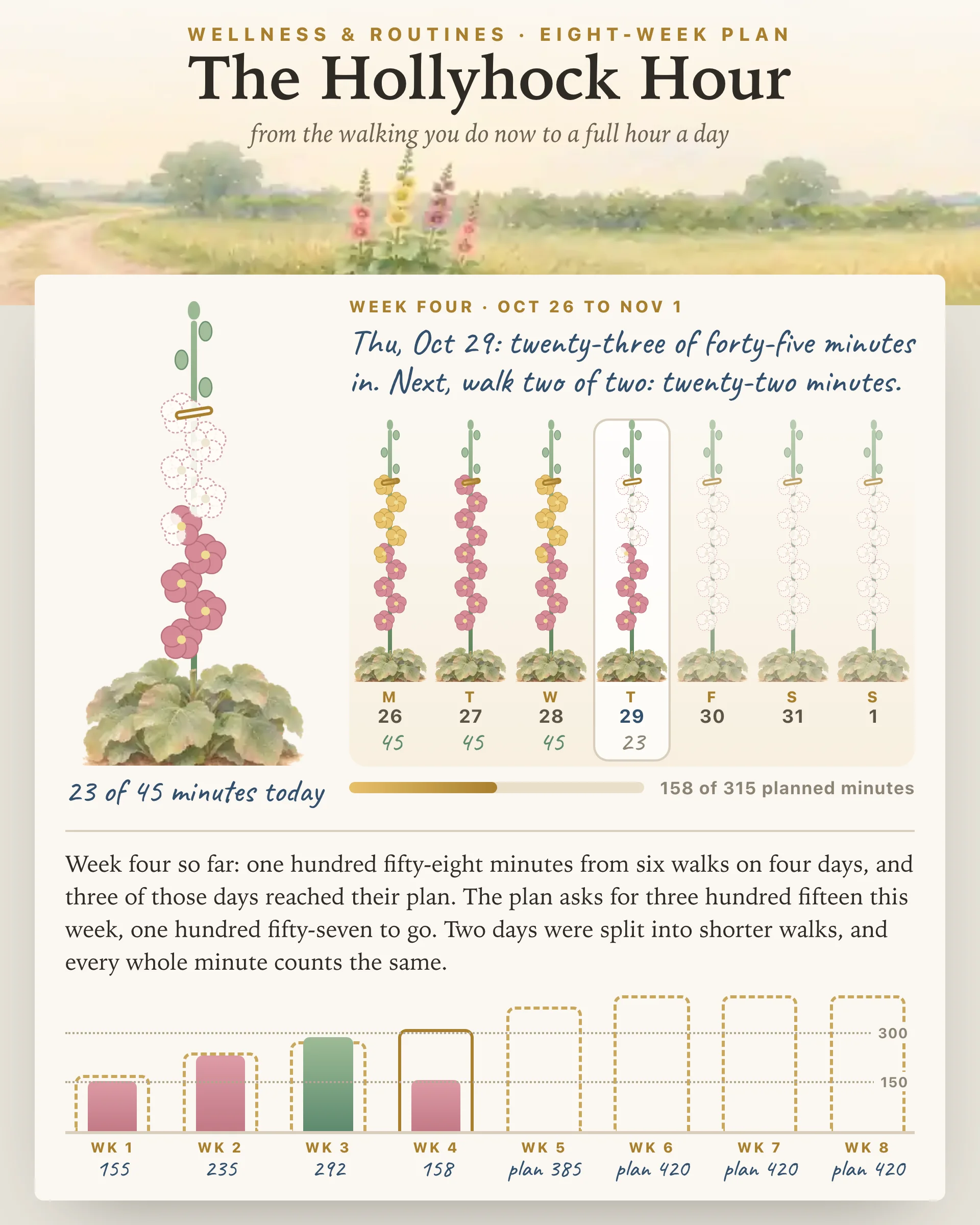
An hour of walking every day sounds simple until you try to fit it in. This page treats the hour as the top of a climb. You start from the walk you already take, choose how many weeks the climb should last, and take each day's minutes in one walk or in two or three shorter ones.
An hour on each of seven days comes to 420 minutes a week. The 2018 Physical Activity Guidelines for Americans ask adults for 150 to 300 minutes of moderate activity a week, plus muscle-strengthening work on two or more days, and they state that more activity brings additional benefit. A daily hour sits above that range: generous, not a minimum.
The best picture of what that extra time might be worth comes from large observational studies. One pooled analysis followed 661,137 adults in six cohorts in the United States and Europe, with a median age of 62, for about fourteen years. People who reported three to five times the recommended minimum of leisure activity had the lowest death rates, the gain over simply meeting the minimum was modest, and there was no sign of harm even at ten times the minimum. An hour of walking a day lands a little under three times the minimum.
Read that with care. Activity was self-reported, and people who walk a lot may differ from those who don't in ways no adjustment fully catches. It shows an association, not that walking caused the difference. It also says nothing about weight. Walking can help alongside what you eat, how you sleep and the weeks it takes, but this page tracks minutes only.
The guidelines used to count activity only in bouts of ten minutes or more. The 2018 edition dropped that rule, saying bouts of any length add to the weekly total. In a small trial, twenty-one previously inactive adults in their mid-forties each spent six weeks walking three ten-minute bouts a day and six weeks walking one thirty-minute bout, five days a week. Fitness, cholesterol measures and tension improved on both schedules, and the short bouts did at least as well.
That study was small and short, its walkers were middle-aged, and it tested half an hour, not a full one. Still, two walks of thirty minutes, or three of twenty, are often easier to keep than one long stretch.
Tell the page how long you walk now: ten, fifteen, twenty, thirty or forty-five minutes. Then pick four, six or eight weeks to reach the hour. Week one asks for your usual walk or a little more, every day, and each week after adds a share of the gap, rounded to five minutes. From twenty minutes over eight weeks, that is five more minutes a day each week, with the full hour in week eight.
No week rises by more than ten minutes over the one before. The guidelines advise building activity gradually to keep the risk of injury down. So from ten or fifteen minutes, four weeks is not offered and the quickest climb is six. Weeks after the hour arrives hold it, so the plan always runs eight weeks.
Each day is a hollyhock stalk. Twelve blooms of five petals make sixty minutes, and every whole minute you walk opens one petal, from the bottom up, the way real hollyhocks open along their spikes. The first walk of a day opens rose petals, a second butter yellow, a third plum. Petals the day's plan still asks for are drawn as pale outlines, and a gold tie on the stem marks the plan, turning solid once it is walked.
The timer runs on the real clock, so a locked phone loses nothing and a pause never counts. It cues an easy start, steady walking where you can talk but not sing, a halfway point for out-and-back routes, and an easy finish. Stop early and the walk keeps only its whole minutes; the next walk takes on what is left. A walk taken without the page can be added by hand.
A row of seven stalks shows the week with its total, and an eight-week chart sets each week against its plan and the 150 and 300 lines. After a week well short of its plan, the reading suggests easing the climb.
If half an hour on most days is the goal, The Thirty-Minute Window builds to it over twelve weeks; this page starts where that one stops and goes on to a full hour every day. For one shaped session with pushes and easy stretches, try The Walking Workout Ribbon. If you are an older adult starting from five minutes, The Picket Fence Walking Plan climbs more slowly and checks how each walk felt. If you count steps rather than minutes, The 7,000-Step Tune ramps a usual day up to 7,000 steps over six weeks.
Talk with a doctor before building toward an hour if you have a heart or lung condition, joint pain, dizzy spells, or have had a recent fall. Stop and rest if anything hurts, and get care for chest pain, faintness or breathlessness that does not ease with rest. Holding a week's minutes for a few extra days is always allowed.
For most adults it is generous rather than risky. Seven hours a week is about 420 minutes, above the 150 to 300 the US guidelines set out, and those guidelines say extra activity brings extra benefit. Build up to it in steps, as the guidelines advise to keep the risk of injury down, and talk to a doctor first if you have a heart or lung condition, joint pain, dizzy spells or a recent fall.
Yes. Since 2018 the US guidelines count activity in bouts of any length toward the weekly total. In a small trial, adults who had been inactive gained at least as much fitness from three ten-minute walks a day as from one thirty-minute walk, though that study tested half an hour, not a full one.
On this page you choose four, six or eight weeks. Starting from twenty minutes, the eight-week climb adds five minutes a day each week. From ten or fifteen minutes the fastest climb offered is six weeks, so that no single week jumps by more than ten minutes.
A pace at which you can talk in whole sentences but could not sing. The US guidelines give walking at 2.5 to 4 miles an hour as a moderate example. Slower walking still has value, they note, but it counts as light activity rather than moderate.
Walking can play a part in that, together with what you eat, how you sleep and the weeks it takes, but this page makes no promise about weight and tracks neither weight nor calories. It counts the minutes you walk, which is the piece you can steer each day.
By the team behind Fabulous, the science-based self-care app used by over 30 million people.


