
The Overwhelm Recovery ProtocolWellness & Routines · ~5 min
About this template · Updated November 2026
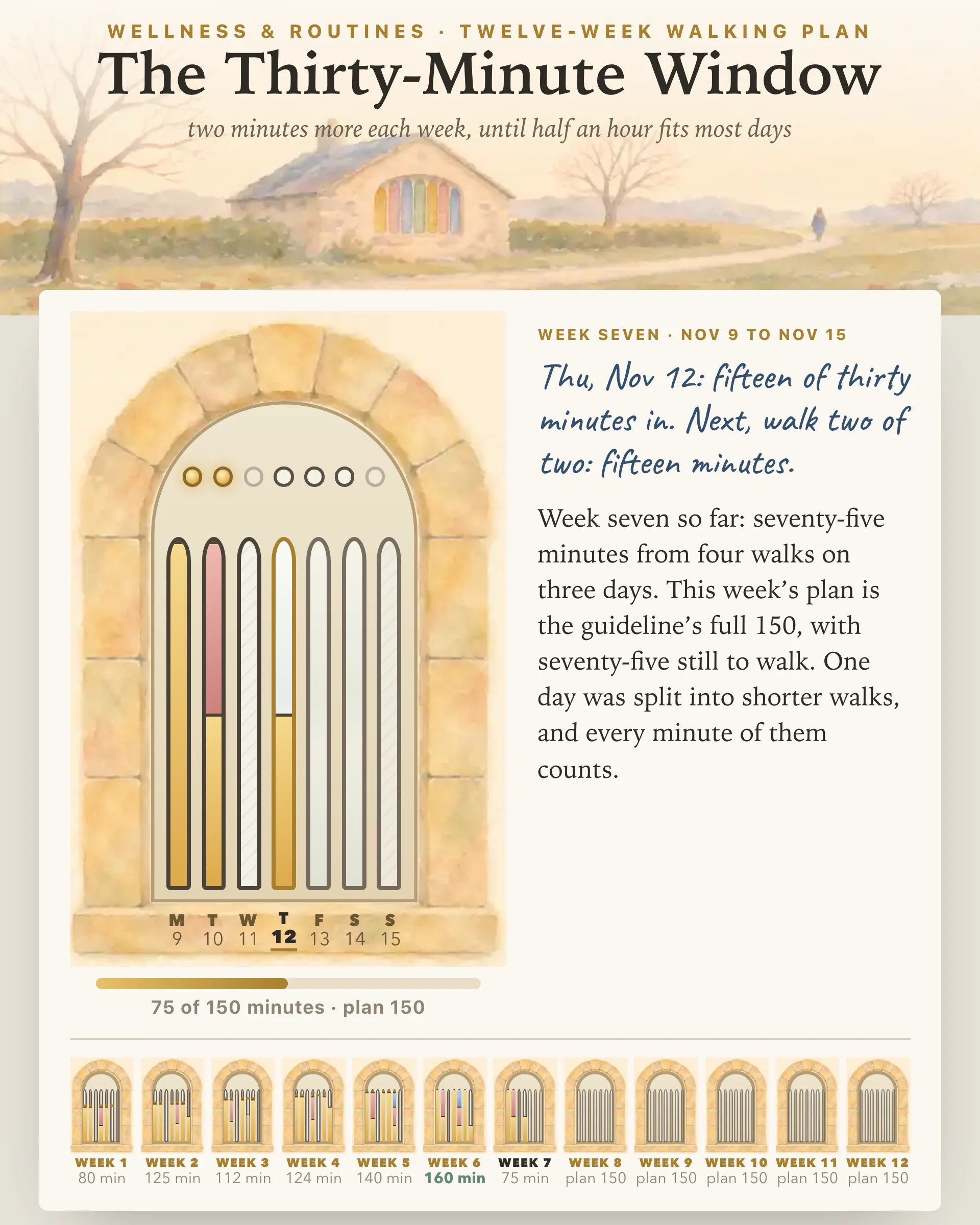
Thirty minutes is a number most people have heard and few have tried to reach on purpose. If your ordinary day holds ten minutes on foot, half an hour can feel like someone else's routine. This page treats it as a destination rather than a starting line: you begin from the walking you already do and add two minutes a week until thirty fits five days.
The half hour is a way of slicing a weekly amount. The CDC's guidance for adults asks for 150 minutes of moderate-intensity activity a week, names brisk walking as an example, and offers thirty minutes on five days as one way to get there. The same page adds two days a week of muscle-strengthening work, which walking does not cover on its own.
The 2018 edition of the Physical Activity Guidelines for Americans frames the aerobic target as a range of 150 to 300 minutes a week of moderate activity. It also notes that the people doing the least gain the most from even modest increases. That second point matters if thirty sounds far off: the first few weeks of a plan like this one are not a warm-up for the real benefit, they are part of it.
The guideline describes a week of movement that research links with better health across large groups of people. It is not a forecast for any one body. Walking trials give a narrower and more concrete picture. A 2015 review pooled randomized trials in which inactive adults simply walked for at least four weeks, compared with people who did not, and found walking raised aerobic fitness and brought blood pressure down a few points. It found no change in cholesterol.
Thirty minutes a day is not a weight promise, a step target or a cure for anything. This page tracks neither weight nor steps. It counts minutes walked, the part you can steer each day.
The CDC page says activity can be spread through the week and broken into smaller chunks of time. A 2019 systematic review prepared for the committee behind the 2018 guidelines looked at this question directly and concluded that activity in bouts of any length was associated with better health. Be clear about the strength of that: the evidence for bouts under ten minutes came from observational studies, and the randomized trials it found all tested bouts of ten minutes or more.
In practice, two fifteen-minute walks are a fine way to reach thirty, and three walks of ten suit a day built around a desk or a caregiving shift. The page keeps each walk separate rather than folding them into one number, so a split day looks like what it was.
The page is a window with seven narrow lights, one for each day of the week. Each walk sets a pane of colored glass in its day's light, as tall as the minutes walked, so a full light is thirty minutes. A gold mark shows what the plan asks for that day, and the round glass above a light glows once that much is walked.
Start by saying how long you walk now: ten, fifteen or twenty minutes. Week one asks for that on five days, and each week adds two minutes until thirty. From ten that takes until week eleven; from twenty it arrives in week six, and the remaining weeks hold steady so thirty becomes ordinary.
Choose one walk, two or three for the day, then begin. The timer cues an easy start, steady walking and an easy finish, and it keeps real time, so a phone that locks in your pocket loses nothing and a pause never counts. A walk stopped early keeps its whole minutes, and the next walk of the day takes on what is left. Walks taken without the page can be added by hand, to today or a missed day.
The sill under the window adds up the week against 150, with a reading that compares the week to its plan and to the guideline. Twelve small windows below hold the whole plan.
Moderate is the pace that counts toward the guideline. The CDC's rule of thumb is that you can talk in sentences but could not sing. In poor weather, laps of a hallway or a large store count the same.
If weight is the reason you are walking, the Walking Plan for Weight Loss is a four-week plan that restrings each week from how the last one felt. If your phone or watch already counts your steps, How Many Steps a Day Should I Be Walking? builds a step ladder from your own baseline instead of minutes. This page is for anyone who wants half an hour of walking to become a normal part of most days, at a pace they can keep. If a distance suits you better than minutes, The Mile-a-Day Scarf knits one row for every mile walked.
If you have a heart or blood pressure condition, have had a fall or dizzy spells, have a joint replacement, or feel pain when you walk, talk with a doctor or physical therapist before adding minutes. Slow down or stop if anything hurts, and treat a rest day as part of the plan.
For the aerobic part of the advice, it can be. The CDC asks adults for 150 minutes of moderate activity a week, and thirty minutes on five days is the example it gives. The walking has to be brisk enough to count as moderate, and the same guidance adds two days a week of muscle-strengthening, which walking alone does not cover.
Yes. The CDC says activity can be broken up into smaller chunks of time, and a 2019 review prepared for the committee behind the 2018 US guidelines found that activity in bouts of any length went with better health. Most of that evidence came from observational studies, since the trials it found used bouts of ten minutes or more.
It is a sound place to begin. Twenty minutes every day comes to 140 a week, close to the guideline, and the 2018 US guidelines note that the least active people gain the most from even modest increases. Starting this plan at twenty brings you to thirty on five days by week six.
The US guidelines describe 150 to 300 minutes of moderate activity a week for adults, so forty-five minutes on five days, 225 in all, sits inside that range. Work up to it the same gradual way, and keep the rest days if your feet or joints ask for them.
Walking can be one part of that, next to eating, sleep and time, but this page makes no promise about weight and does not track it. It counts minutes of walking and nothing else, which is the part you can steer day to day.
By the team behind Fabulous, the science-based self-care app used by over 30 million people.


