
The Overwhelm Recovery ProtocolWellness & Routines · ~5 min
About this template · Updated November 2026
A mile is a good size for a daily habit. It is long enough to feel like a proper walk and short enough to fit before work, after dinner or between errands. Walk a mile a day for four weeks and you have covered twenty-eight miles; keep going for a year and the total reaches three hundred sixty-five.
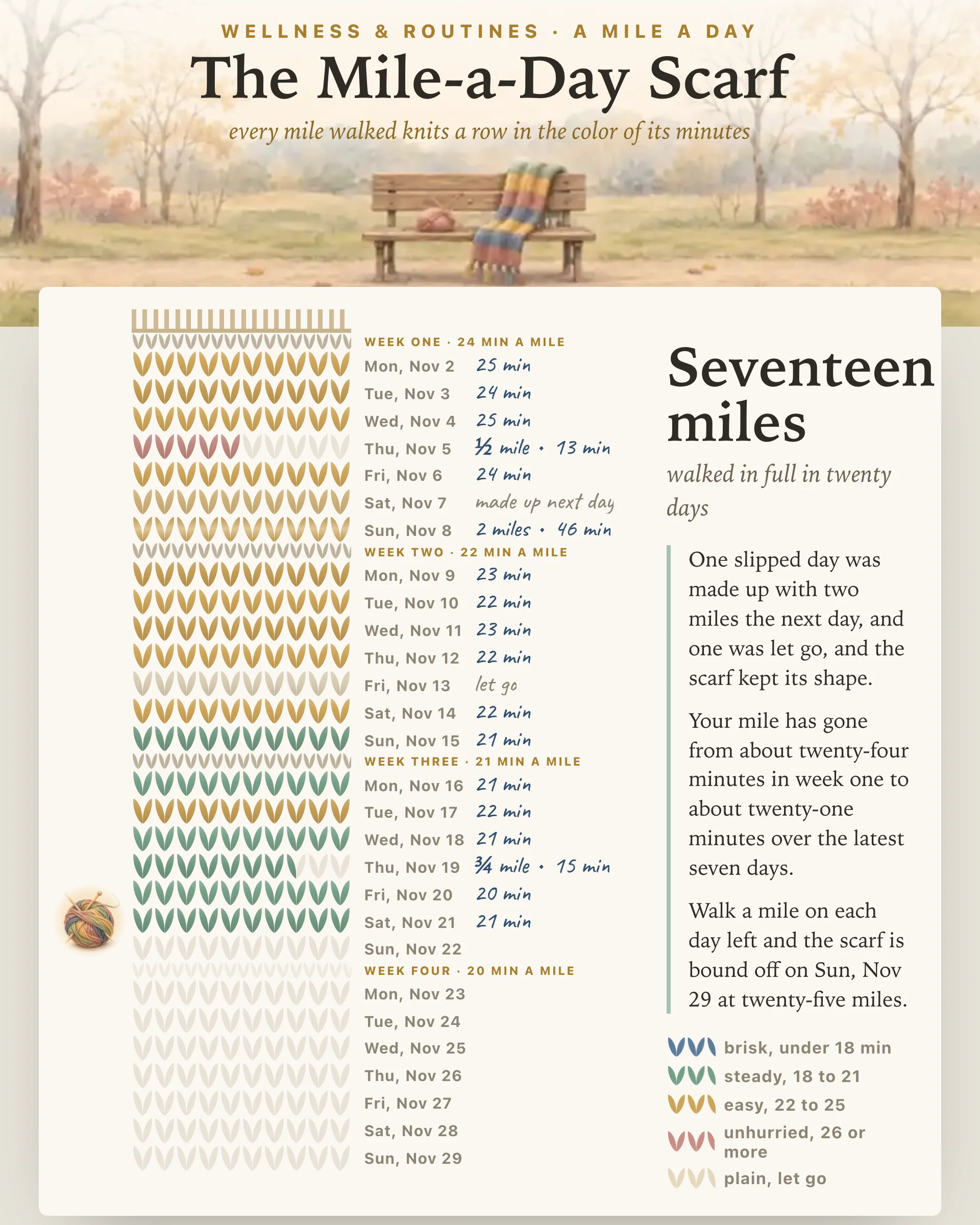
This page turns the habit into something you can see. Every day is one row of a knitted scarf, and every mile you finish knits its row in a color set by the minutes it took.
Most people need somewhere between fifteen and thirty minutes. A meta-analysis of normal walking speed in more than twenty-three thousand healthy adults found group averages ranging from a little over three miles an hour, for men in their forties, to a little over two miles an hour for women aged eighty and over (Bohannon and Andrews, 2011). Spread over a mile, that is roughly nineteen and twenty-eight minutes. Those speeds came from short, straight courses, so a real mile with curbs and corners usually runs a little longer.
The plan here begins at about twenty-four minutes in week one and eases toward twenty by week four. Treat those numbers as a guide: the minutes on your scarf are your own, and a slow mile is still a mile.
Time your walk on the page or set it by hand afterward. Tap the timer as you leave, pause it at a long crossing if you like, and tap mile done when you are back. The clock counts from the moment you started, so a phone locked in your pocket loses no minutes.
The row then fills in one of four yarns: blue under eighteen minutes, green from eighteen to twenty-one, gold from twenty-two to twenty-five, and rose for twenty-six or more. None is better than another. A scarf that starts gold and turns green says your mile got steadier; one that stays rose says you showed up every day at the pace your body likes. Under the scarf, a short reading totals your miles and compares your usual mile with your first week.
A mile counts only when you walk all of it. Turn back at half a mile and the page knits half a row while the mile total stays put. Walk the other half later that day and the row fills in.
If yesterday passed without a walk, you can walk two miles today and both rows get knit. Or you can let the day go, and a plain cream row keeps the scarf whole. Do neither and the day is let go on its own once tomorrow arrives. Nothing resets and no streak snaps, so the mile a day challenge survives a bad day: it costs you one row, not the month.
A review of thirty-two randomized trials in people who were inactive at the start found that regular walking raised aerobic fitness and lowered blood pressure, with small average changes in waist size and body fat, though blood fats did not shift (Murtagh and colleagues, 2015). Those trials ran four weeks or longer, about the length of one scarf.
Pooled data from fifteen cohorts, more than forty-seven thousand adults, linked more daily steps with a lower risk of dying during follow-up; for people aged sixty and over the benefit leveled off at around six to eight thousand steps a day (Paluch and colleagues, 2022). That is an association in observational data. It does not prove that walking a mile a day adds years.
The World Health Organization's 2020 guidelines suggest two and a half to five hours of moderate activity each week, plus regular muscle strengthening (Bull and colleagues, 2020). A twenty-minute mile every day comes to two hours and twenty minutes a week, just short of the lower mark, provided the pace warms you and quickens your breathing.
Find your mile before you need it. Walk away from your door at an easy pace for ten to twelve minutes, then turn and walk home; for most people that lands close to a mile. Keep a second route for rain or a packed day, such as laps of a mall, and when going out is not possible at all, The Living Room Mile lays out a mile around your own floor.
If you want a goal with a destination at the end, a painted route toward a lighthouse suits that better than a scarf. If you think in steps rather than miles, The Daily Steps Ladder builds a daily total up from your own baseline.
Start on a day you know you can walk, at a pace that still lets you hold a conversation. If you have had a fall or bouts of dizziness, or you manage a heart, lung or joint condition, check with your doctor about a sensible distance before your first mile, and stop whenever something hurts. Four weeks from now you will have a striped record of every walk and a clear sense of how long your own mile takes.
Over four weeks you cover twenty-eight miles. In trials of regular walking, people who started out inactive gained aerobic fitness and saw their blood pressure come down a little. Expect gradual change rather than a sudden one, and a bit more benefit when the pace warms you.
Most adults need fifteen to thirty minutes. Normal walking speeds measured in healthy adults come to about nineteen minutes a mile for the quickest age group and closer to twenty-eight for the slowest, and real streets with corners and curbs add a little.
It is a promise to walk at least one full mile every day for a set stretch, often a month. This page runs it for four weeks, knits one scarf row per day and counts only the miles walked in full.
Walk two miles the next day and both rows get knit, or let the day go and the scarf gets a plain row in its place. Nothing resets, so one missed day costs one row and never the whole month.
It is a solid base. The World Health Organization suggests two and a half to five hours of moderate activity a week plus regular muscle strengthening. A twenty-minute mile every day adds up to two hours and twenty minutes, so add a longer walk or some strength moves when you can.
By the team behind Fabulous, the science-based self-care app used by over 30 million people.


