
The Overwhelm Recovery ProtocolWellness & Routines · ~5 min
About this template · Updated November 2026
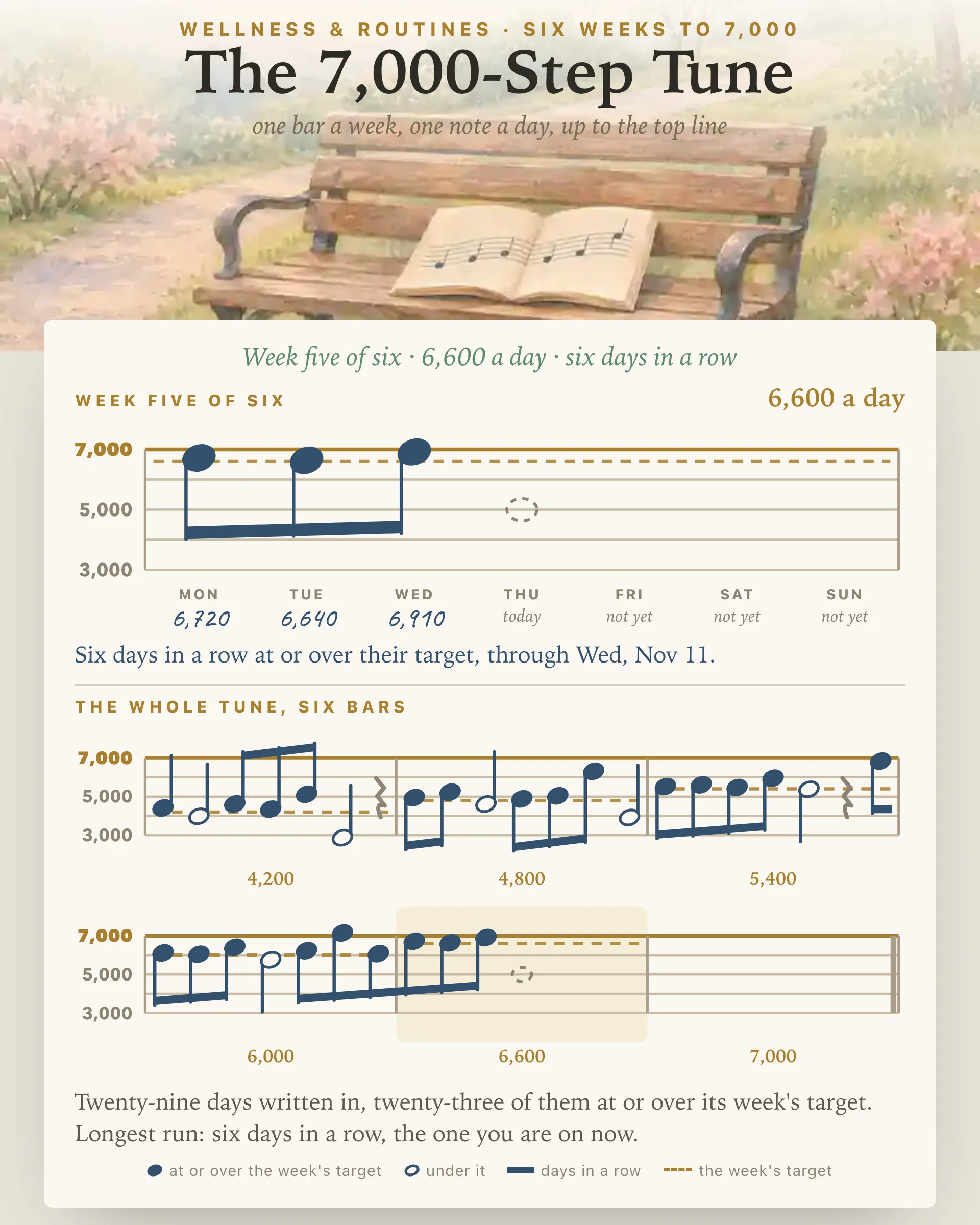
Seven thousand has become the new round number for daily walking, and this time a study stands behind it. This page turns it into a plan: start from what you walk now, climb toward 7,000 a few hundred steps at a time over six weeks, and write each day down so you see what actually happened.
In 2025, a University of Sydney team led by Ding Ding pooled studies that had adults wear a step-counting device, then followed their health for years. Their systematic review and dose-response meta-analysis took in 57 studies from 35 groups of people, most of them in the United States, the United Kingdom and Japan. Just over half looked at adults in general; the rest looked at older adults with an average age of 65 or more. The largest single pooled analysis, on death from any cause, covered about 161,000 people.
Compared with 2,000 steps a day, 7,000 was linked with a 47 percent lower risk of dying during follow-up, 25 percent lower risk of cardiovascular disease, 38 percent lower risk of dementia and 22 percent lower risk of depressive symptoms. Falls were 28 percent less likely too, a finding the authors rated very low in certainty.
The relationship was not a straight line. For death from any cause, cardiovascular disease, dementia and falls, risk dropped most steeply at the low end and each further thousand was linked with less. The authors sum up the bend as around 5,000 to 7,000 steps a day, though their detailed curves put it closer to 8,000 or 9,000 for some of those outcomes. For type 2 diabetes and depressive symptoms, the line stayed closer to straight. Going from 7,000 to 10,000 was linked with a further 10 percent lower risk of death, and for older adults that curve had not flattened. The authors' reading: 10,000 remains a fine goal for people already active, while 7,000 may be more realistic for many.
Every study in it was observational. People who walk more tend to stay healthier, but that does not prove the steps caused it: someone taking very few may already have been unwell or frail, which the review could not fully separate out. Steps were usually measured once, over a few days, on research devices rather than the phone in your pocket. Most outcomes rested on a handful of studies, the data came mainly from wealthy countries, and there was no analysis setting different targets by age. Read 7,000 as a sensible aim, not a line between healthy and unhealthy.
From a usual day of 3,500, reaching 7,000 means doubling, a lot to ask of your legs and calendar in one week. A widely used review of step guidance treats about 100 steps a minute as a reasonable floor for moderate walking. Hence this page's estimate: a ten-minute walk comes to roughly a thousand steps for most people, fewer if you walk slowly, so treat it as a guide. The same review estimated that a day already holding the minimum recommended moderate activity lands at about 7,000 to 8,000 steps, one reason 8,000 often comes up alongside 7,000.
A written number helps too: in a review of step counter studies, having a step goal was one of the clearest predictors of people walking more.
Type a usual day from your phone or step counter history. The page splits the gap between it and 7,000 into six weekly targets, each a few hundred to a thousand steps above the last, laid out as six bars of music under a top line of 7,000. If you already walk 7,000 or more, all six weeks hold there and the page helps you keep it.
Then write in each day once it is over. It lands as a note at its own height: filled when it reaches that week's target, open when it falls short. A day never written in becomes a rest and counts as nothing. Days that reach their targets one after another are joined by a beam, and only truly consecutive dates make a run. Below the music, pick up to five ways to add steps; ideas measured in minutes carry a rough estimate, totaled against the week's gap.
The Daily Steps Ladder answers a different question: what daily count makes sense for you, judged from a week of your history and the research by age group. This page starts once you have settled on 7,000 and is about getting there: one fixed target, a six-week ramp and a log of single days rather than weekly averages. The Steps to Miles Calculator turns a day's count into distance, and to count minutes instead, The Thirty-Minute Window builds a daily walk around time.
Walking 5,000 steps a day is not a failure on the way to 7,000. In the same review, 4,000 a day was already linked with a 36 percent lower risk of death than 2,000, so every bar you climb counts. If you live with a heart or lung condition, joint pain or dizziness, or have fallen recently, ask your doctor or a physical therapist how fast your ramp should rise, and stop for the day if anything hurts. Any week can be walked twice before you move up.
For many adults it is a realistic and worthwhile aim. A 2025 pooled analysis of 57 studies linked 7,000 daily steps with a 47 percent lower risk of death during follow-up than 2,000, with most of the drop in risk already reached by around that point. The studies were observational, so they show a link rather than proof, and people who are already active can keep going past it.
Slightly, for some outcomes. In the 2025 analysis the modeled risk of death at 8,000 was almost the same as at 7,000, while type 2 diabetes and depressive symptoms kept edging lower as counts rose. An older review estimated that a day holding the minimum recommended moderate activity comes to roughly 7,000 to 8,000 steps, so both numbers sit in the same neighborhood.
Yes. In the 2025 analysis, 5,000 steps a day was linked with a 43 percent lower risk of death during follow-up compared with 2,000, and even 4,000 showed a clear difference. If 5,000 is where you are now, it makes a solid floor for a ramp, and on this page it is the starting point for six gradual weeks.
At about a hundred steps a minute, 7,000 steps would take around seventy minutes of walking, but nobody starts from zero. Ordinary moving about the house and errands already adds several thousand, so someone whose usual day is 4,000 needs roughly thirty more minutes of walking, which can be split into short walks.
A few hundred to a thousand more a day each week is a gentle pace for most people, and it is the range this plan uses. If a week felt hard, walk its target again before moving up. Anyone with a heart or lung condition, joint pain, dizziness or a recent fall should ask a doctor or physical therapist how fast to build.
By the team behind Fabulous, the science-based self-care app used by over 30 million people.


