
The Overwhelm Recovery ProtocolWellness & Routines · ~5 min
About this template · Updated November 2026
VO2 max is the most oxygen your body can take in and use in a minute of all-out work. It reflects how much blood your heart pushes with each beat and how well your muscles use the oxygen, and it drifts down with age and sitting still. If you want to know how to improve VO2 max, the short answer is unglamorous: give your heart and lungs regular work near the top of their range, surround that work with plenty of easy movement, and keep it up for weeks.
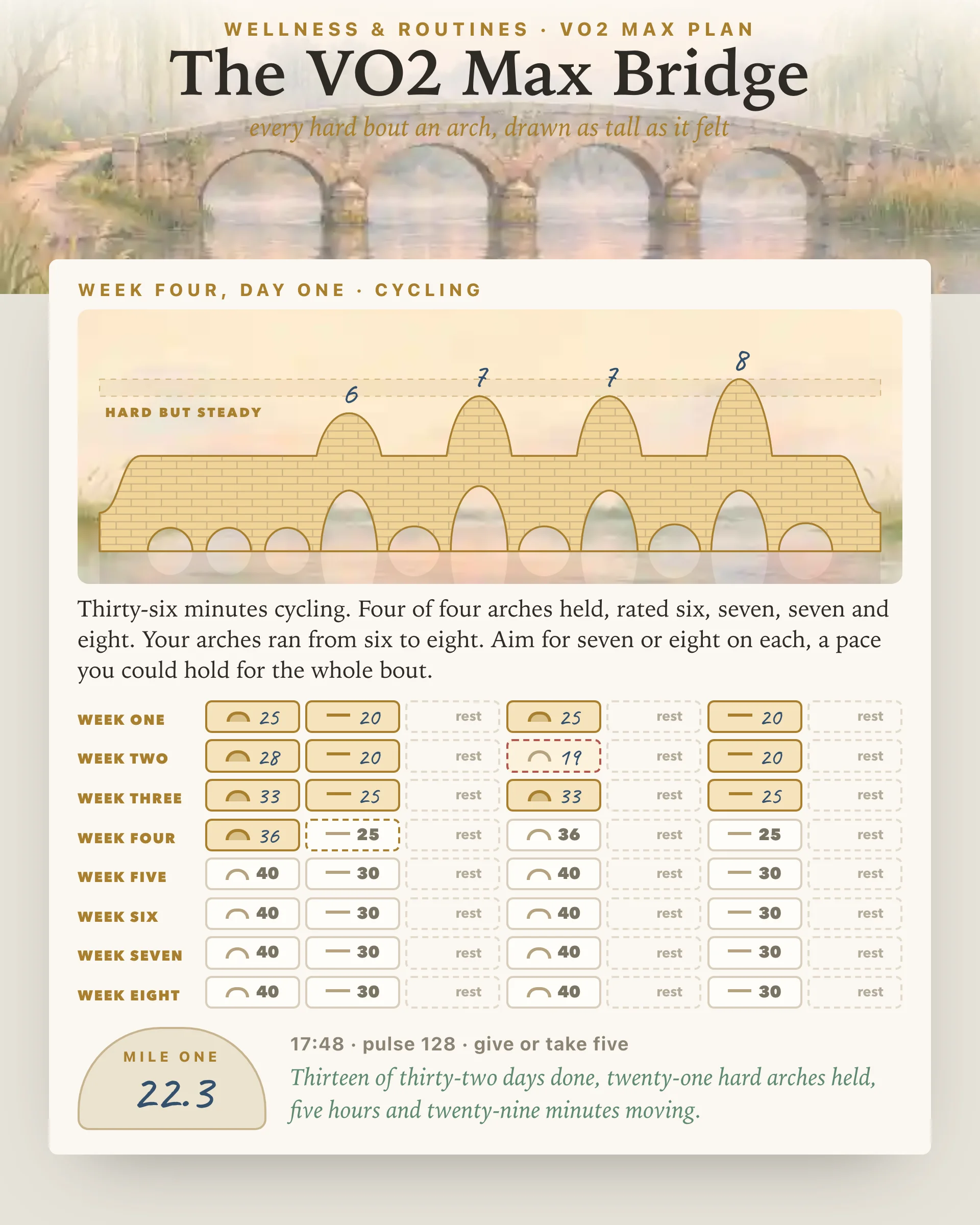
This page turns that answer into a bridge you cross twice a week. Each hard bout is an arch, the easy minutes between are low stretches of stone, and when you tell the page how hard an arch felt, it redraws that arch to match.
The best-known version of this training comes from Helgerud and colleagues' 2007 trial, which compared four ways of training with the same total work. Forty healthy, moderately trained men trained three days a week for eight weeks. One group did four hard bouts of four minutes, each followed by three minutes of easy movement. That group raised its VO2 max by 7.2 percent and a group doing fifteen-second bursts by 5.5 percent, both significantly more than the groups doing long slow runs or steady threshold runs. The blood the heart pumped per beat rose by about a tenth.
That study set the hard bouts near the top of each man's heart rate range. This page uses feel instead, which travels with you from a hill to a bike to a rowing machine.
After every arch you tap a number from one to ten. Aim for seven or eight: hard, a few words at a time, yet a pace you could hold to the end of the bout. A shade-by-shade guide to rating effort shows what each number feels like. Three or four is the easy pace between arches and on easy days, where full sentences come without effort.
Talking is the quickest check. A review of the talk test by Reed and Pipe found that comfortable speech is usually possible below the point where breathing starts to labor and not above it, and that this held across walking, jogging, cycling and other machines. The same review warns that the test is less precise for hard intervals, which is why the page pairs it with the one-to-ten rating.
The ratings matter. If your last arch reaches nine or ten, you started too fast, and the reading says so. If every arch sits at six or under and you could still chat, you have room to push.
Nobody starts at the full four by four. Week one asks for three hard bouts of two minutes. The bouts lengthen to three and then four minutes, a fourth bout arrives in week four, and the full session of four bouts of four minutes runs from week five to week eight. Each week has two interval days, two easy days of twenty to thirty minutes, and three rest days spaced between them.
Pick walking, cycling or rowing for each session. Walkers do best on a hill or an incline, since fast walking on the flat can stall below a seven. If four minutes of hard effort is too much for now, a gentler routine that alternates three brisk minutes with three easy ones builds the same habit. Older adults who want a steadier start can begin with a cardio plan built around the talk test and come back to the arches later. To see how an estimate compares with measured tests at your age, a chart of treadmill results by age lays them out.
Before week one and after week eight, walk one flat, measured mile as fast as you can keep up. The page times it, then counts fifteen seconds while you take your pulse. Kline and colleagues' 1987 walk test combines that time and pulse with your age, weight and sex to estimate VO2 max. They tested 343 healthy adults aged 30 to 69, built the equation from half of them and checked it on the rest. In that check its typical error was about a third of a liter of oxygen a minute, or roughly five points on the per-kilogram scale for many people.
So the result is a rough estimate, compared only with your own earlier miles on the same route. Wind, sleep and a red light can all move it.
A review of twenty-eight controlled trials by Milanović, Sporiš and Weston found that both interval training and steady endurance training produced large gains in VO2 max, with a small extra edge for intervals. Gains were bigger in people who started less fit and in longer programs. Those trials enrolled healthy adults aged 18 to 45, most of them young, so the numbers do not transfer neatly to someone starting at 55. People respond differently, and some change little in eight weeks, so treat this plan as a first block, not a guarantee.
Build up slowly and keep easy days easy. If you have a heart, lung or blood pressure condition, or take medicine for one, talk to your doctor before you add hard intervals. Stop at once and get help for chest pain, faintness or breathlessness that feels wrong.
Give your heart and lungs regular work near the top of their range, with easy movement around it. In one well-known trial, four hard four-minute bouts three times a week for eight weeks raised VO2 max more than the same amount of work done at a steady, moderate pace. This plan starts gentler, with two interval days and two easy days a week, and keeping at it for months matters more than any one session.
Four hard bouts of four minutes each, with three minutes of easy movement between them, after a warm-up of about ten minutes. Each bout is hard but steady: you could hold the pace to the end of the four minutes, but you could not chat. This plan builds up to it over four weeks, starting with three bouts of two minutes.
On a one-to-ten effort rating, aim for seven or eight. A quick check is talking: at that effort you can get out a few words at a time but not a whole sentence. If the last bout feels like a nine or ten, start the next session a little easier so all of them match.
A review of twenty-eight controlled trials found that both interval training and steady endurance training raised VO2 max, with somewhat larger gains from intervals, from longer programs and in people who started less fit. People respond differently, and some change little in a few weeks. Treat these eight weeks as a first block rather than a finish line.
A walking field test gives a rough estimate. You walk one mile as fast as you can, note the time and your pulse right at the end, and an equation published in 1987 combines them with your age, weight and sex. For many adults its typical error is around five points either way, so it is most useful for comparing your own tests on the same route.
By the team behind Fabulous, the science-based self-care app used by over 30 million people.


