
The Overwhelm Recovery ProtocolWellness & Routines · ~5 min
About this template · Updated November 2026
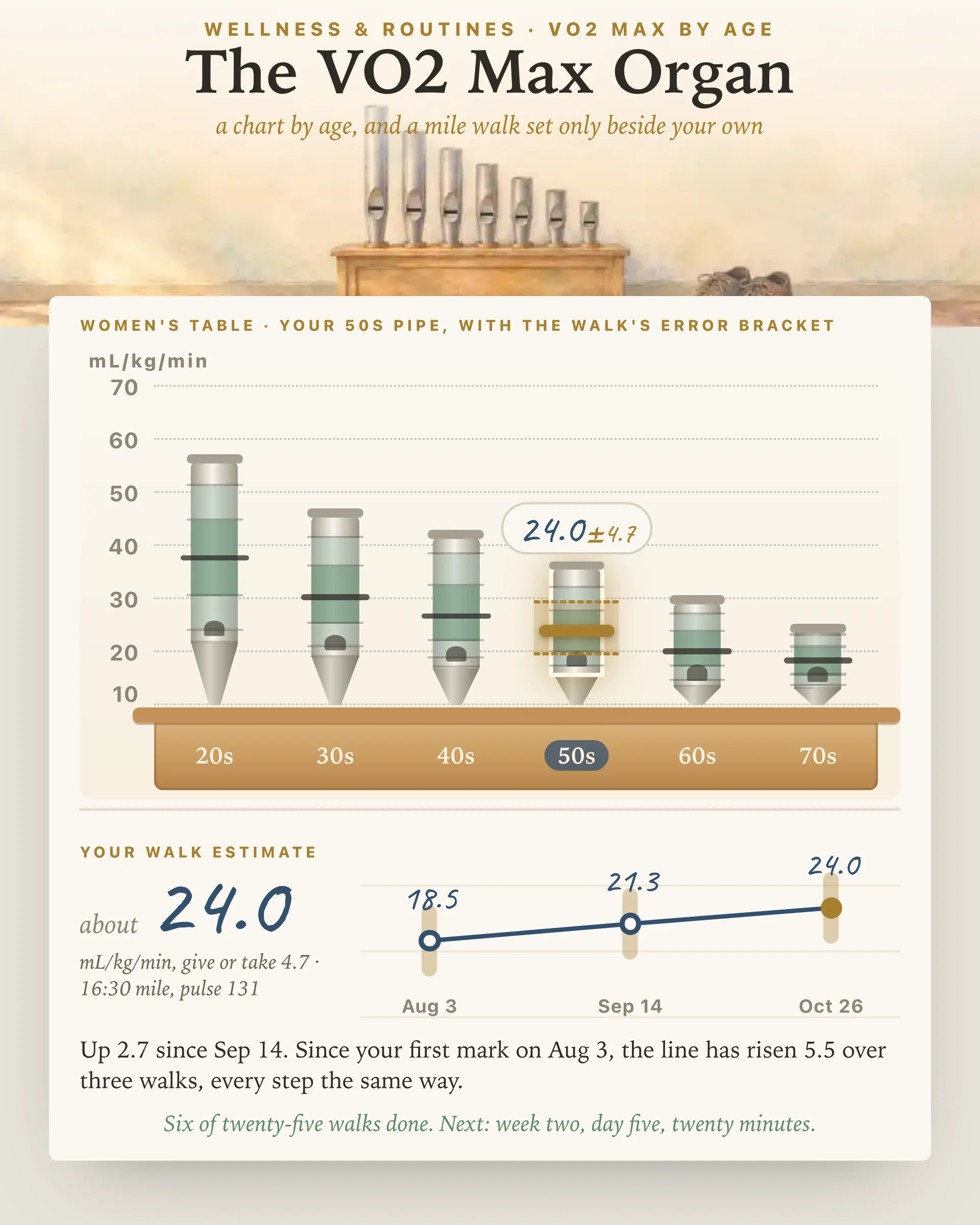
VO2 max is the most oxygen your body can take in and put to work in one minute of all-out effort, counted per kilogram of your weight in milliliters per kilogram per minute. It is the standard measure of aerobic fitness, and a chart by age shows how it spreads across adults. This page draws one as six organ pipes, one per decade, beside a walk test you can do yourself.
The pipes hold reference values from the FRIEND registry, published by Kaminsky, Arena and Myers in 2015. Eight US laboratories sent in 7,783 treadmill tests from adults aged 20 to 79 without known heart disease, each a maximal effort measured through a mask that reads the oxygen in every breath. The worksheet copies the paper's table of percentiles by decade, for women and men, exactly.
The middle half of each decade, the 25th to the 75th percentile, in mL/kg/min, with the 50th after it:
A percentile is a position, not a grade. By design, a quarter of the people in every decade sit below the 25th percentile and a quarter above the 75th. Nor is the registry a random sample of Americans: people were tested for clinical, fitness or research reasons, some had diabetes or arthritis, and fewer than one in thirty were in their seventies. Each decade holds different people, so the steps down the organ describe groups, not one person growing older. That is why the worksheet sets your number beside the pipes only as a rough guide and saves its comparisons for your own earlier walks.
Without a lab, the one-mile walk equation from Kline and colleagues gets you close. They measured VO2 max on a treadmill in 343 healthy adults aged 30 to 69, then had each of them walk a mile around a track as fast as they could. Weight, age, sex, the mile time and the heart rate over the final quarter mile predicted the treadmill result well. In a second group of walkers, the equation missed by a typical 0.355 liters of oxygen a minute, about four and a half points on this chart for someone near 170 pounds. The page prints that miss beside each estimate.
The walk asks for a hard, steady effort rather than an all-out one, which suits a beginner better than a timed run. Use a level, measured mile, such as four laps of a standard running track plus nine meters, warm up for five minutes, then walk as fast as you can hold. A watch or chest strap gives the heart rate closest to the study's. A fifteen-second pulse count right after you stop can read a few beats low as your heart settles, which nudges the estimate up a little.
Pick a table and type your age, and your decade's pipe lights up; tap any pipe to read its numbers. The walk clock keeps time even with your phone locked. Add your weight, mile time and finish heart rate, and the estimate appears as a gold collar on your pipe, with a dashed bracket for its usual miss. Mark it and it joins your own line by date, with a reading that compares it with your last walk and names what moved. A number from a lab or a watch can sit on the pipe as a ring, but it stays off your line, so every mark there was measured the same way. Six weeks of walks, with faster minutes from week three, lead to the next test.
Fitness answers training at any age, if slowly. A meta-analysis of 41 trials in inactive older adults found that aerobic training raised VO2 max by about 3.8 points more than no training, with larger gains when the training ran past twenty weeks. Over five months, walkers averaging 63 who alternated three fast and three easy minutes gained more peak aerobic capacity than those who kept a steady moderate pace. The Japanese Interval Walking Timer runs that pattern, and The Daily Steps Ladder covers the days between. For harder training, The VO2 Max Bridge builds four-minute bouts over eight weeks. Expect a single six-week step to land inside the test's error; three marks moving the same way say more.
Ask your doctor before the walk test if you have a heart, lung or blood pressure condition, have had a fall or dizzy spells, have a joint replacement, or feel pain when you walk. Walk with someone beside you or close by. Stop at once and get help for chest pain, faintness, breathlessness that feels wrong, or a racing, uneven heartbeat. None of these numbers is a diagnosis; a line that drops for no reason you can name is worth raising with your doctor.
Charts give positions, not grades. In a US registry of measured treadmill tests, half of women in their fifties came in below 23.4 mL/kg/min and half of men in their fifties below 32.6. A walk estimate can miss by four or five points, so treat any spot on the chart as a rough guide and judge change against your own earlier tests.
In a lab you walk or run on a treadmill, or ride a bike, while a mask measures the oxygen you breathe in and out, until you reach your limit. Every number in this chart came from treadmill tests done that way. Field tests such as the one-mile walk estimate it instead, using an equation built from your time, heart rate, age, weight and sex.
In the 1987 study that built it, the equation missed the treadmill result by a typical 0.33 to 0.36 liters of oxygen a minute, which for someone weighing 170 pounds is close to four and a half points on this chart. It was built on healthy adults aged 30 to 69 walking as fast as they could on a track, so it reads best for people like them.
In the registry behind this chart, the middle value for men fell from 48.0 in their twenties to 24.4 in their seventies, and for women from 37.6 to 18.3, roughly ten percent a decade. Those are different people at different ages rather than the same people followed for years, so they describe groups, not your own path.
Usually it can, though slowly. Pooling 41 trials in previously inactive older adults, whose groups averaged 60 or older, researchers found that aerobic training lifted VO2 max by about 3.8 points more than no training did, with bigger gains when training ran past twenty weeks. A six-week change can still sit inside the walk test's error.
By the team behind Fabulous, the science-based self-care app used by over 30 million people.


