Leaves on a StreamEmotional Fitness · ~3 min
About this template · Updated September 2026
TIP comes from dialectical behavior therapy (DBT), the treatment created by psychologist Marsha M. Linehan, and the steps on this page follow the TIP handout in the 2015 second edition of her DBT Skills Training Handouts and Worksheets. HabitatZero made this worksheet on its own. Dr. Linehan, Behavioral Tech (the training organization she founded) and the wider DBT community had no hand in it, and none of them has reviewed or endorsed it.
Most coping skills ask you to think. TIP is for the moments when thinking has stopped working because the feeling is too big. Linehan's handout describes it as a way "to reduce extreme emotion mind fast," and it works through the body instead. You change the temperature of your face, spend the energy a surge of emotion builds up, slow your breathing, or tense and then release your muscles. None of this solves whatever set the feeling off. The point is to bring your body down far enough that you choose your next step, instead of the urge choosing it for you.
Cold water drops your heart rate fast and a hard burst of exercise raises it, which is why the handout asks you to check with a health care provider before trying either one if you have a heart condition or another medical condition, a heart rate lowered by medication, an eating disorder or an allergy to cold, or if you take a beta-blocker.
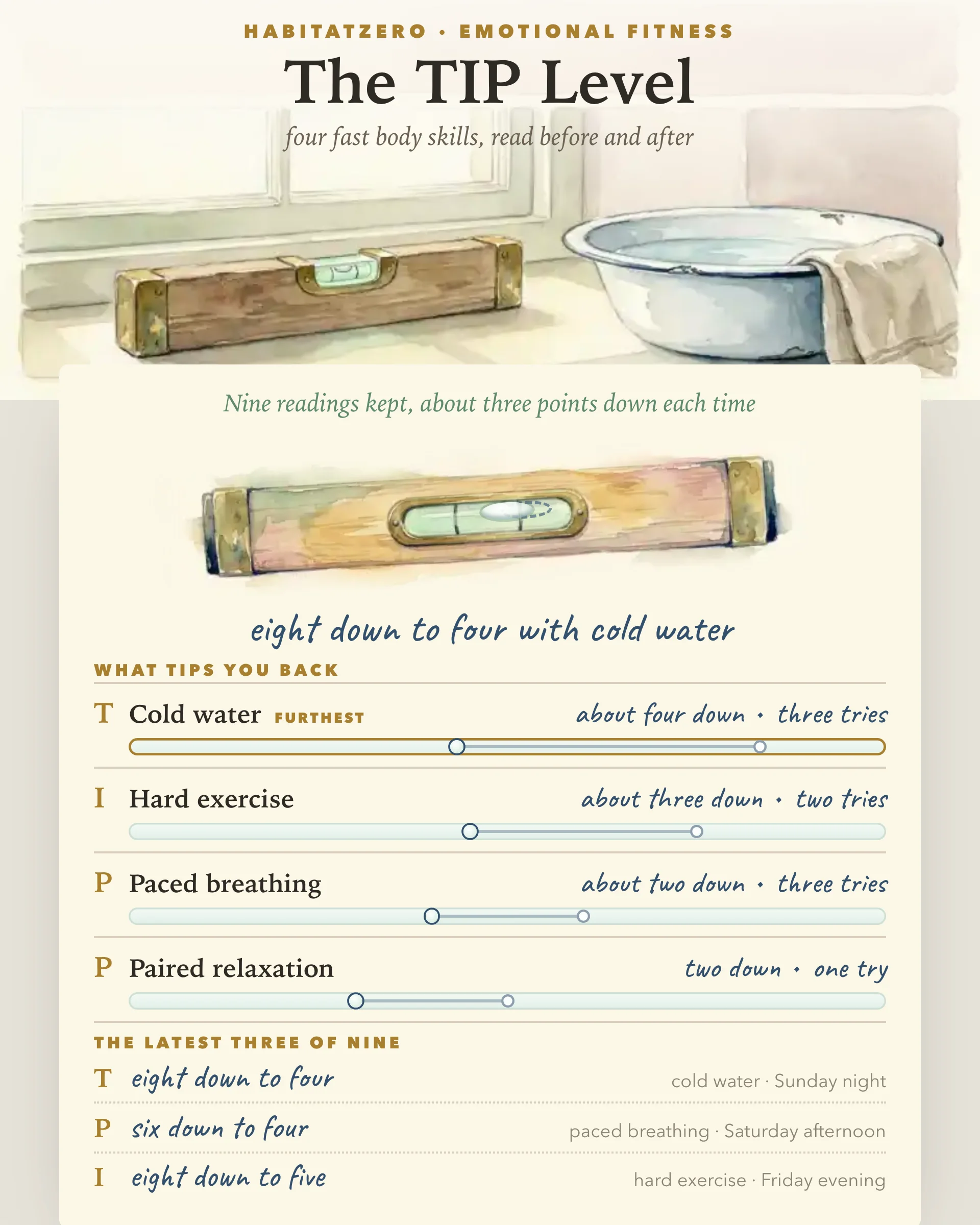
The page is a carpenter's spirit level, because TIP is a word about tipping. Tap the scale under it to say how strong the feeling is, from zero, level, to ten, all the way over, and the painted level tips to match. Pick one of the four and its steps come one at a time; cold water and exercise open on their caution. The cold-water hold gets a silent thirty-second count, exercise gets a quiet timer, and paired relaxation runs a tense-and-release round. For paced breathing the level itself becomes the pacer, tipping up as you breathe in and settling back, more slowly, as you breathe out. Nothing on the page makes a sound.
When you finish, read the level again; a dashed ring keeps the bubble's old spot on the glass. Keep the reading, and after a couple of tries at each skill the page names the one that brings your number down furthest and marks its card for the next hard moment.
When you hold your breath with your face wet, the diving reflex slows the heart. A systematic review of slow-breathing research linked breathing at under ten breaths a minute with higher heart rate variability and with people reporting less arousal, anxiety and anger, though only fifteen studies made the cut, all of them in healthy people.
Research on TIP as a set mostly looks at it inside full DBT programs, alongside many other skills, so it is hard to say how much any single skill adds. In interviews with twenty-four people in eighteen months of DBT, every one of them said distress tolerance skills eased their tension right away, thirteen used TIP skills, and most said the skills that suited them had to be found by trying and then practiced. That is the case for keeping a record: the skill that works fastest for someone else may not be yours.
This page is practice, not treatment. DBT is best learned with a therapist, and if feelings this strong arrive often, that is worth bringing to one. If you are in crisis or thinking about hurting yourself, call or text 988 (US) right now, or reach your local emergency number.
Try each skill once on an ordinary day, so the steps feel familiar before you need them. Reach for the level when a feeling sits at eight or above and you can feel the pull to act on it. Once your body has come down, Urge Surfing helps you ride out an urge that is still hanging around, The Window of Tolerance maps the zone you are working your way back into, and The Skills Compass points to the slower DBT skills for whatever caused the storm.
TIP is a distress tolerance skill from Marsha Linehan's DBT skills training, meant for moments when a feeling is so intense that thinking your way out is not working. The letters stand for temperature, intense exercise and paced breathing, and paired muscle relaxation shares the P. Each one changes what your body is doing within minutes, which can bring the feeling down far enough to choose your next move.
They name the same skill. Linehan's handout groups paced breathing and paired muscle relaxation under one P, so it reads TIP. Many worksheets give the relaxation step a letter of its own and spell it TIPP, sometimes calling it progressive muscle relaxation.
The handout says to hold your breath and keep your face in cold water, or a cold pack on your eyes and upper cheeks, for about thirty seconds, with the water above 50°F. Ask a doctor before trying it if you have a heart or other medical condition, a heart rate lowered by medication, an eating disorder or a cold allergy, or take a beta-blocker.
Most TIPP worksheets are printable handouts. This one is interactive instead: it walks you through each skill, keeps the before and after numbers for you, and works out which of the four helps you most, which a paper sheet cannot do.
The filled-in sample on this page is open to look through. Taking your own readings, running the guided steps and building a record of what works starts once you personalize the page in HabitatZero, and that costs nothing.
By the team behind Fabulous, the science-based self-care app used by over 30 million people.