Leaves on a StreamEmotional Fitness · ~3 min
About this template · Updated September 2026
Credit where it belongs: the window of tolerance is the work of psychiatrist Dr. Dan Siegel, who used the image for the band of arousal in which a person can function and take things in. Trauma therapists have taught it to clients ever since. This page is our own practice sheet built around his idea. Nobody on Dr. Siegel's side made, reviewed or approved it, and it has no tie to him or to his organisations.
A worksheet helps you notice and plan; it is not therapy, and it cannot assess anyone. If you are in crisis or thinking about hurting yourself, call or text 988 (US) right now, or reach your local emergency number.
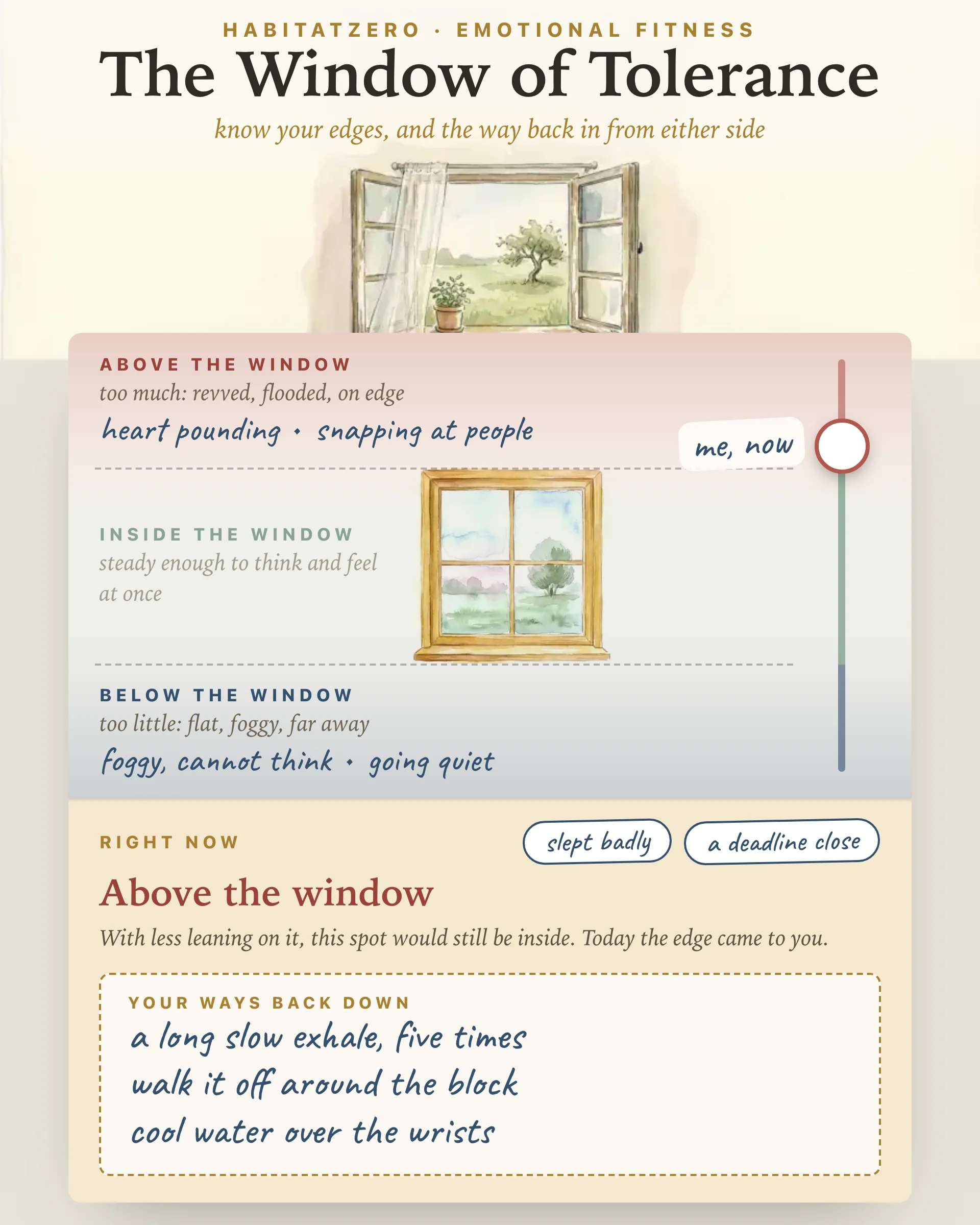
Picture a window set in a wall. Inside the frame you are steady enough to think and feel in the same moment. You can hear criticism without collapsing, feel irritation without throwing it at anyone, and wait a second before you answer. That is not the same as calm: you can be sad, nervous or excited in there. What marks it is that you still have a say in what you do next.
Above the window is too much. Clinicians call it hyperarousal: a pounding heart, racing thoughts, a short fuse, the sense that everything is urgent. Below the window is too little, or hypoarousal: numb, foggy, heavy, far away, going quiet halfway through a conversation.
Both are your body protecting you, and neither is a flaw of character. The practical trouble is that the two edges need opposite help. Someone above the window needs to come down slowly; someone below it needs to come up gently. Advice that suits one makes the other worse, which is why being told to relax lands so badly on a person who has already gone flat.
Your window is not a fixed size. On a rested, fed, unhurried day it is wide, and a rude email bounces off. After a short night the same email sends you through the ceiling. Sleep research points the same way: one review describes a causal relationship between sleep and how the emotional brain functions, with clear impairments after too little of it. Hunger, pain, conflict and too long alone tend to lean on the frame in a similar way.
Tap whatever is true today and the painted window shrinks, pulling both edges toward the middle. Sometimes the marker you placed a minute ago ends up outside without having moved, and the page tells you that on a lighter day the same spot would still be inside. You did not overreact; the edge came to you.
On a steady day you draw the map. For each side you tap or write the signs that tell you where you are, six at most, then up to five ways back: ways down for the upper edge, ways up for the lower one. The limits are deliberate, because a map you can read in ten seconds is the only kind that helps once your thinking has narrowed.
On a rough day you check in. Slide the marker along the wall until it sits where you are, then press check in here. If you are outside the window, the sheet hands your own lines back, so you are reading a plan instead of inventing one. A running count of check-ins shows, after a while, which edge you tend to leave through.
The window of tolerance is a teaching picture, not a measurement. No scan or questionnaire reads off the width of anyone's window, and the sketch on this page is drawn only from your own taps. In the clinical literature the model lives mostly in trauma work; one review applies it to the long-term effects of severe emotional trauma and proposes mechanisms behind it, which is theory-building rather than a trial showing that teaching the model changes outcomes.
Individual ways back stand on firmer ground. A systematic review of fifteen studies found that slow breathing, under ten breaths a minute, went along with higher heart rate variability and lower arousal and anxiety. Those participants were healthy adults, so read it as support for a long exhale on an ordinary hard day, not as proof of anything about trauma recovery.
For the upper edge, think slow and heavy: a lengthened exhale, cool water, palms pressed into a wall. Box Breathing paces the breath for you when counting is beyond you. For the lower edge, think small and bright: standing up, daylight, a sour taste, a song with a beat, a message to one safe person. 5-4-3-2-1 Grounding works from either side because all it asks is that you notice what your five senses can find. When the trouble is one particular feeling rather than its volume, Steadying Practices walks you through a single hot moment.
Use this for everyday swings: the meeting that leaves you buzzing, the Sunday afternoon you cannot get off the couch. If you are outside the window most days, if you lose stretches of time, or if old memories are what push you out, that is work for a trauma-trained therapist, and this map is worth bringing along.
It is a picture of the range of arousal in which you can think and feel at once, a concept from psychiatrist Dr. Dan Siegel. Inside the window you can take things in and choose how to respond. Above it you are flooded and reactive, and below it you are numb and shut down.
Hyperarousal is the upper edge: a racing heart, anger or panic, thoughts that refuse to slow. Hypoarousal is the lower edge: flatness, fog, heavy limbs, a feeling of being far from the room. The two call for opposite help, slowing down from the top and gently waking up from the bottom.
Day to day, the unglamorous basics matter more than any technique: enough sleep, regular meals, movement, and time with people who feel safe. Many therapists also suggest rehearsing a way back while you are only a little past the edge, so the move is familiar when you are far past it. A window narrowed by trauma is work to do alongside a trained therapist.
Neither. Nothing on the page scores or assesses you, and the size of the painted window is a sketch drawn from what you tapped, not a measurement. The check-in count only reflects where you chose to place the marker.
You can read the whole method and study the filled example right here. Moving the marker, saving a map and keeping a check-in count all happen in your own copy, which opens when you press Personalize this template and costs nothing.
By the team behind Fabulous, the science-based self-care app used by over 30 million people.