
The Overwhelm Recovery ProtocolWellness & Routines · ~5 min
About this template · Updated November 2026
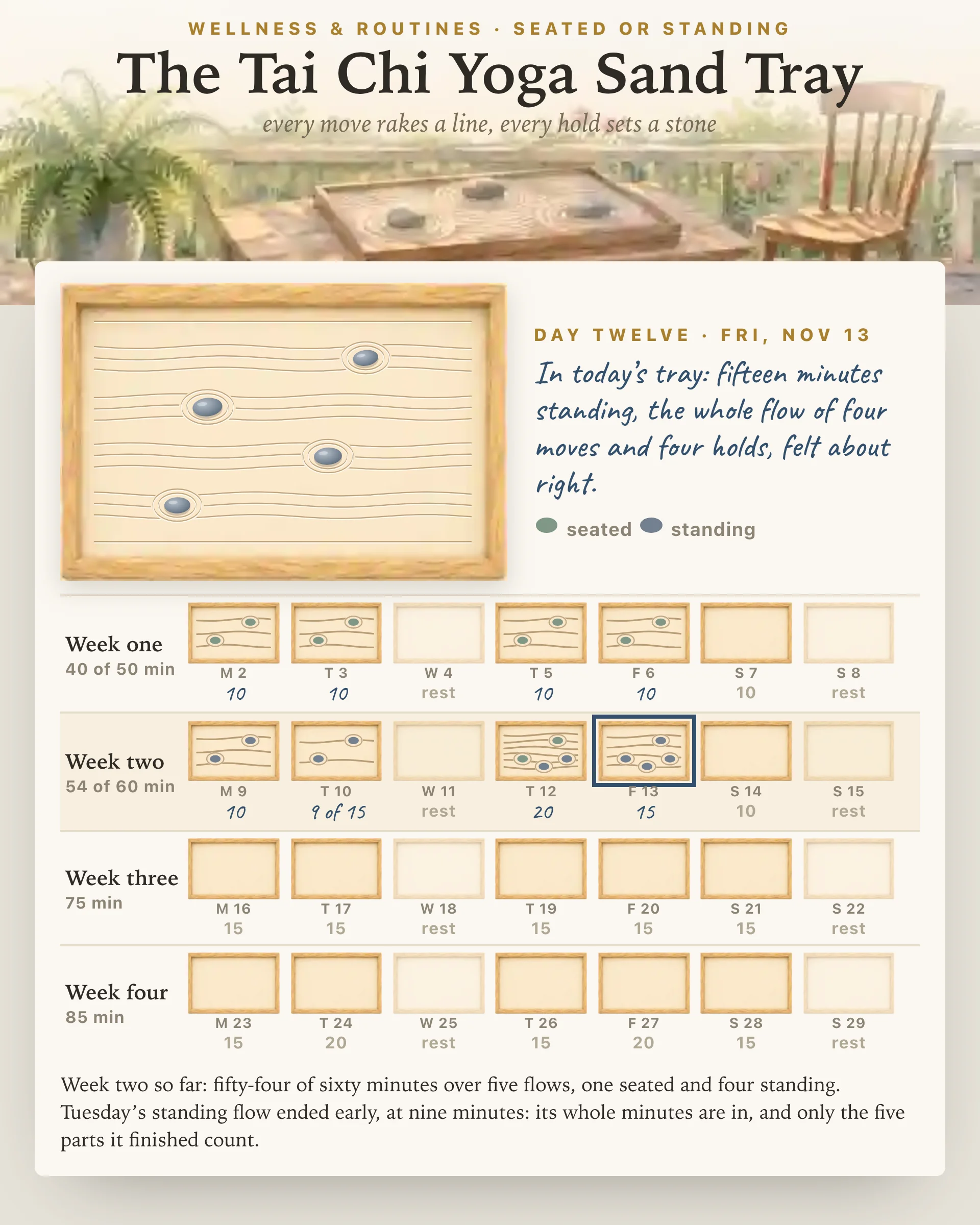
Tai chi yoga is not one official style with a founder and a rulebook. It is what you get when a teacher takes the slow, unbroken weight shifts of tai chi and sets them beside the still, held shapes of yoga. This page does it the simplest way: one slow tai chi move, then one quiet yoga hold, then the next move, for ten to twenty minutes, sitting in a chair or standing behind one.
The two practices ask different things of you. A tai chi move keeps going: in wave hands like clouds, a slow side-to-side sweep of the arms, the hands trade places for two minutes without a pause. A yoga hold stops. In mountain you sit or stand tall and do nothing at all except breathe, and in chair pose you stay in a small sit-back while your legs do quiet work.
Taking them in turns gives each part a job. The move warms you up and gets the breath going; the hold lets it settle. Then the next move begins before stillness turns into fidgeting. The fifteen-minute flow, for example, runs like this: an opening where the arms float up and sink with the breath, wave hands like clouds, mountain, part the wild horse’s mane, a gentle twist, brush knee, chair pose, repulse the monkey, cat-cow, and a closing with the hands resting on the belly.
Pick seated or standing, then ten, fifteen or twenty minutes. The plan marks the length meant for today. Press begin and each part appears with its name, a plain description, how to set up for it and, when you stand, a way to hold the chair. A ring beside the cue grows as you breathe in for four counts and shrinks as you breathe out for six. If counting makes you tense, turn the ring off.
The tray is the record. Each tai chi move rakes a band of three lines across the sand while you do it, and each yoga hold sets a stone, ringed by raked circles, once its time runs out. An opening line and a closing line frame the whole thing. When the flow finishes, the tray is full. Stop early and you keep the whole minutes you did and the parts you finished, nothing more, so a part you cut short or skipped stays smooth sand.
Underneath, four weeks of small trays show every flow: lines for the moves, stones for the holds, green for a seated flow and blue-gray for a standing one. After each flow you tap easy, about right or too much, and a line under the tray suggests what to try next: standing with a hand on the chair, a longer flow, or a gentler one.
Every part has a seated version, so you can do the whole plan in a chair. Standing versions keep a chair back or a counter within reach, and each one names a way to hold on: one hand on the chair while the other arm sweeps, both hands on it for golden rooster, where lifting just the heel still counts. You can sit down for any part without stopping the clock, and the cue tells you how.
Talk to your doctor or a physical therapist before you begin if you have fallen or felt dizzy recently, had a joint replaced, live with a heart or blood pressure condition, or have pain that keeps returning. Stop any part that hurts.
The strongest evidence is about tai chi and falls. A Cochrane review of exercise for older people living in the community pooled 108 trials with more than 23,000 participants. Balance and functional exercise reduced how often people fell, and tai chi may have done the same, though the certainty for its effect on the rate of falls was low.
Yoga has a smaller body of work. A review of yoga-based exercise in people aged 60 and over found six trials with 307 participants and reported small improvements in balance and moderate improvements in mobility. Its authors say plainly that nobody yet knows whether those gains prevent falls.
For the seated side, a review of chair-based exercise in adults over 50 gathered 25 studies with 1,388 participants and found better grip strength and more chair stands in thirty seconds after chair programs.
None of these reviews looked at a blended tai chi and yoga flow, or at a four-week plan like this one. So this page makes no promise about falls, strength or anything else. What the research does back is the habit underneath it: regular, unhurried movement that asks a little of your balance, kept up week after week.
Use it on the days you want to move without breaking a sweat, five days a week for four weeks. If you want a page that stays fully seated and follows one figure, Chair Tai Chi is built for that, and Chair Yoga for Seniors keeps to seated yoga poses alone. If tai chi alone is your interest and you want its standing and seated forms side by side, try Tai Chi for Seniors. For tai chi on a busy day, The 7-Minute Tai Chi Kite builds sessions of five to fifteen minutes.
It is a blend rather than one official style: the slow, continuous weight shifts and arm circles of tai chi, taken in turns with the still, held shapes of yoga. Teachers mix the two in their own ways. This flow trades one tai chi move for one yoga hold, so you move, then settle, then move again.
Yes. Every part of the flow has a seated version, from wave hands like clouds to the twist and cat-cow, so a whole session can happen in a chair. When you choose standing, each cue still tells you how to hold the chair back, and you can sit down for any part.
Here it is ten minutes in the first week, building to fifteen and then twenty on two days of the last week, five days a week. Nobody has worked out a best dose for a blended flow, so the plan starts small and lets you pick a shorter length on any day.
It might, but nobody can promise it. A Cochrane review found tai chi may lower how often older people fall, and a review of yoga trials found small gains in balance in people over sixty. Neither tested a blend like this one, so treat it as gentle practice rather than a fix.
Anyone who has fallen or felt dizzy lately, had a hip or knee replaced, lives with a heart or blood pressure condition, or has pain that keeps returning. Stop any part that hurts, and keep the chair or a counter within reach whenever you stand.
By the team behind Fabulous, the science-based self-care app used by over 30 million people.


