
The Overwhelm Recovery ProtocolWellness & Routines · ~5 min
About this template · Updated November 2026
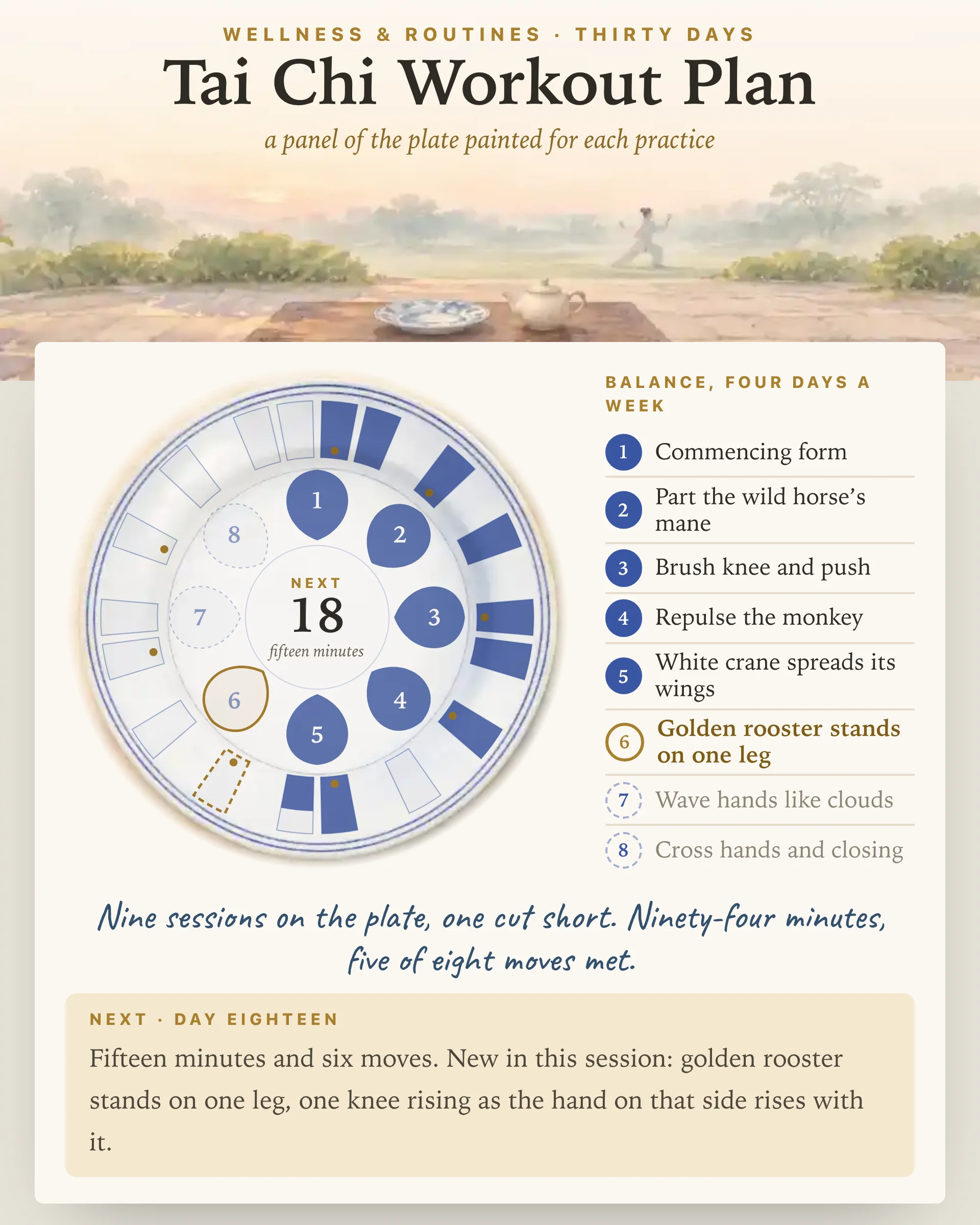
This plan draws thirty days of tai chi from three answers: what you want from the practice, how many days a week you can spare, and how long a full session should run. The page then lays out every day, brings in eight moves one at a time, runs a clock through each session, and paints a panel of a porcelain plate each time you practice.
Start with the goal. Balance brings the stepping moves in early, practiced beside a chair, and holds the one-leg move back until the third week. Calm opens with the slow arm moves, each paced by your breath. Gentle fitness starts stepping early, then asks for a little more bend in the knees each week so your legs carry more of the work. The goal sets the order the moves arrive in and the short cue for each week.
Next, choose three to six days a week; the rest days stay as blank rim on the plate. Last, pick the length of a full session, from ten to thirty minutes. The first two weeks run shorter than your choice on purpose, never under ten minutes, because those weeks are for learning shapes rather than lasting longer.
The first move comes on day one and a new one follows every three or four days. By the fourth week all eight are in, and the final days join them into one slow set.
Each comes from the short classic forms:
Every move has a version done beside a sturdy chair. Use it whenever your footing feels unsure.
Tap any day on the rim to see its minutes, its moves, the week's cue and whether a move is new that day. The next session is outlined in gold. Press begin and the clock walks you from a loosening minute through the day's moves to a still minute at the end. If your phone locks or you switch away, the clock still shows true time when you return, and a pause holds it exactly where you left it.
A session run to the end paints its panel cobalt. Stop early and only the whole minutes you did are painted, so a panel can sit partway full. A move counts as met only once a session has run through all of its part. Missed a day, or practiced somewhere else? Log it by hand, and tap a painted day twice to clear it.
Once the first panel is painted the plan stays put, so the plate stays true to what you did; a fresh plate lets you redraw it.
A 2019 Cochrane review of exercise for people over sixty living at home found fewer people falling in tai chi groups than in comparison groups, a finding it rated high certainty, while its estimate for the total number of falls was less certain. A meta-analysis of eighteen tai chi trials reached a similar conclusion and found the effect tended to grow with more frequent practice, one reason this page lets you choose up to six days a week. For mood, a review of tai chi and psychological well-being found the practice associated with less stress, anxiety and low mood, though its authors asked for longer, better controlled trials before anyone draws firm conclusions.
Be clear about the gap. The trials in the falls analysis ran from two months to two years, most of them three months or more, so thirty days on your own is a beginning rather than the dose they measured. Nothing here can tell you your own risk of falling, and a plan on a screen cannot watch your feet the way a class can.
Draw the plan once, before your first session, and come back to it each practice day.
If you would rather try the moves before committing to a month, the move cards build one session from the moves you pick, and a four-week starter scroll adds one move a week at a steady ten minutes. If feeling steadier on your feet is the main reason you are here, a twelve-week plan practiced at the kitchen counter goes slower and adds a one-leg check every two weeks. For a short standing set to open the day, The Morning Willow paces five qigong moves with a slow breath.
Practice on a clear floor in flat shoes or bare feet with a chair in reach, and stop if anything hurts. If you have had a fall, dizzy spells, a replaced joint, a heart or blood pressure condition or ongoing pain, check with your doctor or a physical therapist first.
Three days is a sound start for most people, and this plan lets you choose anywhere from three to six. One review of falls found that the benefit tended to grow as practice became more frequent, so add a day once the sessions feel easy.
This page is one. It brings in eight classic moves one at a time over thirty days, starts as short as ten minutes, and gives every move a version you can do beside a sturdy chair. You decide the goal, the days and the length, and the plan redraws around them.
A handful of moves learned slowly rather than a long form rushed. Here that means a warm-up minute, a new move every three or four days, practice in the same order each time, and a still minute at the end. By the fourth week all eight are in, and the final days join them into one slow set.
It is low-impact movement that asks a lot of your legs and your balance and less of your heart and lungs. Many people pair it with walking or a little strength work. Choosing gentle fitness on this page brings the stepping moves in early and asks for slightly deeper knees each week.
Nothing is lost. A missed day stays open and you can log it by hand if you practiced it somewhere else. A session you end early paints only the whole minutes you did, so the plate always shows what really happened, and the next session picks up from the furthest day you reached.
By the team behind Fabulous, the science-based self-care app used by over 30 million people.


