
The Overwhelm Recovery ProtocolWellness & Routines · ~5 min
About this template · Updated November 2026
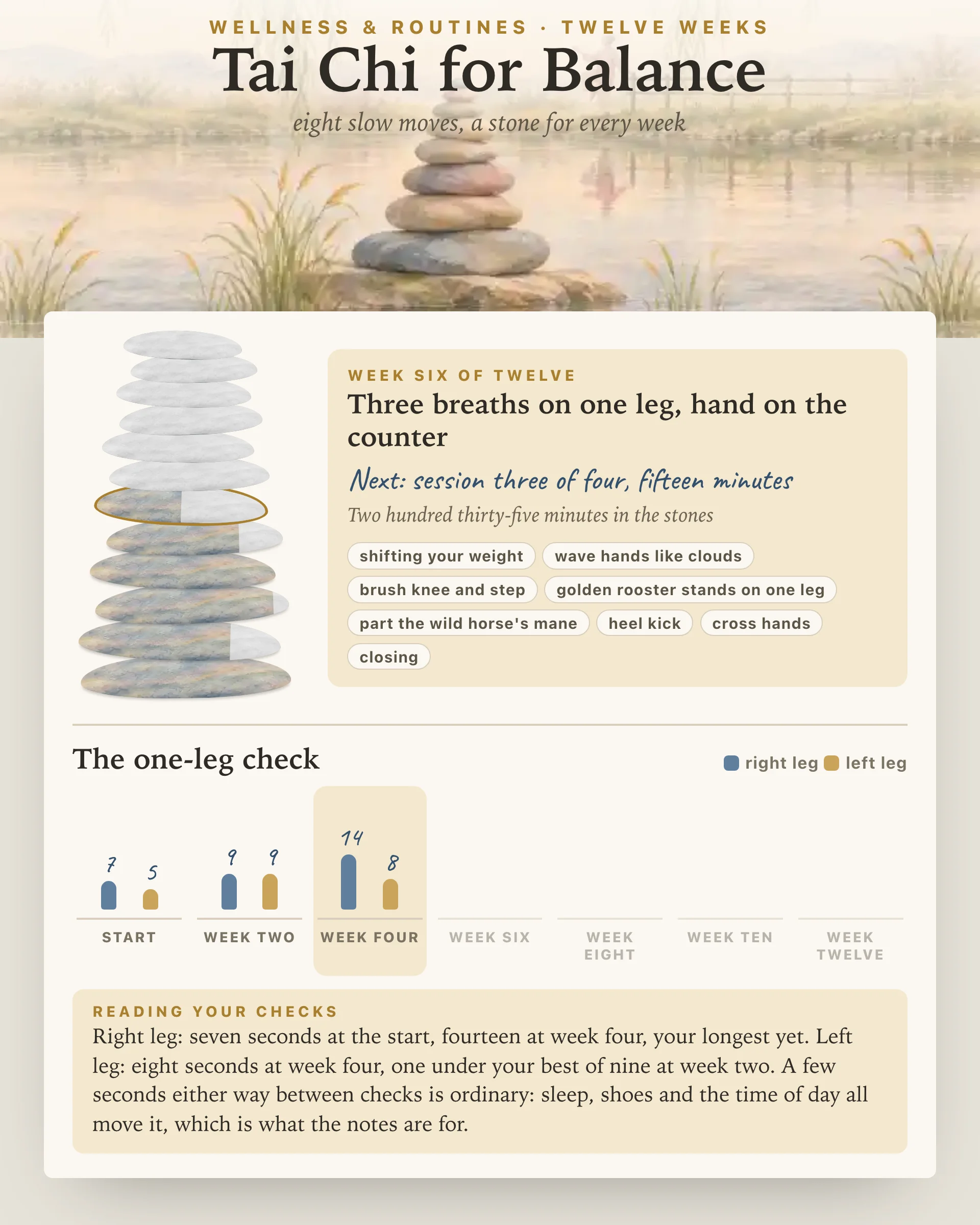
Pulling on a sock while standing, stepping off a curb, turning when someone calls your name: balance is mostly a string of small weight shifts you never think about. Tai chi practices those shifts slowly and on purpose. This page gives you eight moves chosen for that work, a kitchen counter to steady you, and twelve weeks that grow from thirty minutes a week to a hundred.
Several tai chi moves ask you to stand on one leg for a breath or two. Beside a sturdy counter you can practice that hard part without gambling on it. Every move here comes in two versions, and the counter version is listed first, because that is where everyone starts.
Tap begin and a session clock walks you through the eight moves in order, showing how to do each one with a hand on the counter. Pause whenever you need to. If you stop early, it logs the minutes you actually did.
Each week is a stone in a small cairn that fills as you log sessions, so a missed day shows as a stone left partly pale, not a broken streak.
Before week one, and at the end of every second week, the page asks for a one-leg check: side-on to the counter, one foot raised a few inches, the stopwatch stopped when it touches down or your hand goes to the counter. Thirty seconds is the most it counts. Each time is read only against your own earlier ones, with no norms, no scores and nothing about risk. If one leg without a hand is not safe for you yet, keep your fingertips on the counter for every check.
Weeks one and two teach the moves in ten-minute sessions. Weeks three and four add the breath and longer steps, weeks five and six hold the one-leg moments longer, and weeks seven and eight try a lighter touch on the counter where a move already feels easy. From week nine the eight join into one flow you go through twice, and by week twelve a session lasts twenty-five minutes, four days a week.
The clearest early result came from a randomized trial of tai chi and falls in Portland, Oregon. Two hundred fifty-six inactive adults aged seventy to ninety-two took tai chi or stretching classes three times a week for six months. The tai chi group had thirty-eight falls against seventy-three, and its single-leg standing and other balance measures improved more. A later trial with six hundred seventy adults over seventy who had fallen in the past year or had trouble getting around compared a balance-centered tai chi course with two other kinds of exercise, in twice-weekly hour-long classes for twenty-four weeks. The tai chi group had the fewest falls.
Not every trial agrees. In a Dutch trial of two hundred sixty-nine older people at high risk of falling, those who practiced tai chi for an hour twice a week for thirteen weeks fell no less over the following year than those given usual care. Pooling the studies, the Cochrane review on exercise and falls in older people living at home judged with high certainty that fewer people fall when they do tai chi, while rating its estimate for the overall number of falls as low certainty.
Those studies tested classes led by trained teachers, mostly for six months. Nobody has tested this page, and twelve weeks at a counter is lighter than any of those courses. A longer one-leg time tells you how your standing has changed, not whether you will fall. If a class meets near you, go: a teacher can correct what a screen cannot see.
Before your first session, talk with your doctor or a physical therapist if you have fallen before, get dizzy, have had a joint replacement, or live with a heart or blood pressure condition or with pain. Stop if anything hurts, and whenever you stand, keep a sturdy counter or chair close enough to touch.
Open the page at the counter just before you practice. If you would rather begin with something shorter, Tai Chi for Seniors sets six moves side by side, standing and seated, over four weeks. When standing feels wrong, Chair Tai Chi stays in a seat. For plain balance holds without the flowing moves, The Balance Ladder climbs ten counter holds one rung at a time. And for standing poses held longer, The Door Frame times six yoga poses at the counter, the wall or free.
A pale stone is not a lost week. Pick up with the next session.
In a Portland trial, inactive adults aged seventy to ninety-two who took tai chi classes three times a week for six months improved more on every balance measure, single-leg standing among them, than a group who only stretched. Those were supervised classes, so your own change at home may be smaller or larger.
In several trials it did. A Cochrane review of exercise for older people judged with high certainty that fewer people fell in tai chi groups, though it rated its estimate for the overall number of falls as low certainty, and a Dutch trial of a thirteen-week course found no drop in falls. This home plan has not been tested and promises nothing about falls.
Moves that shift your weight slowly and ask for a moment on one leg. This page uses eight: shifting your weight, wave hands like clouds, brush knee and step, golden rooster stands on one leg, part the wild horse's mane, heel kick, cross hands and closing, each with a version done holding a counter.
The trials that reported fewer falls or better balance mostly ran for about six months, with classes two or three times a week. This plan lasts twelve weeks and grows from thirty to one hundred minutes a week, so think of it as a start, and let the one-leg check show how your own times move.
Done slowly beside a sturdy counter it is usually gentle, and every move on this page has a supported version. If you have fallen, get dizzy, have a joint replacement, or live with a heart or blood pressure condition or with pain, ask your doctor or a physical therapist before you begin, and stop if anything hurts.
By the team behind Fabulous, the science-based self-care app used by over 30 million people.


