
The Overwhelm Recovery ProtocolWellness & Routines · ~5 min
About this template · Updated November 2026
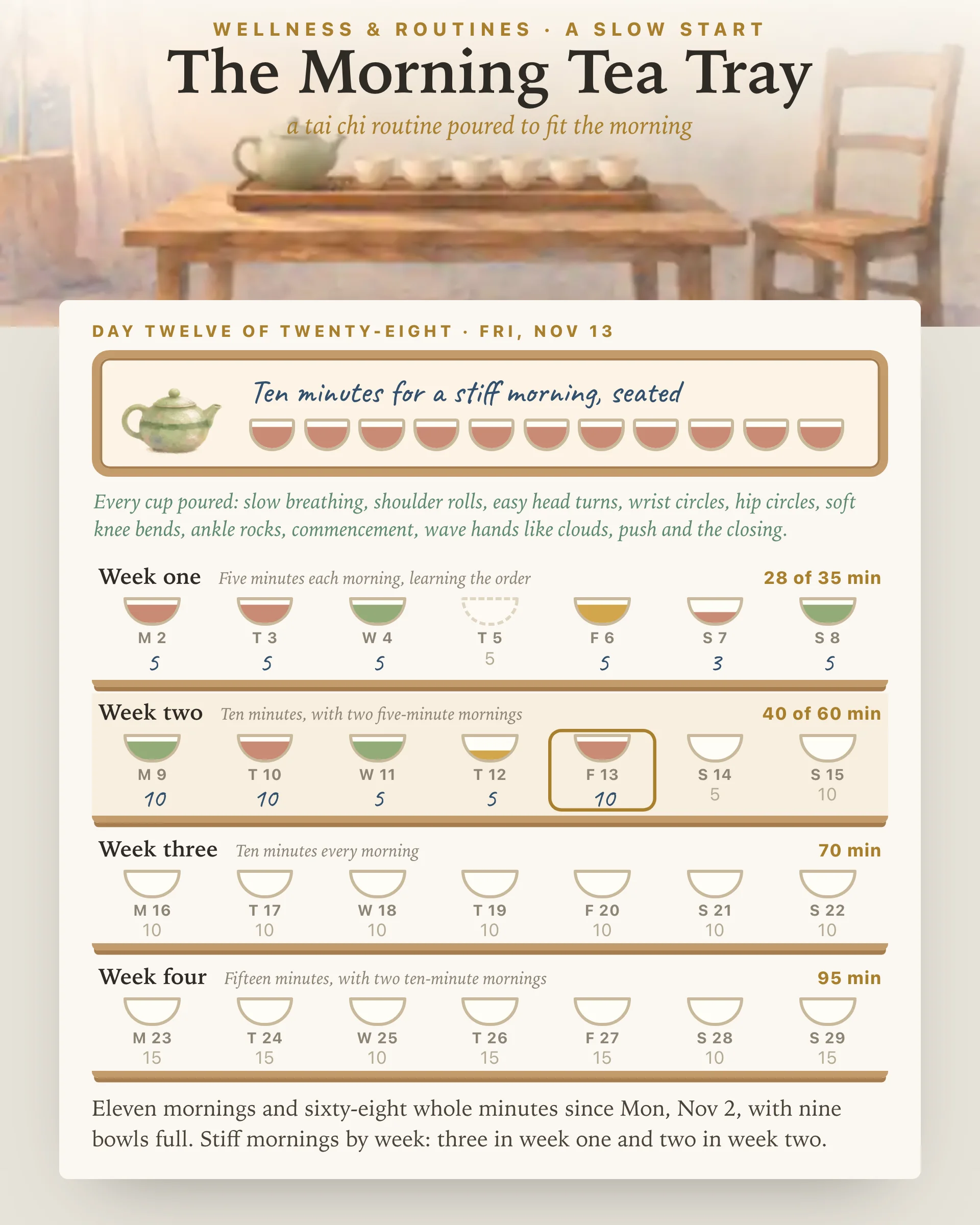
Some mornings you wake up loose and ready. Others your neck creaks, your hips feel like old hinges, or the clock says you have about six minutes before the day starts pulling. A tai chi morning routine that ignores the difference asks too much on the hard mornings and too little on the easy ones.
This page starts with one question: how does this morning feel? Your answer, stiff, steady or short on time, decides what goes on the tray. Then you pick five, ten or fifteen minutes, choose a chair or the kitchen counter, and follow a slow count.
The closest pages on this site each have their own job. The Morning Willow is a fixed five-move qigong set, The 7-Minute Tai Chi Kite fits short sessions into any hour of the day, and The Tai Chi Starter Scroll teaches one new move a week. This one reshapes the routine itself around the morning you actually woke up to. For men past fifty who want more work for the legs, The Tai Chi Horseshoe Board sets how deep the knees bend.
Each piece opens to show two ways of doing it: seated in a sturdy chair without wheels, or standing at a kitchen counter with a hand on it for every move, and both hands for golden rooster, the one moment on a single leg. Traditional names keep a plain gloss: wave hands like clouds is a slow side-to-side sweep of the arms as the waist turns.
Press begin and a painted teapot tips forward on each out-breath, a large handwritten count marks each second, and the cue for your chosen way sits beneath it with the time left in the piece.
The clock keeps real time, so a phone that locks halfway through still finds its place, and paused time never counts. Only what you did counts. Run the routine to its end and every cup on the tray fills. End it early and the whole minutes you finished go into the morning's bowl, with nothing for a part-minute. A skipped piece pours nothing, even if the phone wakes long after the routine would have ended.
Under the tray, a shelf holds twenty-eight bowls, a row for each week, and each bowl fills by the whole minutes you finished that morning against its plan. A short reading counts your mornings, minutes and full bowls, and tallies the stiff mornings week by week. That is a record of how your mornings felt, not proof of what tai chi did.
Week one is five minutes every morning, long enough to learn the order. Weeks two and three settle on ten, with two lighter five-minute mornings in week two. Week four reaches fifteen, with two ten-minute days. Every morning has some minutes, because the daily habit is the point.
Sit on the edge of the bed for a few breaths, then stand with a hand on something steady. The National Heart, Lung, and Blood Institute notes that older adults are more likely to feel dizzy or faint on standing up, and that some blood pressure medicines add to it. It also says sitting down may ease the symptoms, so if your head swims, sit back down until it passes.
In a trial of 204 people with painful knee osteoarthritis, average age sixty and mostly women, twelve weeks of twice-weekly tai chi classes improved pain, stiffness and function scores about as much as standard physical therapy, with no serious side effects. Participants knew which group they were in, instructors led the classes at a hospital, and nobody tested short home routines or the time of day.
A Cochrane review of 108 trials of exercise in older people living at home, whose 23,407 participants averaged seventy-six years old, found that tai chi programs may cut how often people fall by about nineteen percent across seven trials, an estimate the authors rated low certainty. The review weighed exercise programs, not short morning routines, and none of it shows that five minutes at your counter will keep you from falling.
Check with a doctor or physical therapist first if you have had a fall, dizziness or fainting, a joint replacement, a heart or blood pressure condition, or pain that lingers. Stop any move that hurts, keep golden rooster small, and keep the chair or counter within reach whenever you stand.
Right after you get up, before the phone, once you have stood slowly. Answer the first question honestly: the stiff tray on a stiff morning is the right routine, not a lesser one.
A few minutes of easy joint warm-ups, then a handful of slow tai chi moves and a quiet closing. Here that looks like shoulder rolls and hip circles, then commencement, wave hands like clouds and brush knee, ending as the hands cross and sink. A stiff morning swaps some of the moves for more warm-up.
Five minutes is enough to learn the order and still feel the count. The plan on this page keeps five minutes a morning for the first week, settles on ten through weeks two and three, and reaches fifteen on most mornings of week four, with shorter days mixed in.
For most people, yes, if the moves stay small and slow and you stop anything that hurts. Choosing stiff gives you a longer warm-up, a longer out-breath and smaller reaches. If morning stiffness is new, keeps getting worse or comes with swollen joints, see your doctor about it.
Yes. Every piece has a seated way in a sturdy chair without wheels. The counter way keeps one or both hands on a kitchen counter for every standing move, including the moment on one leg, so you can switch between them from one morning to the next.
When you get out of bed, blood shifts toward your legs and your blood pressure can dip for a moment. Some people, often older adults and people taking blood pressure medicines, feel dizzy or lightheaded then. Sitting on the edge of the bed for a few breaths first, and sitting back down if your head swims, gives your body time to catch up.
By the team behind Fabulous, the science-based self-care app used by over 30 million people.


