
The Overwhelm Recovery ProtocolWellness & Routines · ~5 min
About this template · Updated November 2026
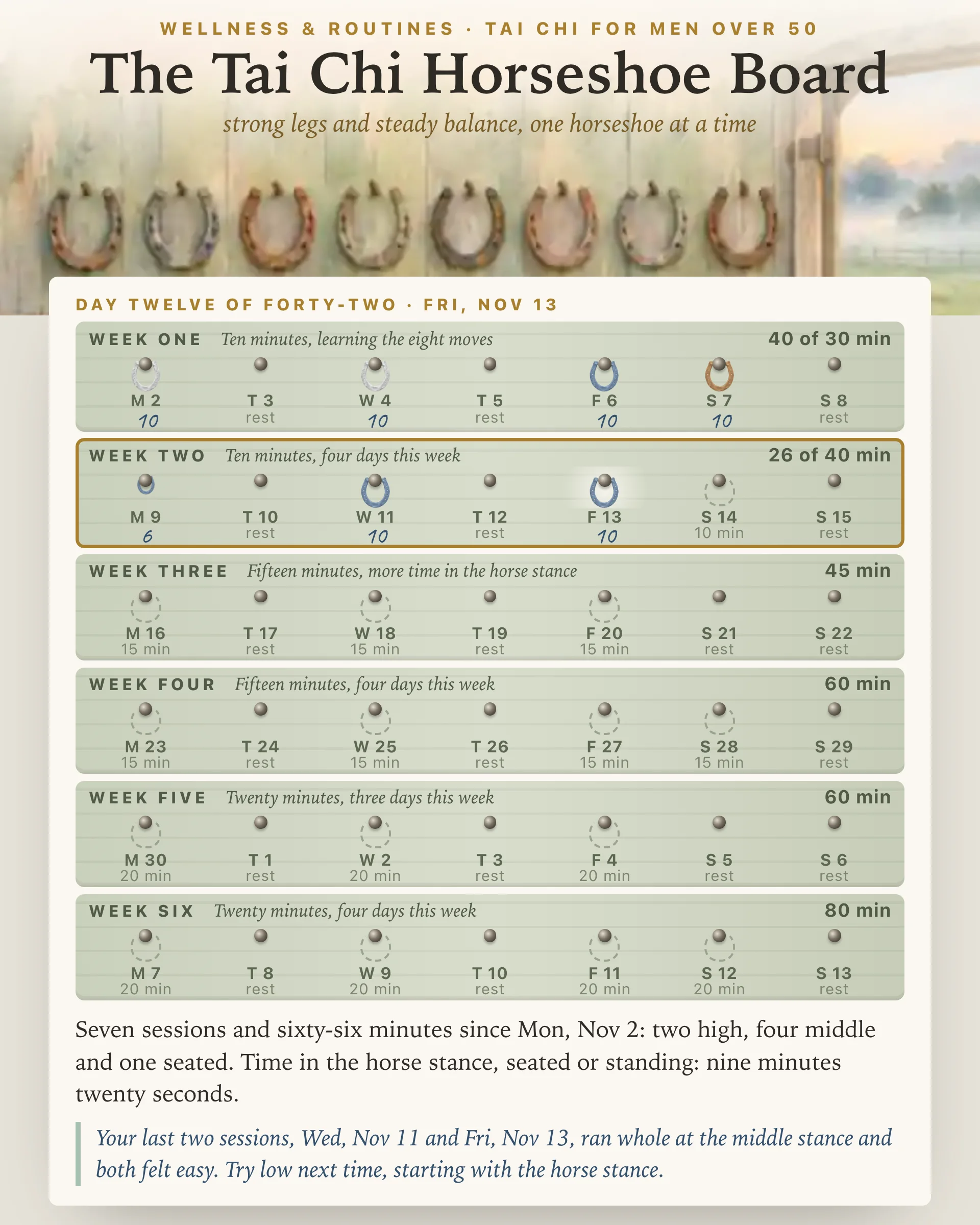
Somewhere past fifty, many men notice small things: getting up from a low couch takes a hand on the armrest, and pulling on a sock while standing turns into a hop. This page gives you six weeks of tai chi aimed at those moments: eight slow moves chosen for strong legs and steady balance, a stance you set yourself, and a board that keeps an honest record of what you did.
Before you start, check with a doctor or physical therapist if you have fallen or had dizzy spells, had a hip or knee replaced or any recent surgery, have a heart or blood pressure condition, or live with pain in your knees, hips or back. Stop any move that hurts, and whenever you stand, keep a kitchen counter or a sturdy chair within reach.
Tai chi looks like an arm practice, but the work happens below the waist. Nearly every move is done on bent knees while your weight travels slowly from foot to foot, so your thighs hold you up the whole time instead of momentum. The horse stance, feet wide and knees bent as if sitting astride a horse, is the plainest form of that work, so it comes second in every session.
The stance sets how deep your knees bend on every standing move. High means knees just unlocked, hips barely lower than standing tall, and everyone starts there. Middle is a bend as if starting to sit on a tall stool. Low is a bend as if starting to sit on a chair seat, thighs still well above level.
It also sets the rhythm of the horse stance hold. Each forty seconds splits into holding and resting: thirty seconds held at high, twenty-five at middle, twenty at low, since a deeper bend asks more of the same muscles. At every depth your knees point the same way as your toes.
Commencement opens each session, then come the horse stance hold, wave hands like clouds (a slow side-to-side sweep of the arms), part the wild horse’s mane (a diagonal step as one hand opens out), brush knee, golden rooster at a counter, repulse the monkey (a small step back as one palm eases forward) and the closing. Every move has two ways: seated at the front edge of a sturdy chair, or supported, standing with your hands on a counter. A seated session is a full session.
Press begin and a clock that keeps real time leads you through the moves, ten to twenty minutes in all; a pause stops it outright. A move counts only when its whole time runs, and then it hangs a horseshoe. End early and the session keeps its whole minutes, rounded down; skipped seconds never count.
Each session hangs a shoe on its day of the six-week board, tinted by stance, smaller if it ended early. Then you mark how your legs felt: easy, worked, wobbly, or sore or dizzy. When your last two sessions, in order, both ran whole at one stance and both felt easy, the board suggests going one lower. Easing off needs no streak: one wobbly session, even a cut-short one, suggests a stance higher.
The Cochrane review of exercise for preventing falls pooled 108 trials and 23,407 people. For tai chi it found high-certainty evidence of about a fifth fewer people falling, and low-certainty evidence of a similar drop in the total number of falls. The people studied averaged 76 years old, and 77 percent were women.
A 1996 Atlanta trial enrolled 162 women and 38 men aged 70 and older. With falls tracked through the study, the tai chi group’s risk of falling more than once came out 47.5 percent lower once other risk factors were accounted for. A Hong Kong trial with 90 men and 90 women aged 65 to 74 tempers that: after a year of tai chi three times a week, balance, flexibility and falls were no different from a group that did no exercise, and the slower bone loss at the hip seen in women did not appear in men.
One study looked only at men. Twenty-eight men who had practiced tai chi for about thirteen years, average age 67, stood longer on one leg with their eyes closed, were more flexible and had lower resting heart rates than thirty men who did no regular exercise. It compared two groups at one moment, so it cannot say whether tai chi made the difference or whether steadier men are the ones who stay with it.
None of these studies centered on men in their fifties, and none shows tai chi building muscle the way lifting weights does. Treat it as one good habit alongside walking and strength work.
Three or four days a week, at the same counter, for six weeks. If balance is your main concern, Tai Chi for Balance runs a longer plan with a one-leg check. If tai chi is new to you, Tai Chi for Beginners teaches one move a week. For the strength work this page cannot replace, pair it with Strength Training for Men Over 50. On mornings when ten slow minutes is all there is, The Morning Tea Tray builds a short routine from how stiff you feel.
It is a gentle one that asks a lot of your legs: most moves happen on bent knees while your weight shifts slowly from foot to foot, and the horse stance hold is plain leg work. It will not raise your heart rate the way a brisk walk does or build muscle the way lifting does, so plenty of men pair it with walking and two days of strength work a week.
Eight moves in a fixed order: commencement, the horse stance hold, wave hands like clouds, part the wild horse’s mane, brush knee, golden rooster at a counter, repulse the monkey and the closing. Sessions run ten to twenty minutes, three or four days a week for six weeks, and every move has a seated way and a way with your hands on a counter.
Only as low as you can hold steadily without pain. Begin high, with the knees just soft, and go lower after two whole sessions in a row at one stance that both felt easy. Even the low stance here keeps your thighs well above level, with your knees pointing the same way as your toes.
Only in part. Most tai chi and falls trials enrolled far more women than men, and in the largest review of exercise for falls, 77 percent of the people studied were women with an average age of 76. A Hong Kong trial that took equal numbers of men and women aged 65 to 74 found no difference in balance or falls after a year, so read any benefit as possible rather than promised.
Anyone who has fallen or had dizzy spells, has had a hip or knee replaced or other recent surgery, has a heart or blood pressure condition, or has ongoing pain in the knees, hips or back. Stop any move that hurts, and keep a counter or sturdy chair within reach the whole time you stand.
By the team behind Fabulous, the science-based self-care app used by over 30 million people.


