
The Overwhelm Recovery ProtocolWellness & Routines · ~5 min
About this template · Updated November 2026
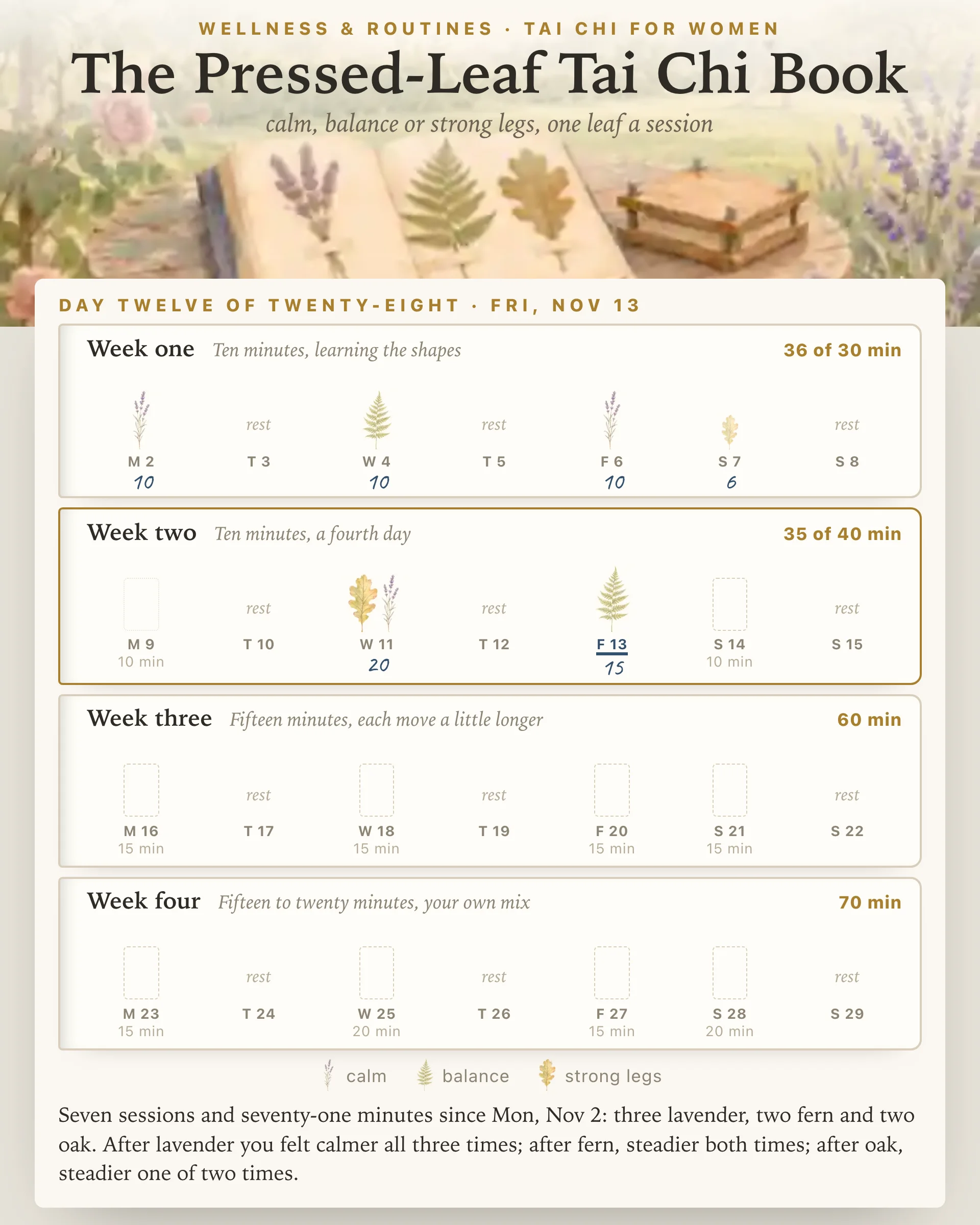
Most people looking up tai chi for women arrive with a reason: a mind that will not settle, a step that felt less sure than it used to, legs that want work without jumping or weights. This page builds each session around that reason. Pick calm, balance or strong legs, choose ten, fifteen or twenty minutes, sit or stand with support, and the sheet times the moves. Nothing here is about how your body looks, only about how practice leaves you feeling.
Each session you finish presses one leaf onto its day in a book of four weekly pages: lavender for calm, fern for balance, oak for strong legs. At a glance you can see which practice you keep returning to.
Every session opens with the arms rising and settling, and ends with the hands crossing, opening and sinking. Between them, each aim brings three moves of its own.
Each move has two forms. Seated happens near the front of a sturdy chair without wheels. Supported means standing with one hand on the chair back or a counter, and the balance moves keep both hands there. Tap a move to read both forms side by side.
Press begin and the clock leads you through the five moves, a minute each for the opening and closing and an even share for the three between. It reads real time, so a phone that locks still shows where you are, and a pause holds everything. Stop early and your whole minutes go in the book, but only moves that ran their full time count as done, and skipped time never counts. Afterward, mark whether you feel calmer, steadier, about the same, or sore or dizzy. That last mark brings a note to rest, and to see a clinician if it comes back.
The plan runs four weeks: ten minutes on three days in week one, a fourth day in week two, fifteen minutes in week three, and fifteen or twenty in week four. Rest days stay open for a short session if you want one.
Much tai chi research includes women, but usually women of one age group or with one health condition, which limits what any of it says about you.
A 2019 Cochrane review of exercise for preventing falls pooled 108 trials of people aged 60 and over living at home, average age 76, and 77 percent of them women. In the tai chi trials it pooled, fewer people fell, and tai chi may also have cut how often falls happened, though that second finding was rated low certainty. A four-week home plan is not what those trials tested, and no sheet can tell you your own risk.
A pilot trial in postmenopausal women with low bone density enrolled 86 women aged 45 to 70 for nine months of tai chi alongside usual care. Bone density showed no clear difference in the main analysis, while measures of standing sway improved in a subgroup of sixteen. It does not show that tai chi builds bone or prevents fractures.
A trial in 90 breast cancer survivors with insomnia compared a simplified form called tai chi chih with cognitive behavioral therapy for insomnia, the standard behavioral treatment. Each group had three months of its program, and fifteen months on, similar shares had responded. It speaks to one group of women with one problem, not to sleep in general.
The US National Center for Complementary and Integrative Health describes tai chi as appearing to be safe, but notes that no published studies have looked at it during pregnancy, and advises against using it to delay seeing a clinician about a health problem. Talk to your doctor or physical therapist first if you are pregnant, have had recent surgery, a fall or dizzy spells, a joint replacement, a bone or joint condition such as osteoporosis, a heart or blood pressure condition, or pain. Stop any move that hurts, and keep the chair within reach whenever you stand.
For a wider choice of moves, Tai Chi Exercises offers a library of move cards. If steadiness is the main reason you practice, Tai Chi for Balance builds a whole plan around it. To stay seated throughout, Chair Tai Chi keeps every session in the chair. If you are over sixty and new to tai chi, The Tai Chi Sapling Row takes six moves one at a time from the chair to the counter to hands free, each only once it feels steady.
For many women it is a gentle, low-impact way to move that can be done in a chair or with a hand on a counter. Some trials have enrolled women in midlife and later life specifically, with mostly modest or uncertain results, so treat it as steady practice rather than a cure for anything.
Yes. Every move here has a seated way and a supported, standing way, and the first week asks for only ten minutes on three days. If you have had a fall, dizzy spells, a joint replacement, a bone or joint condition, or pain, speak with your doctor or physical therapist before your first session.
Ten minutes is plenty to begin. This four-week plan asks for ten minutes on three or four days early on and works up to fifteen and twenty by the last week. You can pick a different length on any day, and the plan simply shows what it suggested.
The US National Center for Complementary and Integrative Health notes that no published studies have looked at the safety of tai chi during pregnancy, and it advises pregnant women to talk with their health care providers before starting. Have that conversation first, and follow whatever limits they suggest.
Nobody can promise that. In one small trial of postmenopausal women with low bone density, nine months of tai chi made no clear difference to bone density in the main analysis, though standing sway improved in a subgroup of sixteen women. Bone health questions belong with your doctor.
By the team behind Fabulous, the science-based self-care app used by over 30 million people.


