
The Overwhelm Recovery ProtocolWellness & Routines · ~5 min
About this template · Updated November 2026
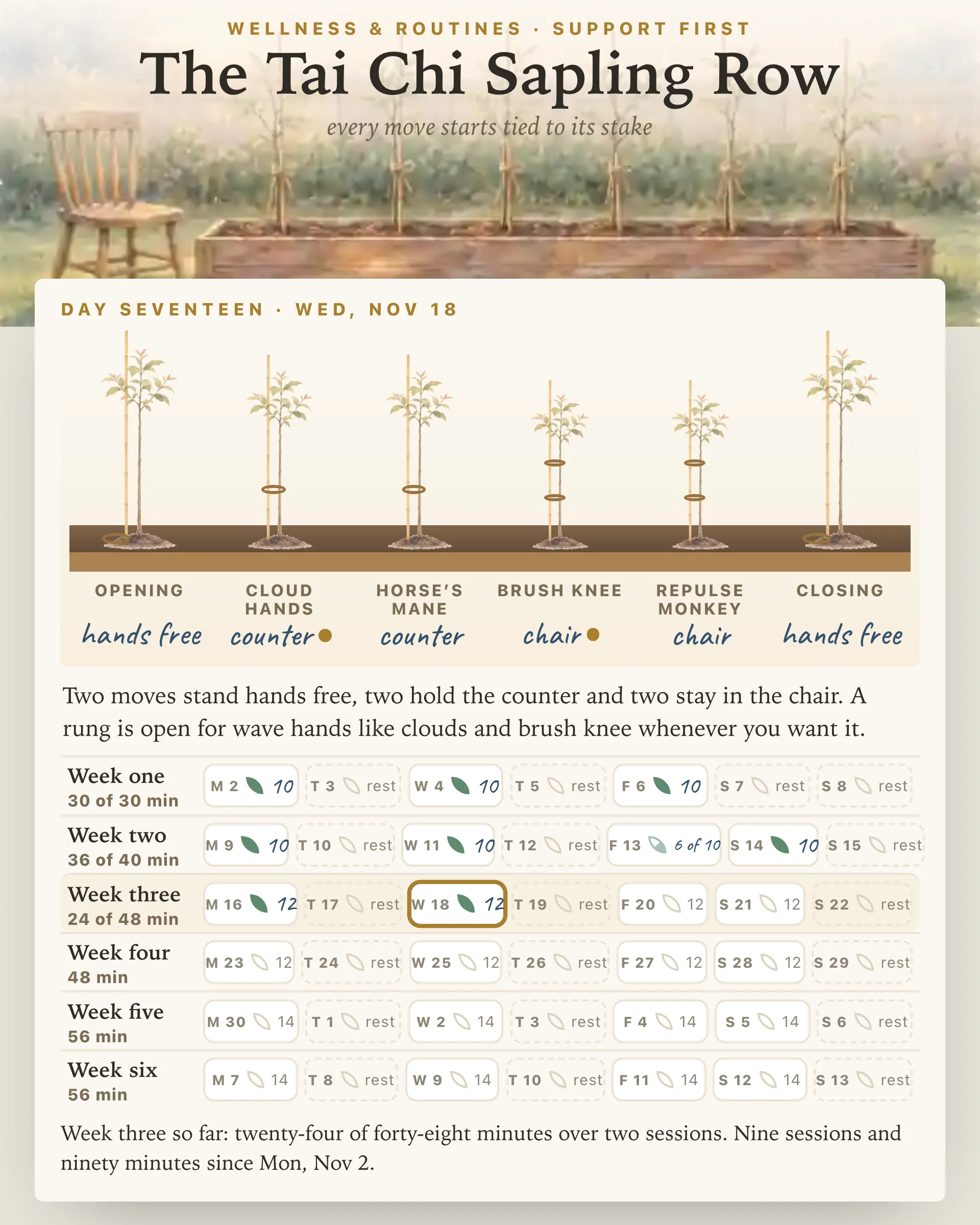
Starting tai chi after 60 raises one question before any other: what do I hold on to? Most pictures of tai chi show someone standing in an open room, and if your balance is not what it was, that picture can stop you before you begin. This page starts from the other end. Every move begins in a chair, and support comes away only when the move has earned it.
Think of a young tree planted beside a stake. A gardener ties it close at first, loosens a tie once the trunk holds, and takes the last one off only when the tree stands on its own. Even then the stake stays in the ground. Each of the six moves on this sheet is one of those saplings, and its ties show how much support you are using.
A rung opens once that move has run through two whole sessions in a row, both marked steady, on the rung below. Whole means the session ran to its end with nothing skipped. An early stop, a skipped move, a wobbly mark or a move left unmarked breaks the run, and the count starts again. Going back down is never locked: when a move felt wobbly, the sheet points to the chair or the counter, and it never moves you up on its own.
Press begin and the sheet runs a session on a real clock: a minute for the opening, an even share for each of the four moves in the middle, and a minute for the closing. A slow count runs underneath, four counts in and four out, with an even slower one if you prefer. A pause stops the clock until you go on, and a phone that locks mid-session still gets true time. End early and your whole minutes go in the log, though only the moves you finished count as done. Skip a move and its time never comes back.
Afterward, tap steady or wobbly for each move. Those marks decide which rungs open, and the row of saplings shows where every move stands. The plan runs six weeks: ten minutes on three days in week one, a fourth day from week two, then twelve and fourteen minutes.
A 2019 Cochrane review of exercise trials in older people living at home found that programs built on balance and functional movement reduce how often people fall, and that tai chi may as well, though its evidence on fall rates was rated low certainty. Those trials were mostly supervised classes running for months. A six-week home plan is not one of them, and nothing here can tell you your own risk or promise fewer falls.
The World Health Organization's 2020 activity guidelines ask older adults to include balance and strength work on three or more days a week. A short tai chi session counts toward the balance side: one piece of a week, not all of it.
The US National Center for Complementary and Integrative Health says tai chi appears to be safe, citing a 2019 review of 24 trials in which side effects were about as common with tai chi as without it. It also warns against using tai chi to put off seeing a clinician about a health problem.
If you have had a fall, dizziness, a joint replacement, a heart or blood pressure condition, or pain when you move, talk to your doctor or physical therapist before your first session. Stop any move that hurts. Practice beside a sturdy chair and a counter you can reach without stepping, in shoes with grip or bare feet rather than loose slippers.
Use this sheet to begin tai chi with your support set for you, one rung at a time. If you would rather learn one new move each week, The Tai Chi Starter Scroll works that way. To see standing and seated versions side by side, try Tai Chi for Seniors. And if staying seated suits you best, Chair Tai Chi keeps every session in the chair. If you would like each session built around one aim, such as calm or balance, The Pressed-Leaf Tai Chi Book builds it at the length you pick.
For many people it is a gentle way in: the moves are slow, low impact and can all be done sitting down. Tai chi appears to be safe in the research so far, but talk to your doctor or physical therapist first if you have had a fall, dizziness, a joint replacement, a heart or blood pressure condition, or pain.
Yes, and this plan is built around that. Every move begins in a sturdy chair, a hand on the kitchen counter comes next, and hands free opens only after two whole sessions in a row that felt steady, with the counter still a step away.
It does. The six moves are the ones most beginners learn first at any age, and nobody has to prove their balance to start. People who feel steady early simply climb sooner, and anyone who prefers the chair can stay in it for the whole six weeks.
Shorter than most people expect. This plan opens with ten minutes on three days of the first week and grows to fourteen minutes on four days by week five. Ending a session early still keeps every whole minute you moved.
No page can promise that. Large reviews of exercise trials found that balance-based programs lower how often older people fall and that tai chi may as well, but those were mostly supervised classes lasting months. Treat this as practice, and bring any worry about falling to your doctor.
By the team behind Fabulous, the science-based self-care app used by over 30 million people.


