
The Overwhelm Recovery ProtocolWellness & Routines · ~5 min
About this template · Updated November 2026
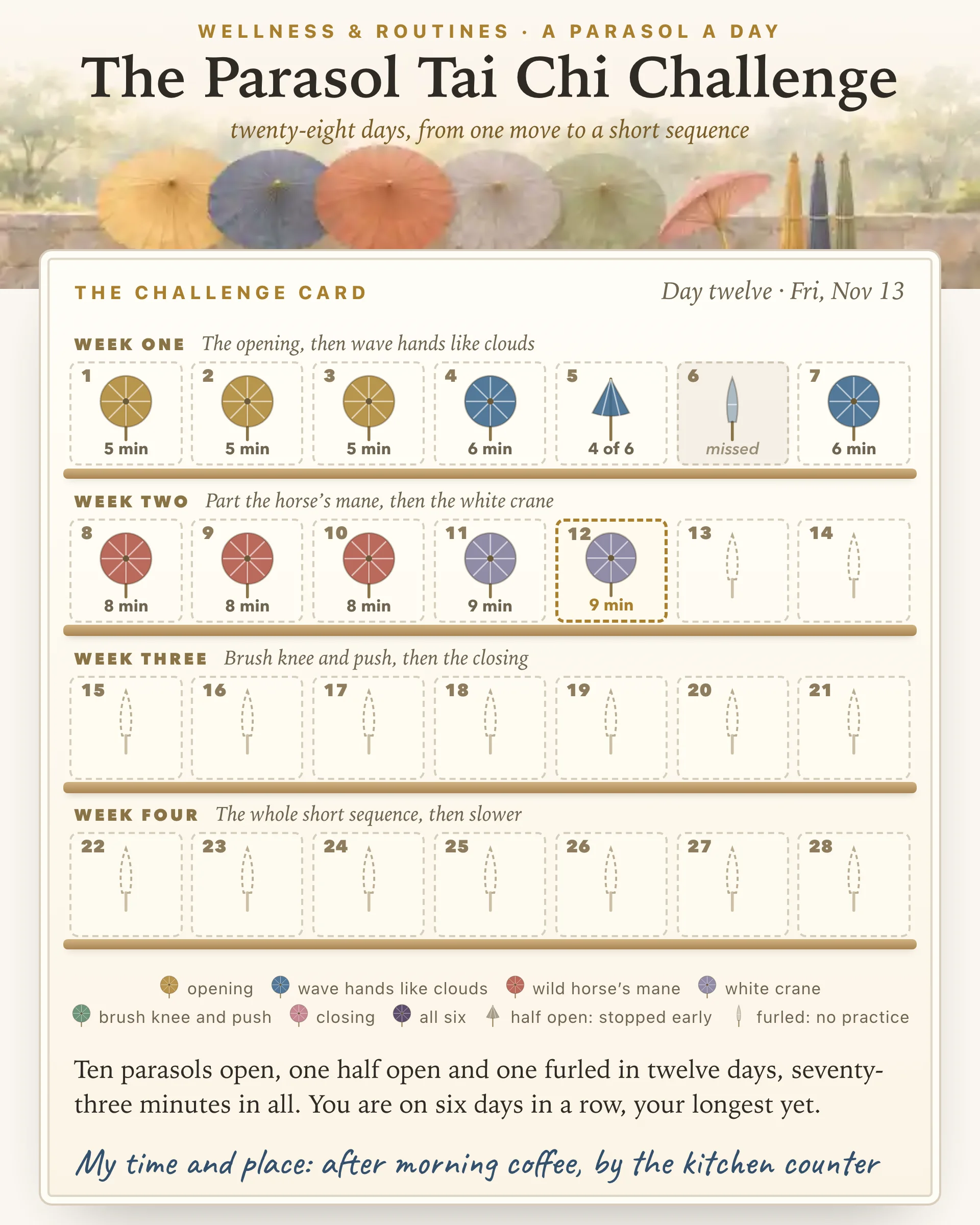
This tai chi challenge asks for one short practice a day for twenty-eight days. It opens with a single move and adds another every few days until, in the last week, you run a short sequence of six. Days run five to fifteen minutes, and every move has a chair version.
The card holds twenty-eight furled parasols, one per day, and only a whole practice opens a parasol all the way.
Every practice starts with a minute of shoulder rolls and slow weight shifts. Then come the moves, in the order you meet them:
From day twenty-two you run all six in order, four times through at half a minute a move. From day twenty-five you go through twice at seventy seconds a move, since slower asks more of you.
Standing, you keep a hand on a kitchen counter for every move that shifts your weight, and no move asks you to step or stand on one leg. Seated, you turn your chest where the standing version shifts your weight.
Press begin and a thread line crosses the screen and back on a slow count of five: breathe in as you move one way, out as you come back. A note tells you when to switch sides.
The timer keeps real time, so a locked phone or a hidden tab does not lose your place, and a pause stops the clock outright. Run the practice to its end and the parasol opens in the color of that day's newest move, so the rows show the sequence growing. End early and it opens only halfway, keeping your whole minutes, never rounded up; a day with no practice leaves it furled.
Your run of days in a row means exactly that: consecutive days, each with its parasol fully open. A half-open or furled day ends the run, and the next whole practice starts a new one. You never go back to fill a missed day; you pick up with today's practice, and the page says so after any gap. Write when and where you will practice on the time-and-place line, since a fixed time and spot make the day easier to keep.
Print the page, or save it as a PDF from the print window, and the card fits on one page with the plan, each move's chair version and what you have done so far.
The Cochrane review of exercise for preventing falls in older people living in the community pooled trials of people over sixty, average age seventy-six. There, tai chi lowered the number of people who fell (high-certainty evidence) and may have lowered how often they fell (low-certainty evidence). Those were programs running for months, not a four-week challenge at a kitchen counter, so this page promises nothing about falls.
The National Center for Complementary and Integrative Health describes tai chi as slow, gentle movement with controlled breathing and says it appears to be safe, with reported problems mostly minor aches. It also warns against using tai chi to put off seeing a health care provider about a medical problem.
On the daily part, a study of how habits form followed 96 volunteers repeating one behavior in the same setting each day. Reaching a plateau took anywhere from 18 to 254 days, and missing a single day did not materially change how the habit formed. Twenty-eight days is a beginning, then, and one furled parasol is no reason to quit.
If you have had a fall, dizziness, a joint replacement, a heart or blood pressure condition, or pain, ask a doctor or physical therapist before day one whether this suits you. Keep a counter or a sturdy chair back within reach whenever you stand, stop any move that hurts, and take the chair version on any day you feel unsteady.
Use it when you want a small daily commitment with a clear finish line. It differs from the twenty-eight-day bamboo walking tracker, which teaches slow stepping across a room; here the moves stay in place beside a counter or chair. After day twenty-eight, the Tai Chi Move Cards let you build sessions from a wider set, and a thirty-day plan drawn from your own goal can carry you forward on your own days and minutes. If wave hands like clouds keeps coming apart, Cloud Hands, Stroke by Stroke takes that one move apart, piece by piece.
It is four weeks of short daily tai chi practice, five to fifteen minutes at a time, that begins with a single move called the opening and adds another every few days. By week four you run a short sequence of six from start to finish, and every day has its own parasol on the card waiting to open.
Yes. Print this page from your browser, or pick save as PDF in the print window, and the challenge comes out as a one-page card: twenty-eight parasols to fill in, the plan for each stretch of days, every move with its chair version, and any days you have already done.
The plan runs twenty-eight days so that each week starts on the same weekday. For an even thirty, run the whole sequence on the two days after day twenty-eight and mark them in the margin of your printed card. The page itself keeps count of the first twenty-eight.
That day's parasol stays furled, and your count of days in a row goes back to zero, since a run only counts days that follow one another. Everything you already did stays on the card. Pick up with today's practice rather than going back for the missed one: in a study of people building a daily habit, skipping a single day did not set the habit back in any lasting way.
Yes. Each move has a chair version: sit near the front of a sturdy chair with both feet on the floor, keep the same arm paths, and turn your chest where the standing version shifts your weight. You can switch between standing and sitting from one day to the next, and either way the day counts.
By the team behind Fabulous, the science-based self-care app used by over 30 million people.


