
The Overwhelm Recovery ProtocolWellness & Routines · ~5 min
About this template · Updated November 2026
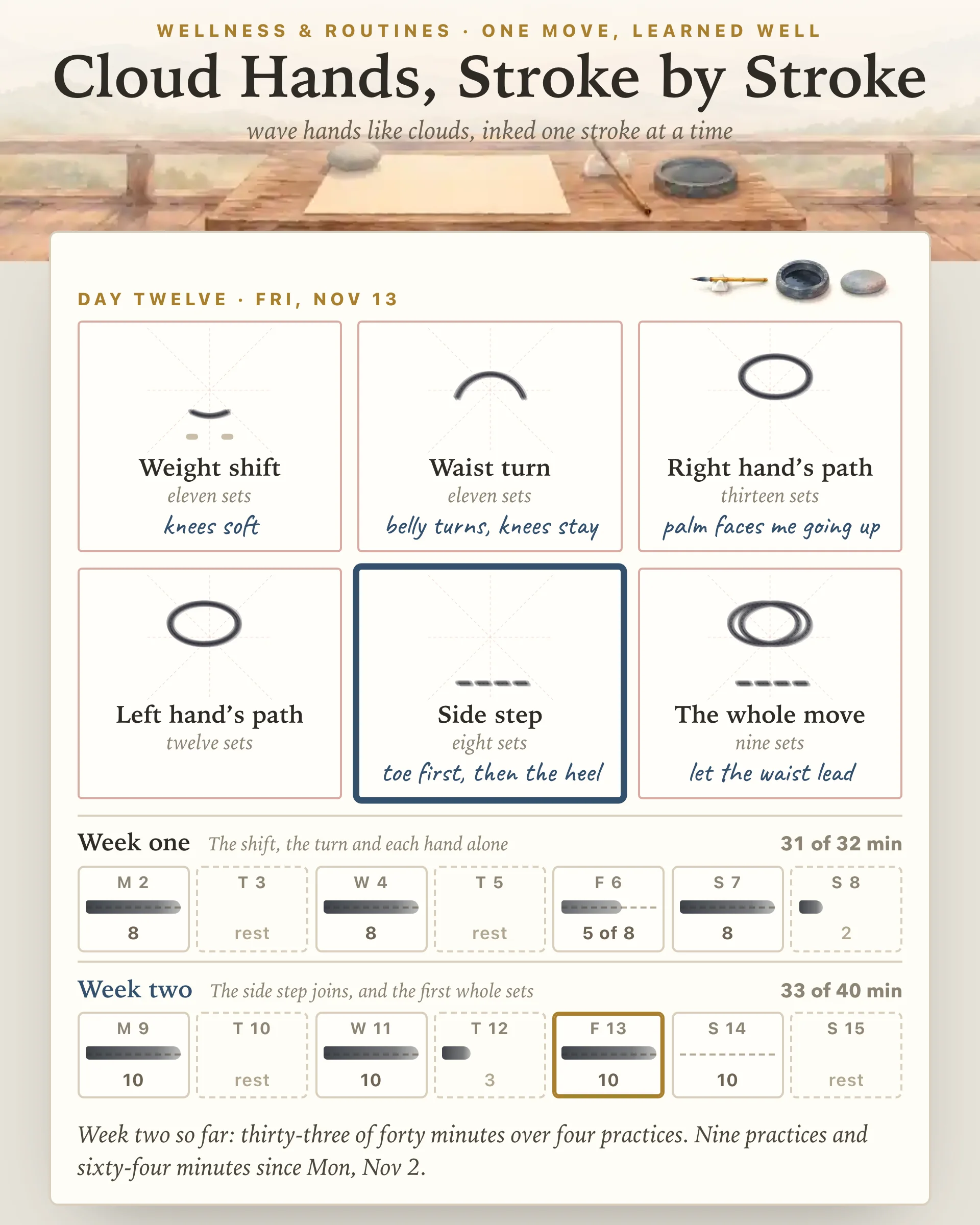
Wave hands like clouds, usually shortened to cloud hands, is the slow side-to-side sweep found in nearly every style of tai chi. Your weight drifts from one foot to the other, your waist turns with it, one hand floats past your face while the other glides past your belly, and in most forms you travel sideways with small steps. It looks like one easy motion until you try it and find four things happening at once.
So this page treats cloud hands the way a calligraphy student treats a hard character: practice each stroke alone until it is familiar, then write the whole thing.
Each part has a chair version too, with your weight easing between your sitting bones and your feet sliding instead of stepping.
Tap a square to read its part, standing and seated, and keep a cue of your own under it, such as "knees soft."
Press begin and the page counts for you: four counts toward the right, four back, about a second and a quarter each. Dots show where your weight and each hand should be on every count, drawn as you face them, so your right is the right of the square. Six rounds make a set of about a minute.
The clock follows real time, so a locked phone or a hidden tab does not lose your place, and a pause stops it outright. Each finished set inks a stroke on its square, so the sheet darkens where you have put in the work. A set stopped partway leaves no ink, skipped time never comes back, and an early stop keeps only whole minutes.
The four-week plan starts at eight minutes on four days of the week. The side step joins in week two, and by week four a fifteen-minute practice is a short warm-up of parts and ten sets of the whole move. A drill button gives any single part two to ten sets of its own whenever it feels shaky.
Cloud hands has a small research literature of its own, mostly from stroke rehabilitation in China, where it is called Yunshou and is often chosen because a whole form asks too much of someone recovering. In a cluster trial with 250 stroke survivors at ten community health centers, people practiced it five times a week for twelve weeks. Their balance and mobility improved about as much as in a group doing standard balance training, and they did better on movement, fear of falling and mood. A 2023 review of twelve trials with 966 participants found gains in balance and movement after stroke but called the evidence early, and the trials differed a great deal.
For older adults in general, the Cochrane review of exercise for preventing falls in older people living in the community found that tai chi may lower how often people fall, with low-certainty evidence for the number of falls and high-certainty evidence that fewer people fell at all. Those were whole programs, often classes running for months, not one move practiced in a kitchen. The National Center for Complementary and Integrative Health says tai chi appears to be safe.
None of this shows that cloud hands on its own will keep you from falling. Treat it as a slow coordination practice: shifting, turning and stepping sideways with control, at your own pace.
If you have had a fall, dizziness, a joint replacement, a heart or blood pressure condition, or pain that worries you, check with a doctor or physical therapist before you start. Keep the counter or chair back within reach for every step, make the steps smaller whenever you feel unsure, and stop if anything hurts. The seated version is a full practice, not a lesser one.
Use it when cloud hands keeps coming apart inside a longer form, or when you want one move you can do well in ten quiet minutes. Once the whole move feels familiar, carry it into a fuller practice with the Tai Chi Move Cards, the short sessions of The 7-Minute Tai Chi Kite, or the one-move-a-week pace of The Tai Chi Starter Scroll. For a daily habit that starts from cloud hands, The Parasol Tai Chi Challenge adds one short practice a day for twenty-eight days.
Cloud hands, also called wave hands like clouds, is a slow side-to-side move found in most tai chi forms. Your weight and waist sway from one side to the other while your hands trade places, one drifting past your face and the other past your belly, and in many forms you travel sideways with small steps.
Learn it in parts. First ease your weight from foot to foot, then add a gentle turn of the waist, then trace the oval path of one hand at a time, then practice the side step with your fingertips on a counter. Only after that put them together, slowly, on a count of four each way.
Yes. Every part on this sheet has a version for a sturdy chair: the weight eases between your sitting bones, the chest turns while the knees stay forward, the hands draw the same ovals, and the feet slide out and in instead of stepping.
A few minutes is enough to learn it. The plan here starts at eight minutes on four days of the first week and grows to fifteen by week four, and a set of six slow rounds takes about a minute, so short practices still add up.
It has mostly been studied in people recovering from a stroke, where trials of cloud hands practiced on its own found gains in balance and movement, though the evidence is early and the trials varied. For older adults in general, reviews find that tai chi may lower how often people fall. No single move can promise that, so treat this as practice and talk to your doctor about any worry about falling.
By the team behind Fabulous, the science-based self-care app used by over 30 million people.


