Leaves on a StreamEmotional Fitness · ~3 min
About this template · Updated September 2026
The Subjective Units of Distress Scale comes from Joseph Wolpe, the behavior therapist who introduced it with Arnold Lazarus in a 1966 book and who called a single point on it a sud. A 2025 review of the scale traces that history and tests how well it has held up. This page is an independent tool that Fabulous built around Wolpe's idea; none of its wording comes from his books, and no one connected with him has reviewed or endorsed it.
Distress is hard to describe from the inside. "I feel awful" covers a lot of ground, and so does "a bit on edge". A number turns that ground into a ruler. Wolpe asked people to think of the worst anxiety they had ever felt or could imagine and call it a hundred, then to picture complete calm and call that zero.
Therapists still use it to rate the start and end of a session and to rank the steps of an exposure plan. On your own, it does something simpler: it tells you how big a feeling is before you decide what to do about it. A bare number drifts, though. Your sixty this week may have been a forty last month.
The review argues that a rating is hard to read unless you know what the person was rating. It points to a practice from Prolonged Exposure therapy for PTSD, where therapists help clients write personal examples for zero, twenty-five, fifty, seventy-five and a hundred and keep them fixed for the whole course of treatment. The authors suggest this may make ratings clearer and more consistent, and they are candid that it has not been properly tested yet.
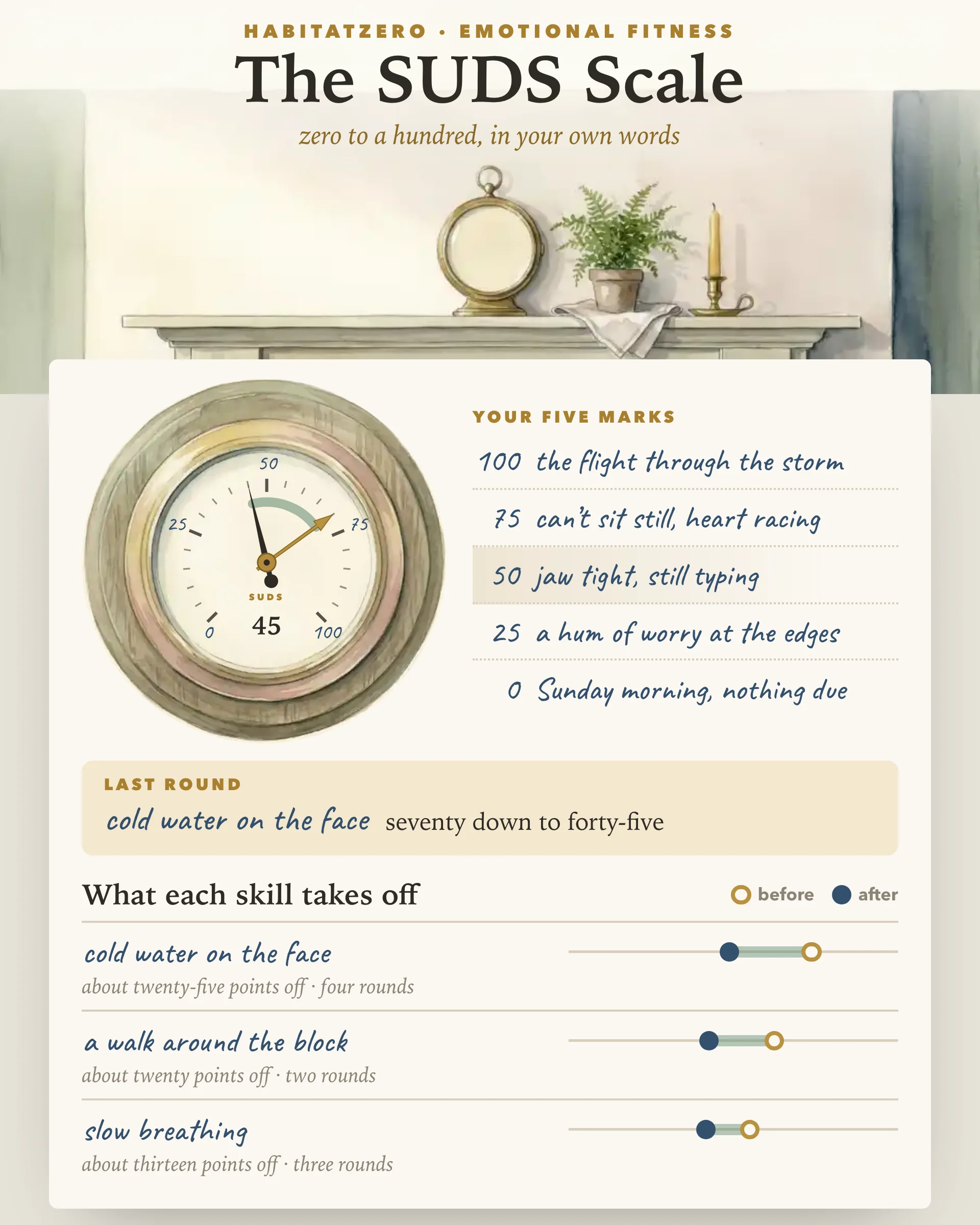
This dial borrows that structure. Each mark starts with printed words that you replace with your own: a body feeling, a place, a particular afternoon. Once a mark is yours, its number on the dial turns to handwriting. For the hundred, a code word for your worst memory is plenty.
Slide the needle or tap the face, and the page names the mark your reading sits closest to. That comparison is the whole trick: is this more like my fifty or my seventy-five?
Before you try something that usually settles you, park the brass hand at your number and name the skill. Afterwards, move the needle to where you are now and log the round; the shaded arc between the hands is what that attempt took off. The ledger lays every skill on one line from zero to a hundred, with a brass ring where you tend to start and an ink dot where you tend to end. It names the skill that has brought your number down most, and says so plainly when that lead rests on a single try.
The scale has some support. In a study of sixty-one people treated with EMDR at a trauma clinic, first-session ratings rose and fell with questionnaire scores for depression, anxiety and trauma-related distress, and the rating at the end of that session tracked how much clinicians judged each person had improved by the end of treatment.
The 2025 review is blunter about the limits. It concludes that the scale has significant weaknesses as a precise measure, partly because distress has never been tightly defined and partly because it is often left unclear whether a rating describes the moment or the peak. So rate the moment, not the worst point of the day, with your marks in view.
One limit no page can fix: distress often eases with time whether or not you do anything, so a drop after a skill mixes the skill with the minutes that passed. Read the ledger as a pattern across many rounds, never as proof.
Keep this ledger for coping skills, not for exposure practice. In exposure work, where you face something you fear on purpose, a falling number is not the aim. Michelle Craske and colleagues review evidence that neither how far fear drops during an exposure nor where it ends predicts how people fare in the long run. They also describe safety signals, such as a phone or another person nearby, which ease fear in the moment and let it return once they are gone. A calming skill used halfway through an exposure can do the same job. Working up a fear ladder is exposure therapy, best done with a trained clinician; if you have one, ask before you bring a skill into an exposure.
Write your marks on an ordinary afternoon, when zero is easy to remember, then take readings at small moments as well as big ones: a sharp email, a crowded train, the minute before a dreaded call. Short skills give the needle a fair test, so 5-4-3-2-1 Grounding and The Physiological Sigh make good first entries. For a child, The Feelings Thermometer swaps numbers for five pictured levels.
A reading tells you how big a feeling is, not what it means. If your needle sits high most days, or distress is crowding out work, sleep or the people around you, take a few weeks of readings to a doctor or a licensed therapist.
SUDS stands for Subjective Units of Distress Scale, a rating from zero to a hundred of how upset you feel at this moment, where zero is complete calm and a hundred is the worst distress you can imagine. The behavior therapist Joseph Wolpe introduced it in the 1960s and called each point a sud. This dial is our own version of that idea, and nobody connected with Wolpe's work has reviewed or endorsed it.
Ask how big the feeling is right now, not how bad it got earlier, and take the first number that fits. Steps of five are precise enough. Personal anchors make it quicker: if your fifty is a tight jaw while still working and your seventy-five is being unable to sit still, a new moment usually finds its place between them in a second or two.
Both are in use. Wolpe's original runs from zero to a hundred, and many exposure therapists keep it. EMDR therapists usually ask for a zero to ten rating of disturbance instead, the same idea on a shorter ruler, so a seven there matches a seventy here. Choose one and stay with it, because switching back and forth makes your own ratings harder to compare.
No. A SUDS number says how intense a feeling is for you at one moment, and nothing about its cause or whether it points to a disorder. Your seventy and a stranger's seventy are not the same size, so no score works as a cutoff. If high numbers show up most days, a licensed clinician can assess what is going on, and a few weeks of ratings give them something concrete to look at.
The dial on this page is a filled-in example to look over. Writing your own five marks, logging rounds and keeping a ledger that remembers them all happens in HabitatZero, where setting up the template costs nothing.
By the team behind Fabulous, the science-based self-care app used by over 30 million people.