The Overwhelm Recovery ProtocolWellness & Routines · ~5 min
About this template · Updated September 2026
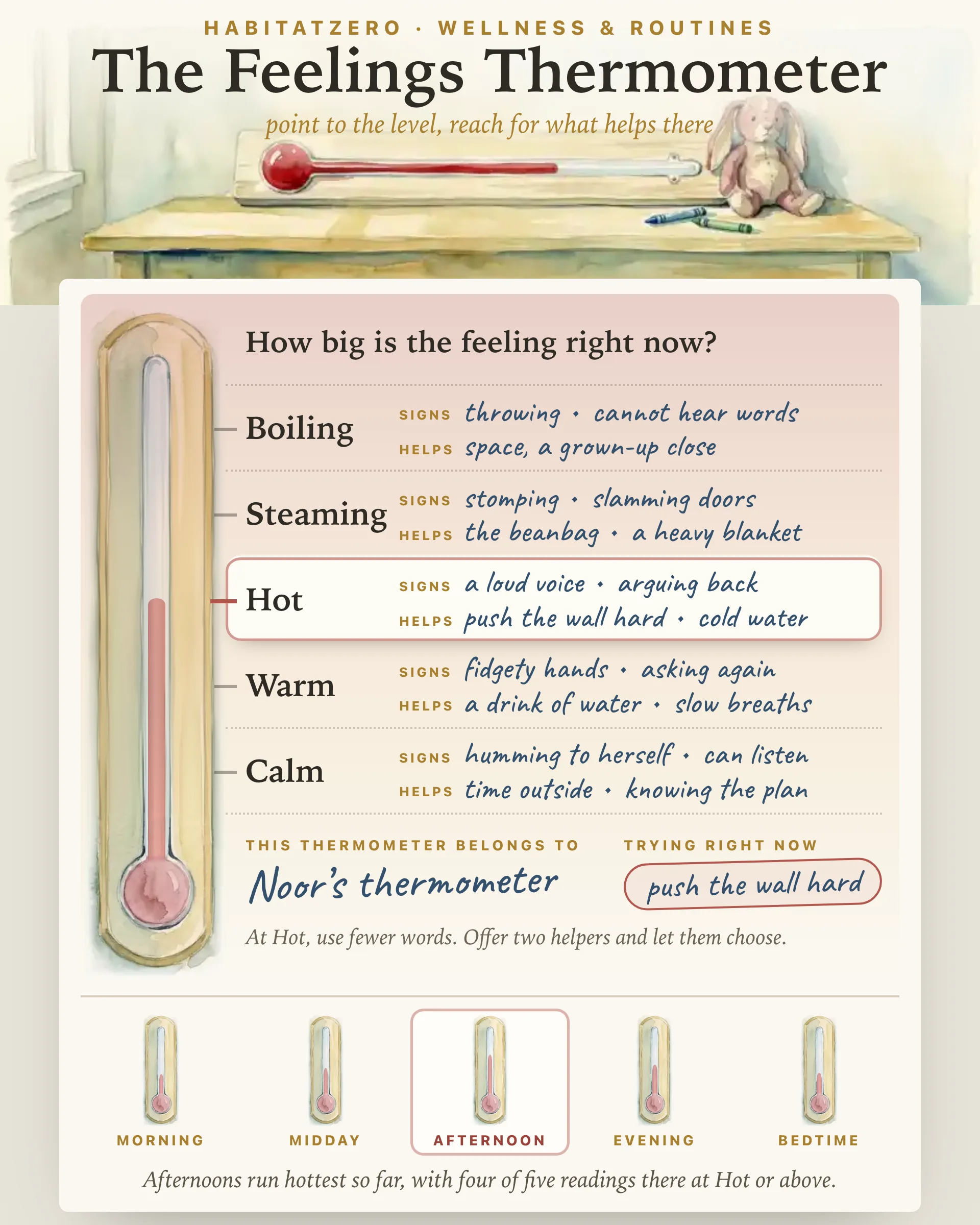
Credit first, because this tool has a family tree. Nobody owns the feelings thermometer, but its oldest ancestor is the Subjective Units of Distress Scale, the self-rating that psychiatrist Joseph Wolpe introduced in 1969; a later validity study found that adults' distress ratings lined up with clinicians' separate judgments of how they were doing. Child therapists turned that number line into a picture a six-year-old could point at. Two classroom cousins are The Zones of Regulation, a trademarked curriculum created by Leah Kuypers, and The Incredible 5-Point Scale from Kari Dunn Buron. This page copies nothing from either and has no connection to or blessing from their authors.
A child in the grip of a big feeling has almost no words. Ask what is wrong and you get a shrug, a scream, or "nothing." Ask where the red line is and you get a finger on a picture. A hard question (what are you feeling, and why) becomes an easy one (how big is it), and size is something even a four-year-old can judge.
"Calm down" is useless advice near the top of the thermometer and unnecessary at the bottom. A drink of water and a stretch may be plenty at Warm, while at Boiling the only plan worth having is a safe spot and a quiet adult. Sorting helpers by level keeps you from offering breathing exercises to a child who is far past them.
There are five levels, Calm at the bulb and Boiling at the top, and they fit any large feeling: anger, worry, disappointment, even the over-excited kind of happy.
Fill in the key together. On an easy day, climb the levels one at a time. For each, ask your child what it looks like on them (fidgety hands, a loud voice, hiding) and what helps there. A level holds three signs and three helpers and refuses a fourth, because a hot head cannot read a long list. Begin with Calm; a child who knows what settled feels like in their body has somewhere to aim.
Take a reading. When a feeling shows up, let them tap a level or slide the red line. The card underneath returns their own helpers for that level, plus one sentence about what your job is at that height. Circle the helper you are going to try.
Log it. One tap records the level, the part of the day and the helper. Later you can mark whether it helped.
Read the strip. Five small thermometers, morning to bedtime, show how hot each stretch has run. After a handful of readings the page says whether one of them stands out. If it turns out to be the hour after school, you have a reason to try a snack or a quieter plan before that hour, instead of a consequence after it.
No trial has tested a feelings thermometer by itself. What exists is evidence for the parts it is built from.
Putting a feeling into words seems to take some heat out of it. In a brain-imaging study with adults, labeling an emotion dampened the amygdala's response to upsetting pictures. A level on a thermometer is a very small word, but it is a word.
Thermometers like this one are standard tools in cognitive behavioral therapy for anxious children, and a Cochrane review covering eighty-seven trials concluded that such therapy probably raises recovery rates compared with no treatment. That speaks for whole programs run by trained people, not for a chart on the fridge.
What it cannot do is diagnose, measure or treat. The levels are your child's own words for their own experience, never a score.
Set it up on a quiet weekend morning, not in the wreckage of a meltdown. Then take readings at unremarkable moments as well, so that pointing at the thermometer never becomes a sign that someone is in trouble. Teachers and counselors can keep one per child.
It pairs well with a place to go: a Calm Corner gives the Hot and Steaming helpers a home. If anger is the usual visitor, Steady the Flame teaches the long exhale that often ends up written on the Warm level, and for older children who want finer words than five sizes, The Feelings Wheel picks up where the thermometer stops.
If the log shows Boiling most days, or anyone is getting hurt, bring it to your pediatrician or a child therapist. A record of when, and how high, gives them something concrete to work from.
It is a picture of a thermometer that a child uses to show how big a feeling is, from calm at the bulb to boiling at the top. Each level is paired with what that size of feeling looks like on this particular child and what tends to help there, so the adult knows what to offer.
Fill it in together when everyone is settled, then practice pointing at ordinary moments so it never feels like a punishment. When a feeling climbs, ask where the red line is instead of asking what is wrong, offer one or two helpers from that level, and save the talking for when the line is back down.
Most children can point to a level from around four, well before they can explain a feeling in words. Older children and teenagers often prefer to tap their own reading and may want more exact vocabulary, which is where a feelings wheel takes over.
They are relatives, not the same thing. The SUDS rating was introduced by Joseph Wolpe for therapy with adults, and The Zones of Regulation is a trademarked school curriculum by Leah Kuypers. This thermometer is an independent family tool, uses none of their materials, and has no tie to either.
You can explore the filled-in example on this page as it is. To build one for your own child, keep the key, and log readings over time, open it in HabitatZero, where the thermometer is free to personalize.
By the team behind Fabulous, the science-based self-care app used by over 30 million people.